Land Clearing Debris
Mulch It or Haul It Away
Mulching the debris where it was cut adds nothing to a clearing bill, because nothing leaves the property. Hauling it away adds a truck and a tip fee, and posted Northeast Ohio yard rates run from free for wood chips to $72 a cubic yard for large stumps. Mulch suits woods and open ground you are keeping. Haul where the ground must be bare soil. BrushBoss mulches in place for $2,000 to $2,990 an acre.
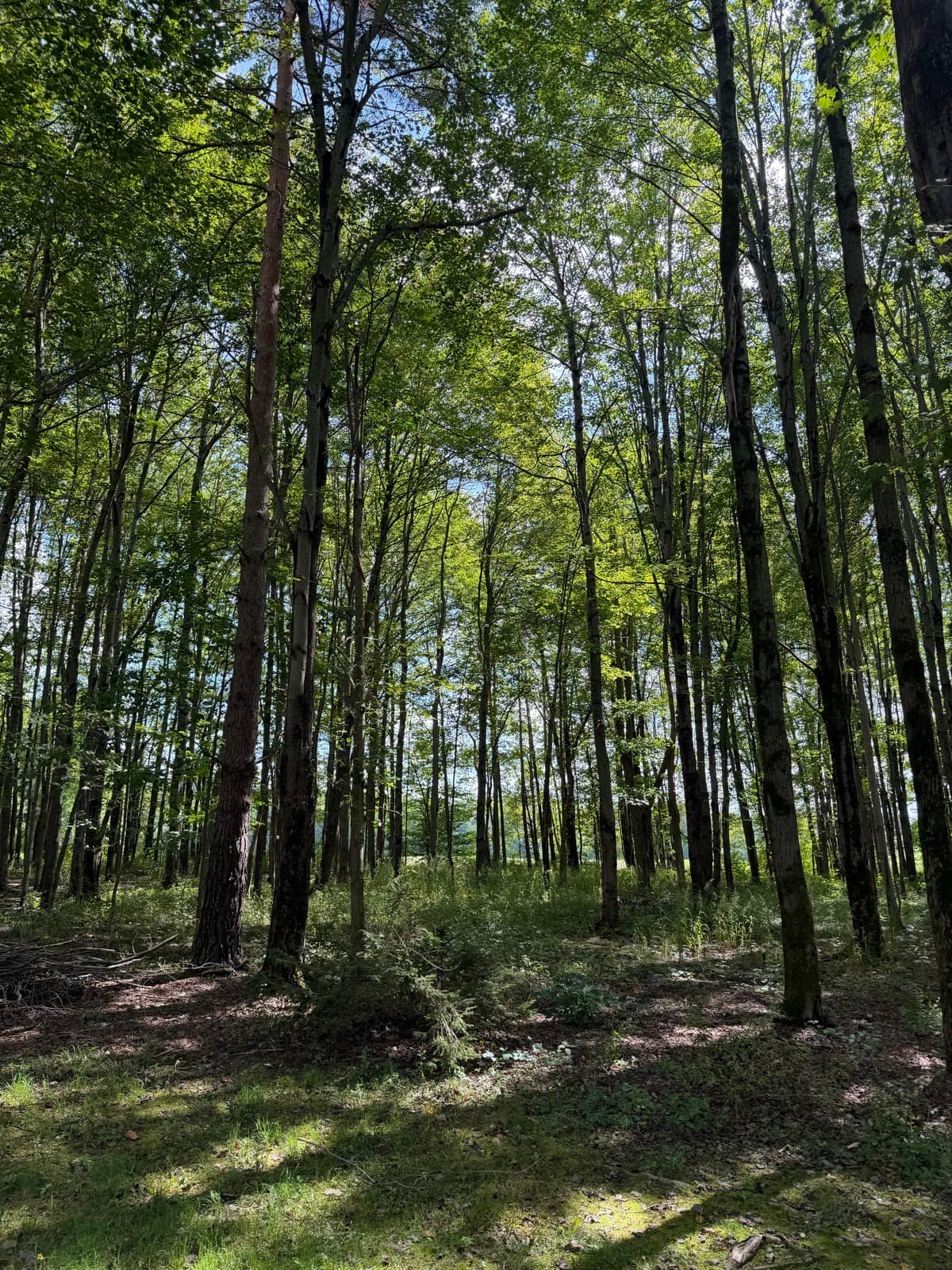
Actual BrushBoss job photograph. Results depend on your property.
Land recovery and property protection · Northeast Ohio
We give you your land back, and we make it safe to use.
The brush, thorn and poison ivy that grew up under your good trees comes out, and what you get back is ground you can walk without watching your step.
From $295 for an afternoon's work to full estate restoration.
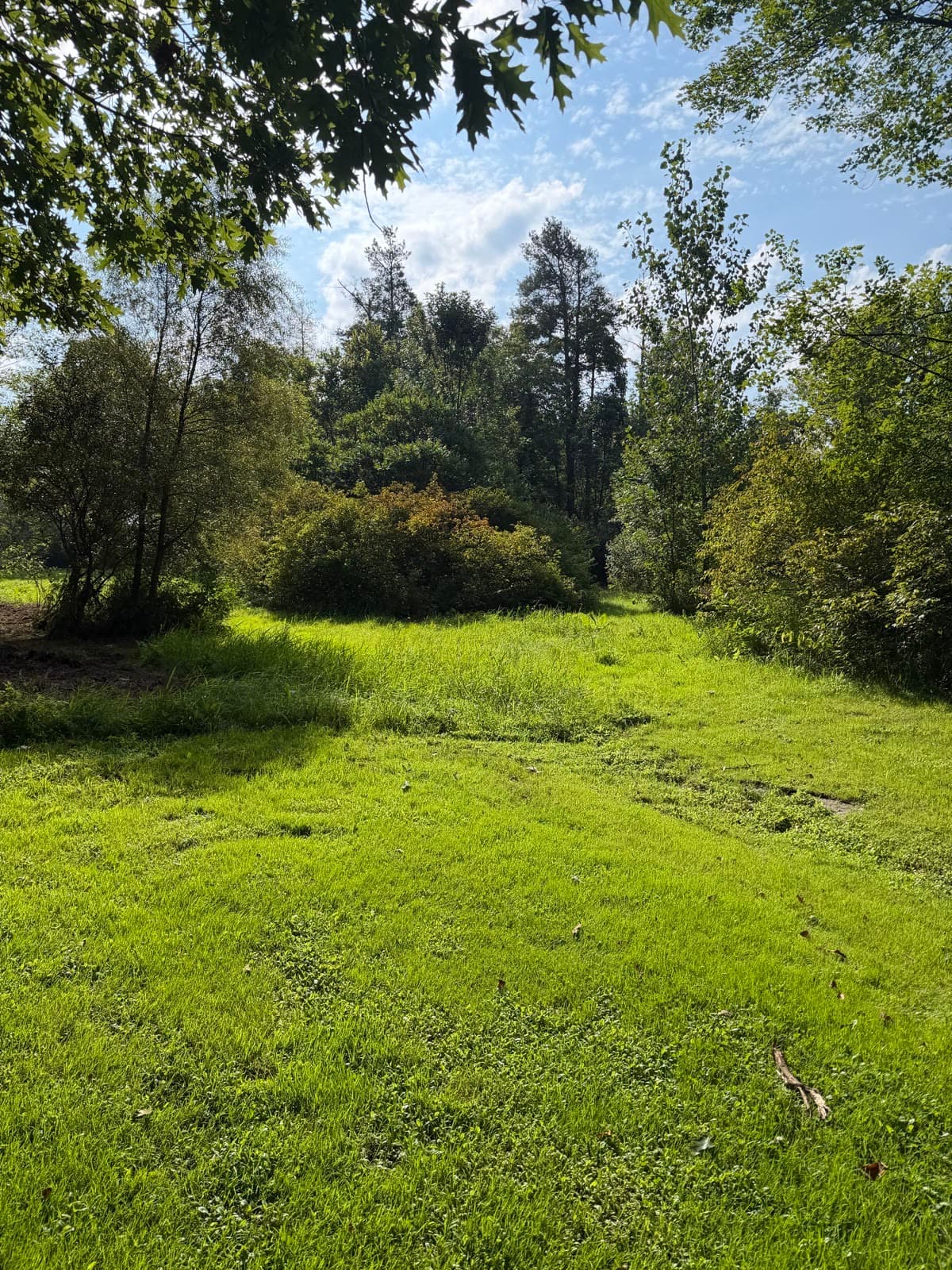 Actual BrushBoss footage · September 2026
Northeast Ohio · Woodland recovery
Real work. Real footage.
See past the tangle.
Brush and vines fill the space beneath your good trees. Start with the ground you want to use again.
Follow the transformation
Mulch, haul or burn: the options side by side
Every clearing job ends with the same question: where does the cut material go? Here are the usual answers, on the same criteria.
| Factor | Mulched in place | Chipped or hauled away | Piled and burned |
|---|---|---|---|
| What happens to it | Cut and shredded where it stood, and left as a layer on the ground | Chipped on site, or loaded whole, and taken to a compost yard or landfill [2] | Stacked, dried and burned on the property, where the rules allow it [2] |
| What it adds to the bill | Nothing beyond the clearing: no costs outside labor and the machine [3] | A truck and a tip fee. One Ohio contractor puts disposal at $200 to $500 or more a truckload [14] | Labor to pile, a person to watch the fire, and clean-up of ash and scorched ground |
| The ground afterward | Covered by a layer of chips over your own topsoil | Bare where the material was dragged and loaded | Burn scars where the piles stood |
| Soil and erosion | Reduces erosion and helps hold soil moisture [3] | No cover left behind, so bare spots need seed or straw | Hard to get a complete burn [1] |
| Rules and limits | None for the material itself | Stumps and large logs are refused at some drop-off sites [13] | Land clearing waste needs Ohio EPA's written permission [17] |
| Best for | Woods, edges, trails and views you are keeping | A building pad, a lawn or a garden that has to be clean soil soon | Rural acreage far from neighbors, where a permit is granted |
The three ways debris leaves a site
Cut brush and trees are mulched in place, chipped or hauled off the property, or piled and burned. HomeGuide lists the same choices: haul it to a landfill or processing facility, chip and mulch it on site as ground cover, or burn it if local rules permit [2].
Mulched in place
A clearing machine cuts the brush and young trees and shreds them where they stood. Nothing is dragged, stacked or loaded, and the material becomes the ground cover. Texas A&M Forest Service notes that because the mulch is made on site, there are no costs outside labor and the machine [3].
Chipped or hauled away
A crew cuts by hand or machine, drags the material to a chipper or a truck, and hauls it away. Chipping on site shrinks the load, and at some Northeast Ohio yards it also changes the fee: chips cost less to drop than whole branches, or nothing at all [10][11].
Piled and burned
The material is stacked, left to dry and burned. Virginia Tech's extension service calls pile-and-burn simple and cheap, and lists the drawbacks: a fire hazard, a burn that is hard to get complete, and a permit that may be required [1]. The same table lists a fourth option, piling the brush and leaving it, which is very cheap but unsightly and can harbor weeds [1].
What land clearing debris removal costs in Northeast Ohio
Hauling debris means paying for the truck or container and a tip fee at the yard, on top of the labor to load it. Posted fees at Northeast Ohio yards run from free for wood chips to $72 a cubic yard for large stumps, and one Ohio contractor puts disposal at $200 to $500 or more a truckload [10][11][14].
| Material | MRLM, Mentor (2025, per cubic yard) | Boyas, Cleveland (per cubic yard) |
|---|---|---|
| Brush | $21.50 [10] | $12 for branches under 12 inches across [11] |
| Logs | $35 under 12 inches across, $50 over [10] | $24 for tree lengths over 12 inches [11] |
| Stumps | $60 under 18 inches across, $72 over [10] | $35 [11] |
| Wood chips | Free [10] | $10 [11] |
Where the material can go matters as much as the price. The Geauga-Trumbull Solid Waste Management District lists five compost facilities in Geauga County that take yard waste, which it defines to include brush, tree trunks and stumps, and names the Cleveland yard above as a nearby option [9]. Not every drop-off takes everything: Kurtz Bros. does not accept stumps as yard waste, and its store locations refuse logs wider than a five-gallon bucket or longer than four feet [13].
The container costs extra. Angi puts a 10-yard dumpster at $225 to $575 and a 40-yard dumpster at $350 to $800 on average in 2026 [15]. A public agency's price is a useful check: Cleveland Metroparks' contract pays $500 to haul away one container of wood chips and debris in 2026, rising to $600 in 2028 [12].
Our arithmetic, not a quote: at the Mentor brush rate [10], every 10 cubic yards of brush is $215 in tip fees alone, before anyone cuts, drags or loads it, and before the truck. We found no public source for how many cubic yards an acre of brush makes, and it depends on how thick the growth is. Ask any contractor who hauls how many loads they expect and whether disposal is in the price, because HomeGuide notes that some include it and others bill it separately [2].
When the material is mulched in place, that line is not on the bill. BrushBoss clears land for $2,000 to $2,990 an acre, set by how thick the growth is, and the price includes leaving the mulch where it fell.
What mulch does for the soil
A mulch layer covers the soil, so rain soaks in instead of carrying it away, and it holds moisture, evens out soil temperature and adds organic matter as it breaks down. Texas A&M Forest Service says mulching reduces erosion potential and stabilizes the soil, and that mulch left on site returns nutrients, holds moisture and reduces soil temperature swings [3].
Ohio State's extension horticulturists describe organic mulch as a stand-in for the leaf litter on a forest floor: it moderates soil temperature, preserves moisture, holds weeds back and adds organic content as it decays [4]. Virginia Tech's extension service says mulching can maintain or even increase soil organic matter and reduce erosion [1]. A Forest Service research summary found soil nutrition was not harmed by mechanical mulching, and that erosion and compaction were kept down when the machines drove over the mulch they had just made [6].
Hauling takes that cover away with the brush. Whatever was dragged out leaves bare ground behind, and bare ground needs seed, straw or time before it holds up in a storm. How each clearing method treats the soil underneath is covered in forestry mulching vs bulldozing.
The limits of a mulch layer
A mulch layer can be too deep in places, it is fuel until it breaks down, and it does not stop sprouts coming up from the roots of what was cut. None of these is a reason to haul everything away, but each is worth knowing before you choose.
Depth
Ohio's tree-care guidance calls for a thin layer. Ohio State's guidance is no more than two to three inches around trees and shrubs [4], and ODNR's is two to four inches, kept off the trunk [5]. Mulch made where the brush stood is not spread to a set depth: it lies thicker where the growth was dense and thinner in the open. Where you plan to seed grass or plant, rake the thick spots thin. Ohio State also warns that raw wood chips can draw nitrogen from the soil as they break down [4], which matters most where you want something new to grow quickly.
Around the trees you keep, the mulch should not be heaped against the trunk. The same Ohio guidance says to pull it back from the flare at the base, where the trunk meets the roots.
Fuel
Fresh mulch burns. The Forest Service summary is plain about it: mechanical mulching can increase the amount of fine fuel on the ground, and if it is lit, that fuel can smolder for a long time. On some sites that makes it the wrong treatment [6]. Those studies were on dry western forests, where wildfire is a bigger concern than in Northeast Ohio. The practical point carries anyway: do not build a burn pile, a fire ring or a brush fire on fresh mulch, and keep the deepest mulch away from the house.
Regrowth
Mulch holds back seedlings, but it does not stop sprouts from the roots of what was cut. Ohio State's fact sheet on the berry brush found in many Ohio woods, bush honeysuckle, says that cutting the shrub off at the base causes prolific sprouting [7]. A 2026 study found mulching an effective way to clear invasive shrubs without harming the native plants on the forest floor, and that deeper treatment meant fewer sprouts. The shrub still sprouted [8]. Plan on catching the new shoots in the first seasons. How to do that is in how to stop brush growing back after clearing.
When mulch is too much
When the ground has to be bare soil soon. A house pad, a septic field, a driveway base or a new lawn needs clean soil, and HomeGuide notes that forestry mulching is not suited to building sites [2]. On those jobs the material has to be hauled, or mulched and then scraped off where the work is. For a house on wooded land, see clearing a wooded lot to build.
Can you burn land clearing debris in Ohio?
Sometimes, with Ohio EPA's written permission, on the property where it was cut, at least 1,000 feet from any neighbor's inhabited building, and outside the daytime ban in spring and fall. Ohio's rule for unrestricted areas allows burning land clearing waste generated on the premises only with Ohio EPA's written permission and that 1,000-foot distance [17].
- Permission takes time. Ohio EPA says written permission for a restricted area may take two weeks [16].
- The waste has to stay where it was cut. Ohio EPA says no wastes generated off the premises may be burned, so a contractor cannot haul your brush somewhere else to burn it [16].
- The calendar narrows it further. Outside municipal limits, Ohio law bans open burning of wood and brush between 6 a.m. and 6 p.m. in March, April, May, October and November [18], which covers much of the clearing season.
On many Geauga and Chagrin Valley lots a neighbor's house sits inside 1,000 feet, and the burn pile is simply not available. Townships and fire departments add their own rules, and the fuller summary is in how to clear overgrown land.
Which option fits your property
Mulch it where the land is staying wooded or open and you want it usable soon. Haul it where the ground has to be bare soil. Burn it only on rural acreage where the permit and the distances work.
| Your plan for the ground | What we would do with the debris |
|---|---|
| Woods you are keeping, with the brush and thorn gone | Mulch in place, and let the layer settle into the forest floor |
| Trails, a view to the pond, a back edge you can walk | Mulch in place, raked thin where you will seed |
| A lawn, a garden or a pasture next season | Mulch, then thin or remove it where the seed goes |
| A house pad, septic field or driveway | Haul from the footprint and mulch the rest of the clearing |
| A few branches from one tree | A township brush pickup or one of the Geauga compost facilities [9] |
| Larger trees named in the scope | Cut and stacked for firewood or for you to have hauled |
Stumps follow the same logic. Inside ground we are clearing, they are ground to ground level for $425 per acre of cleared ground, and the grindings stay with the mulch. Hauled, they are the most expensive thing to tip at both yards above.
Questions to ask about debris on any quote
- Where does the cut material go, and is that in the price?
- If it is hauled, how many loads do you expect, and to which yard?
- If it is burned, who applies for Ohio EPA's permission, and what happens if it is refused?
- How deep will the mulch be, and will you thin it where I want to seed?
- What happens to the stumps and the larger logs?
- What should I expect to grow back, and when should I look for it?
Where BrushBoss fits
BrushBoss is a land clearing company in Northeast Ohio. We mulch what we cut where it stood, so there is no hauling, tip fee or burn permit on our quotes, and the work is done without losing a tree worth keeping. Clearing is $2,000 to $2,990 an acre by density, and small jobs are flat-priced, from $295 for a driveway or fence line to $750 for a corner or back edge. Every price is on the pricing page, and the larger choice of who to hire is in land clearing company vs tree service.
Methodology and sources, updated October 2026
BrushBoss prices on this page come from our published price schedule. Every other figure comes from the sources below, each read in October 2026, and is marked in the text with its number. We put government, university extension and peer-reviewed sources first. Disposal fees come from the yards' own posted rate sheets, and the container price from a public agency's contract, because no county or state source publishes brush tip fees for Northeast Ohio. Posted fees change, so call the yard before you load.
The evidence is thin in two places, and we say so in the text. We found no public figure for how many cubic yards of debris an acre of brush produces, so we give the fee per cubic yard and not a per-acre total. The Forest Service research on mulch as fuel comes from western forests, not Ohio. Arithmetic built from a sourced figure is labeled as ours.
Sources
- Options for Clearing Land to Establish Pasture (465-341). Virginia Cooperative Extension, Virginia Tech, 2021.
- How Much Does It Cost to Clear Land? (2026). HomeGuide (cost guide), 2026.
- Mulching and Shredding. Texas A&M Forest Service, accessed October 2026.
- Mulch Madness!. Ohio State University Extension, Buckeye Yard & Garden onLine (Joe Boggs), March 2022.
- Mulching Your Trees. Ohio Department of Natural Resources, Division of Forestry, 2021.
- Is Mastication Right for Your Site? (Science You Can Use, Issue 45). USDA Forest Service, Rocky Mountain Research Station, November 2020.
- Controlling Non-Native Invasive Plants in Ohio Forests: Bush Honeysuckle (F-68). Ohio State University Extension, March 2024.
- Higher Intensities of Mulching-Head Treatments Limit the Response of a Target Invasive Shrub (Lonicera maackii). Forest Science, vol. 72 (Springer), January 2026.
- Compost Facilities. Geauga-Trumbull Solid Waste Management District, accessed October 2026.
- Mentor 2025 Tip Fee per Cubic Yard. MRLM Landscape Materials (registered compost facility, Mentor), 2025.
- Disposal Fees. Boyas Recycling (Cleveland), accessed October 2026.
- Clean Wood Chip/Debris Award, contract 20260011, 2026–2028 price list. Cleveland Metroparks, February 2026.
- Yard Waste Drop-Off. Kurtz Bros. (Northeast Ohio), accessed October 2026.
- How Much Does Land Clearing Cost in Ohio? 2026 Pricing Guide. Apex Land Services (an Ohio contractor), May 2026.
- How Much Does It Cost to Clear Land? [2026 Data]. Angi (cost guide), 2026.
- Open Burning. Ohio Environmental Protection Agency, accessed October 2026.
- Rule 3745-19-04, Open Burning in Unrestricted Areas. Ohio Administrative Code, effective April 30, 2018.
- Section 1503.18, Kindled Fires. Ohio Revised Code, effective September 14, 2016.
Land Clearing Debris: Common Questions
How much does land clearing debris removal cost?
It depends on how much material there is and where it goes. Posted tip fees at Northeast Ohio yards run from free for wood chips to about $21.50 a cubic yard for brush and $72 for a large stump at a Mentor compost facility, before loading and trucking. One Ohio contractor puts disposal at $200 to $500 or more a truckload, and Angi puts a 20-yard dumpster at $275 to $700. Mulching in place avoids the line entirely.
Is it cheaper to mulch brush or haul it away?
Mulching in place is usually cheaper, because there is no loading, trucking or tip fee. Texas A&M Forest Service notes that mulch made on site costs nothing beyond the labor and the machine. BrushBoss clears and mulches land for $2,000 to $2,990 an acre. Hauling is worth paying for where the ground has to be bare soil, such as a house pad or a septic field.
Can I burn land clearing debris in Ohio?
Only with Ohio EPA's written permission, on the property where it was cut, and at least 1,000 feet from any inhabited building that is not on the property. Outside municipal limits, Ohio Revised Code 1503.18 also bans open burning of brush from 6 a.m. to 6 p.m. in March, April, May, October and November. Townships and fire departments can add rules of their own.
Is the mulch left after land clearing good for the soil?
Generally yes. Texas A&M Forest Service, Ohio State and Virginia Tech extension all describe mulch as protecting soil from erosion, holding moisture, evening out temperature and adding organic matter. The limits are depth, since Ohio's tree-care guidance is two to four inches, and the fact that fresh mulch is fuel until it breaks down.
Will brush grow back through the mulch?
Some will. Mulch holds back seedlings, but cut woody shrubs sprout from their roots. Ohio State Extension says cutting bush honeysuckle at the base causes prolific sprouting. Catching the new shoots while they are small in the first seasons is what keeps the ground open.
Where can I take brush and stumps in Geauga County?
The Geauga-Trumbull Solid Waste Management District lists registered compost facilities in Chesterland, Middlefield, Chardon and Chagrin Falls that accept yard waste, and names others in neighboring counties. Call first, because fees and accepted materials vary, and some yards do not take stumps. Inside ground BrushBoss is clearing, stumps are ground in place for $425 per acre.
Nothing to Haul.
Get a Fixed-Price Quote.
Draw the area in the Land Clearing Cost Calculator and see the number in under a minute, with the mulch left where it falls.
You own the land. You just cannot use it.
That is one layer of brush, and it comes off in a morning.
We'll tell you what it costs. From $295, no project minimum.
Ground you can walk without watching your step — because we take the cover out.
Without losing a tree worth keeping.