Land Clearing & Forestry Mulching
Woodmere, OH
We give you your land back, and we make it safe to use.
Draw Your Clearing Area ↗About this service in your area
Woodmere is one of the smallest villages in Cuyahoga County, tucked between Pepper Pike, Orange and Beachwood on the eastern rise above the Portage Escarpment. The wooded parcels here sit on clay loam, and what land there is tends to be either mature residential lot or the wooded buffer behind the Chagrin Boulevard commercial strip. Both respond well to forestry mulching, which clears the understorey and leaves the ground covered rather than scraped. Because the village is compact, most quotes here are same-week and most jobs are a single day.
Land clearing · Woodmere, Cuyahoga County
Who does land clearing in Woodmere, Ohio?
BrushBoss does. We take overgrown woods, fields and lots in and around Woodmere back from the brush, thorn and poison ivy, and hand them back as ground you can walk and use again. Woodmere is one of the smallest villages in Cuyahoga County, tucked between Pepper Pike, Orange and Beachwood on the eastern rise above the Portage Escarpment.
Clearing woods and fields runs $2,000 to $2,990 an acre on most ground, depending on how thick the growth is. Smaller jobs are flat-priced from $295, and you get the number before anything starts.
How the work is done, what stays standing and how every job is priced is set out on one page: land clearing in Northeast Ohio. Pasture and open ground that only need cutting back are a lighter job, covered under brush hogging.
Close to Woodmere, we also work Orange Village, Beachwood, Pepper Pike and Moreland Hills.
5.0 out of 5 from 10 Google reviews. Read them in full
Land recovery and property protection · Northeast Ohio
We give you your land back, and we make it safe to use.
The brush, thorn and poison ivy that grew up under your good trees comes out, and what you get back is ground you can walk without watching your step.
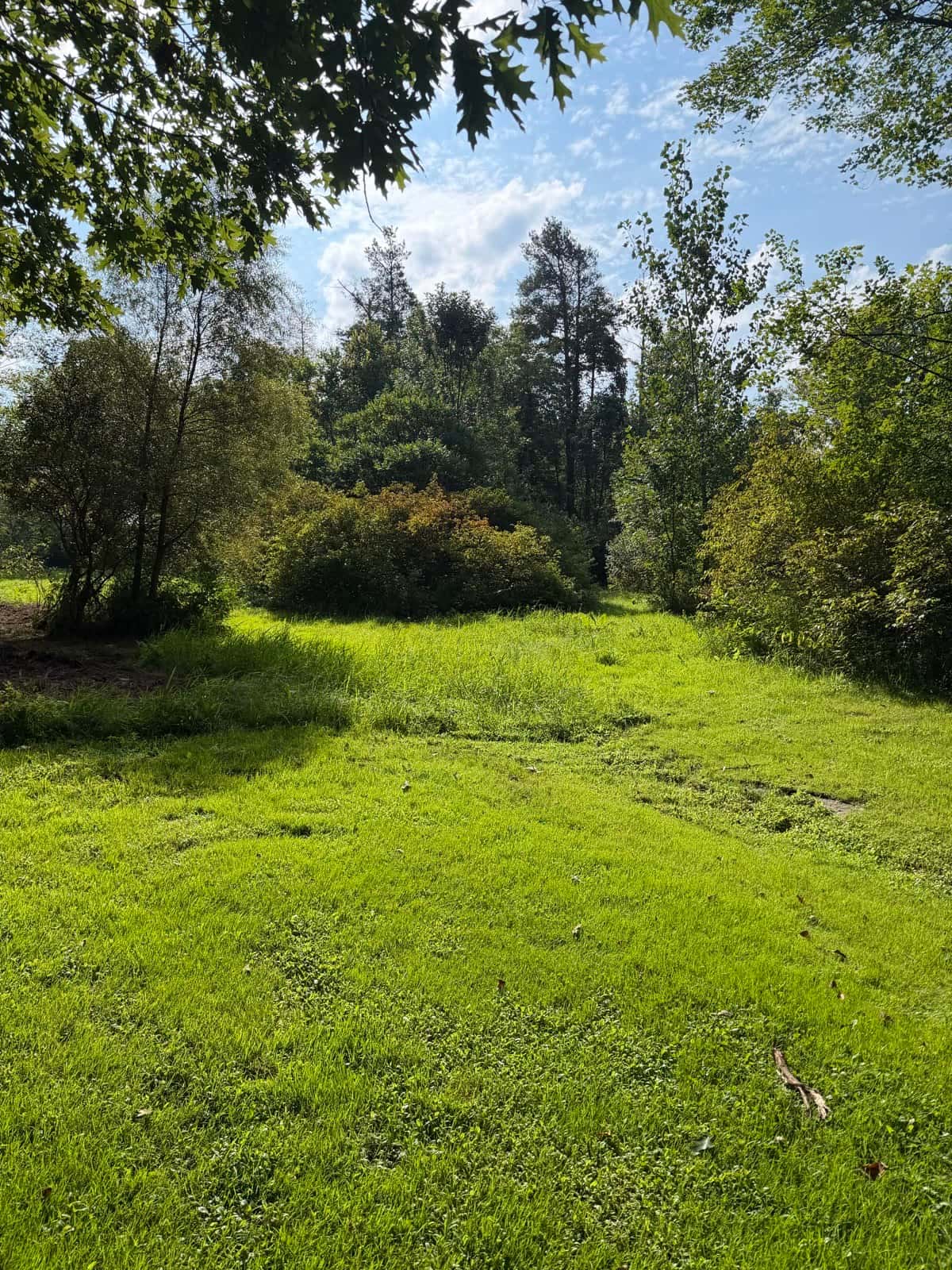 Actual BrushBoss footage · September 2026
Northeast Ohio · Woodland recovery
Real work. Real footage.
See past the tangle.
Brush and vines fill the space beneath your good trees. Start with the ground you want to use again.
Follow the transformation
Woodmere Ground Conditions
Woodmere's small footprint means nearly every job borders a neighbour, so clearing is planned around sightlines as much as around the vegetation. Screening that took thirty years to grow is not something to remove by accident.
The soil is the same slow-draining clay loam that runs through this stretch of the escarpment's eastern shoulder. It carries equipment well when dry and poorly when not, which sets the working window more than anything else does.
Commercial buffers along Chagrin Boulevard are a recurring job here — narrow strips of closed-in growth between parking and property line, which mulch cleanly and stay maintainable afterwards.
Woodmere's scale changes the economics rather than the method. A village parcel is usually under half an acre of actual clearing, which means the cost is driven by mobilisation — getting equipment on site and off again — more than by the hours spent working. That is why we quote the parcel rather than the hour, and why a Woodmere job priced honestly often comes in below what an hourly contractor would bill for the same afternoon.
The commercial buffers along Chagrin Boulevard behave differently from residential lots. They are narrow, they are usually bounded by pavement on one side, and they have often gone fifteen years without attention. Once mulched they can be held with ordinary maintenance, which is generally the reason a property manager calls in the first place.
Woodmere sits in the Chagrin River watershed on the eastern shoulder above the Portage Escarpment, and almost all of its ground maps as urban land — built, paved, or landscaped rather than open soil. That is unusual even for an inner-ring village, and it means the vegetation that remains is concentrated in narrow strips: commercial buffers, rear lot lines, and the wooded margins between properties. Those strips do a lot of work visually, which is why clearing them is a precision job rather than a volume one.
What We Clear in Woodmere, OH
Forestry Mulching
Overgrown brush and crowding saplings ground into a finished mulch layer beneath the trees you keep. No burning, no hauling, no soil disturbance. Slow-draining clay loam on the escarpment's eastern shoulder sets Woodmere's working window.
Brush Clearing
Briars, thickets, and woody growth a mower cannot touch — converted to ground cover that suppresses regrowth while it feeds the soil. Narrow commercial buffers along Chagrin Boulevard are the recurring Woodmere job.
Lot Clearing
Building envelopes, driveways, and septic fields cleared to your survey stakes with topsoil intact, before the excavator arrives. The river corridor and its floodplain limit where clearing is appropriate at all; that boundary gets set first. Nearly every Woodmere parcel borders a neighbour, so clearing is planned around sightlines first.
Fence Line Clearing
Buried fence rows reclaimed on both sides — posts and wire exposed, with a clean mulched strip a mower can hold from now on. Property-line work at close quarters, where a finished edge matters more than speed.
Trail Cutting
Walking loops and ATV routes cut through your own woods with a mulch footing that stays walkable in wet weather. Valley-wall routing along the Chagrin, kept above the floodplain. Short rear-lot paths where the ground carries; the village is compact enough that routing is simple.
Invasive Species Removal
Honeysuckle, multiflora rose, and autumn olive thickets taken to grade — with a written follow-up plan for the regrowth the first season brings. Buffer strips are where invasive growth establishes here before it reaches the lots.
FAQ — Woodmere, OH
No. Small parcels are routine for us, and a compact village lot is often a half-day job rather than a multi-day one. The price reflects that.
Yes, and it is common work in Woodmere. A mulched buffer stays maintainable, which is usually the point — the strip stops being an annual problem.
Village lots are small enough that most work is a flat single-day price. You get it in writing before anything is scheduled.
Only if you want it to. We mark what stays before anything runs, because in a village this size the screening between lots is doing real work.
There is no acreage minimum, but there is a practical price floor set by moving equipment to site. In a village the size of Woodmere that usually works in your favour: several small jobs scheduled the same day share the mobilisation, so neighbours clearing at the same time each pay less than they would alone. It is worth asking whether anything else nearby is already booked.
Usually yes. The work happens from within the vegetation rather than needing a haul route, so the footprint is the buffer strip itself plus a little working room. We walk the access with the property manager first and schedule around business hours where the tenant mix requires it.
Very likely, and at a lower threshold than most places. Woodmere's code requires a Building Inspector permit for excavation, filling or a change of grade with no minimum size written into it — unlike neighbouring communities that only trigger above a set area. We confirm the current requirement with the village before quoting rather than assuming, because in a village this small the rules are administered directly and personally.
Yes. Nearly every Woodmere job borders a neighbour, so the screening you share with the house next door is settled first and the underbrush is cleared around it. The closed-in growth comes out, the trees and the privacy stay, and the ground is left covered rather than scraped. On a compact village lot this is usually a single day's work, and the price is set for the parcel rather than by the hour, and you have it in writing beforehand.
It is careful edge work rather than bulk clearing. Almost all of Woodmere is built, paved or landscaped, so the vegetation that remains sits in narrow strips: rear lot lines, the wooded margins between properties, and the buffers behind Chagrin Boulevard. Each strip is cleared to a deliberate edge because it carries so much of the view. If your plan includes any change of grade, the village's Building Inspector has to issue a permit before work begins.
Price Your Clearing In Two Minutes
Pull up your address on a satellite image, click around the area you want cleared, answer a few questions about the growth, and get a per-acre estimate on screen — no site visit, no phone tag. Overgrown acreage, invasive brush, fence lines and trails, mulched in place with no burn piles and no haul-off.
Per acre on flat terrain, by brush density. Fixed written quotes after a free property walk — no hourly meters.
Draw Your Clearing Area ↗