Land Clearing Company
vs Tree Service: Which to Hire
Hire a land clearing company when the job is acreage: brush, thorn and unwanted trees across wooded or overgrown ground, with the good trees kept. Hire a tree service, ideally an ISA Certified Arborist, when the job is one tree, such as pruning, a hazard limb, or a removal near the house or wires. For acreage, machine clearing usually costs less per acre than crews cutting by hand; BrushBoss clears land for $2,000 to $2,990 an acre.
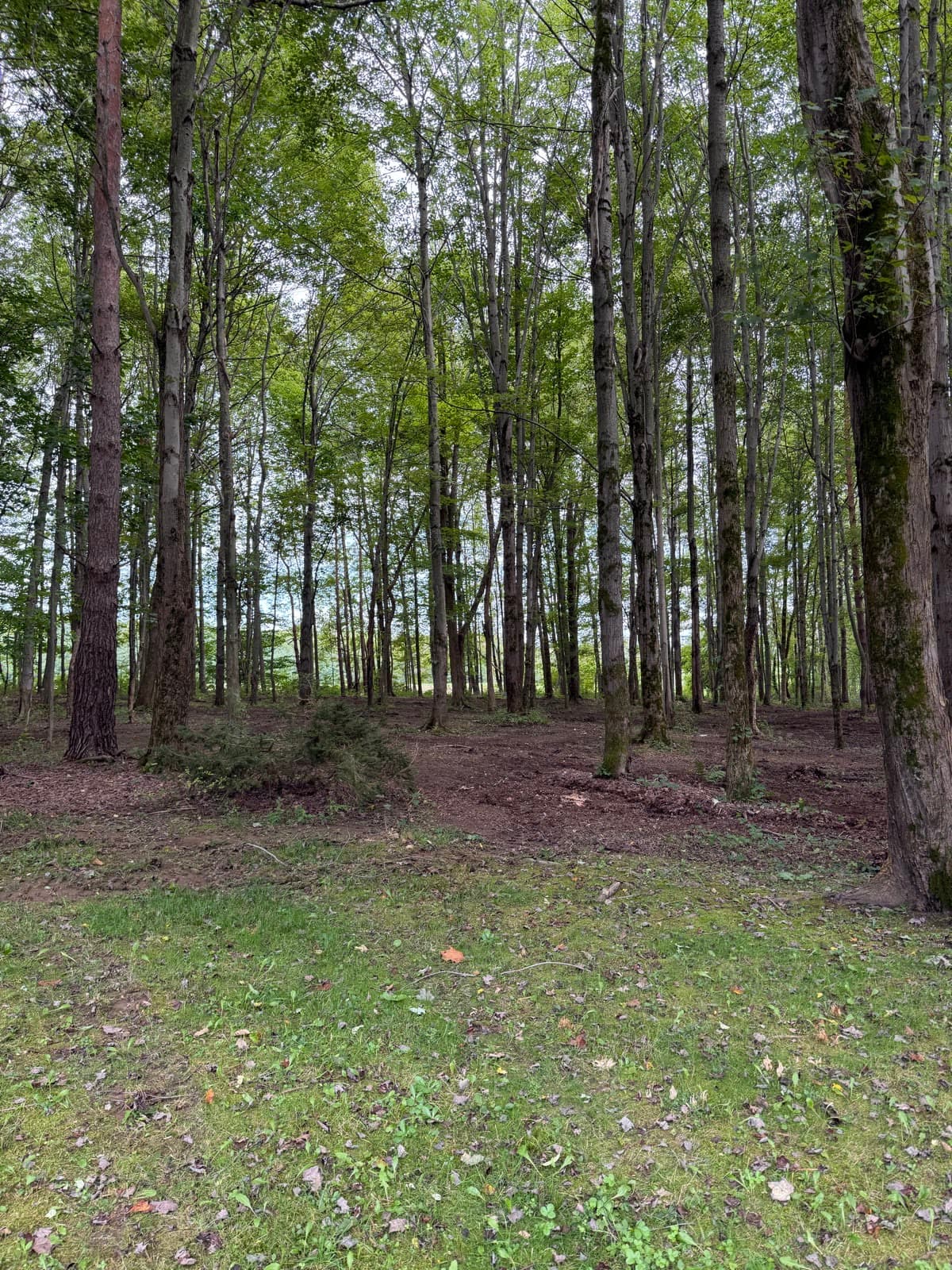
Actual BrushBoss job photograph. Results depend on your property.
Land recovery and property protection · Northeast Ohio
We give you your land back, and we make it safe to use.
The brush, thorn and poison ivy that grew up under your good trees comes out, and what you get back is ground you can walk without watching your step.
From $295 for an afternoon's work to full estate restoration.
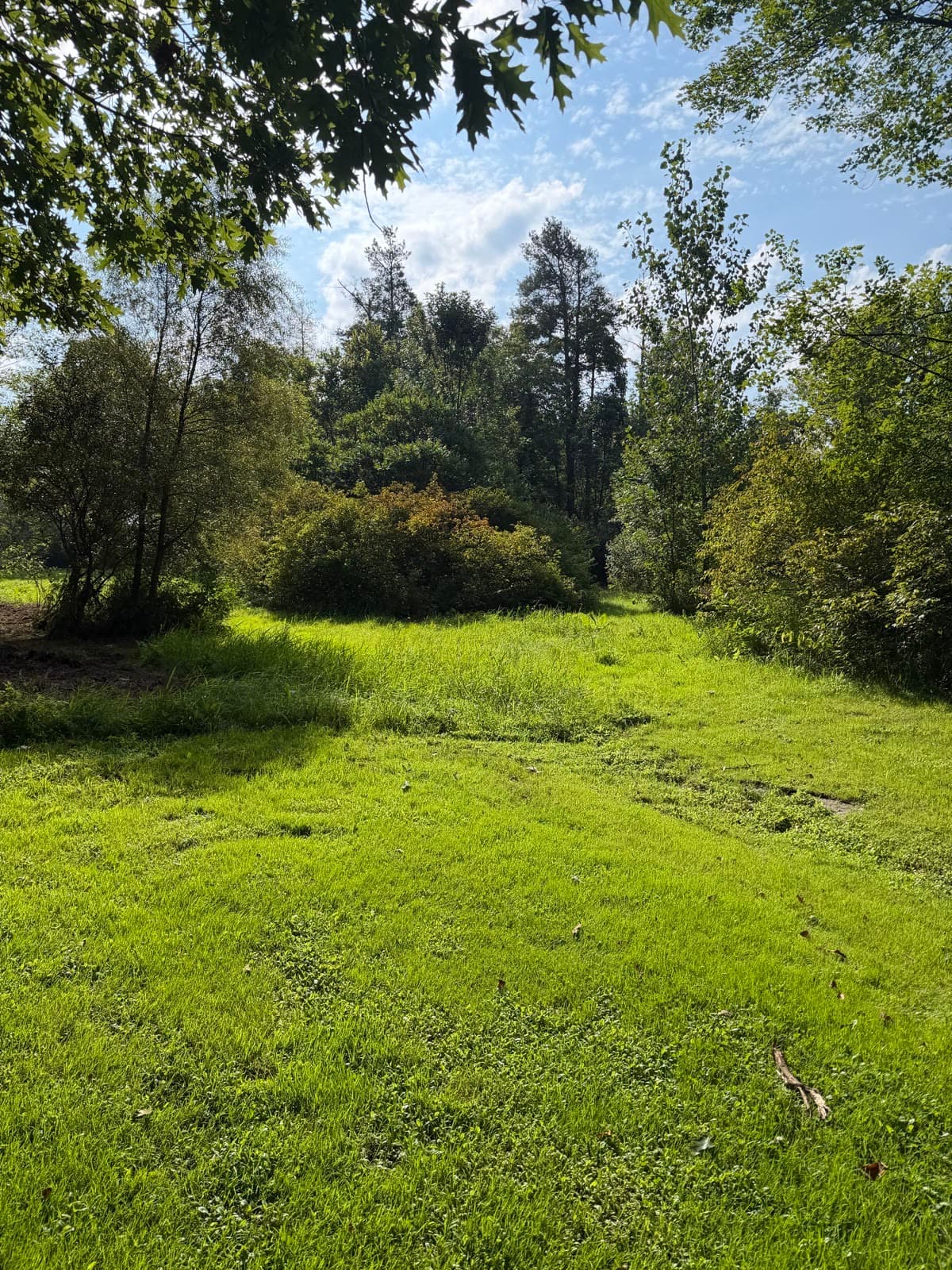 Actual BrushBoss footage · September 2026
Northeast Ohio · Woodland recovery
Real work. Real footage.
See past the tangle.
Brush and vines fill the space beneath your good trees. Start with the ground you want to use again.
Follow the transformation
Land clearing company vs tree service, side by side
The two trades overlap on one job, taking trees out, and differ on most of the rest: how the work is done, how it is priced, and what the ground looks like when the crew leaves. Here they are on the same criteria.
| Factor | Land clearing company | Tree service |
|---|---|---|
| Main work | Brush, thorn, vines and unwanted trees across acreage | Individual trees: pruning, removal, cabling and bracing, plant health care [1] |
| How the work is done | Purpose-built clearing machines that cut the growth and mulch it where it stood | Climbers and saws, with a ground crew feeding the cut material into a chipper or a truck |
| How it is priced | By the acre, or a flat price for a small area | By the tree [5] or by the crew-hour [22] |
| Published cost | BrushBoss: $2,000 to $2,990 an acre. Other Ohio mulching contractors publish $1,850 to $3,500 [24] | $400 to $1,200 a tree on average [5]. National guides put tree clearing at $1,200 to $8,000 an acre [6] |
| What is left on the ground | A layer of mulch over your own topsoil [12] | Cut material chipped, hauled away or piled; disposal is often billed separately [6] |
| Trees kept | The ones you choose, flagged before work starts and worked around | Tree by tree, which is the right way to treat one valuable tree |
| Stumps | Ground at ground level inside cleared ground; at BrushBoss, $425 per acre of cleared ground | Priced per stump, $100 to $400 on average [7] |
| Time | One to eight hours an acre by machine, set by the growth [9] | Hand clearing is labor-intensive and slower [6] |
| Insurance to ask for | A certificate of liability insurance before work starts | Proof of workers' compensation and general liability insurance [3] |
| Best for | Getting wooded or overgrown acreage back into use | An individual tree, especially near the house, wires or other property |
What a tree service does, and what a land clearing company does
A tree service looks after individual trees; a land clearing company changes the condition of a piece of ground. OSHA describes tree care companies as providing pruning, removal, plant health care, cabling and bracing, transplanting, consulting, fertilization and lightning protection [1]. The credential to look for is the International Society of Arboriculture's Certified Arborist, which documents a tested base of knowledge in tree biology, diagnosis, maintenance and safety and has to be kept current with continuing education [2].
A land clearing company works at the scale of the property. The brush, thorn, vines and crowding young trees across an acre or ten come down and are turned into mulch where they stood, and the trees worth keeping are left. Virginia Tech's extension service describes the mulching machines as cutting standing growth and grinding down stumps [9].
The overlap is real. Many tree services advertise land clearing, and on a small or tight lot they do it well. On acreage they usually do it the way they do everything else: crews with saws cut the growth, and the material is chipped, hauled or piled. A tree service can also rent a clearing machine for a job; one Texas rental house lists a track loader with a mulching head at $1,750 a day, with transport quoted separately [15].
Which costs less per acre, a tree service or a land clearing company?
For acreage, a land clearing company usually costs less. A machine clears an acre in one to eight hours, depending on the growth [9], hand clearing is slower [6], and nothing has to be hauled away. For one or two trees, a tree service is usually cheaper, because there is no acreage to spread the cost of a machine across.
Tree services price the way their work comes: by the tree or by the hour. HomeGuide puts the average tree removal at $400 to $1,200, with a national average of $850, and notes that companies often take 10% to 25% off each tree when several come out on one visit [5]. For comparison, Angi puts land-clearing professionals in general at $110 to $250 an hour [8]. A pricing analysis of tree companies found owners charging $225 an hour for a crew of three, and up to $575 an hour for a larger crew [22]. At the low end of that range, an eight-hour day is $1,800 (our arithmetic).
An illustration, not a quote. Suppose a wooded acre has 30 unwanted trees. At the low end of the per-tree average, $400, less the largest multi-tree discount of 25% [5], that is $9,000 before the stumps and before any of the brush between the trees. Each stump after the first adds $30 to $60 [7]. The tree count is our assumption; your acre will have its own.
Machine clearing is priced by the area. Virginia Tech's extension service puts clearing and mulching contractors at $200 to $400 an hour and up to $1,200 for the largest equipment, which costs more but works faster, and says an acre can take one to eight hours depending on the growth, the terrain and the soil [9]. The same publication reports a 2008 comparison at Virginia Tech's Southern Piedmont research center that found mulching cheaper than conventional clearing: $850 an acre against $1,650 [9]. A U.S. Forest Service study of one machine on western forest ground measured an average of 0.57 acres an hour at $530 an acre [10]. Both are older and from other regions, so read them for the gap between methods, not as today's Ohio price.
For current Ohio numbers, BrushBoss clears land for $2,000 to $2,990 an acre, set by how thick the growth is, and smaller areas are flat-priced: $295 for a driveway or fence line up to 500 sq ft, $495 for a longer strip, and $750 for up to a quarter acre. A Central Ohio contractor publishes forestry mulching at $1,850 to $3,500 an acre and full clearing with haul-off and grading at $4,000 to $8,000 [24], and another Ohio contractor lists traditional clearing at $3,000 to $6,000 and up [25]. National guides run lower for mulching, at $500 to $1,000 or more an acre [6]. We have not found an Ohio contractor publishing that range, and national averages mix regions and job sizes.
Where the evidence is thin: no study we found measures how fast a hand crew clears Northeast Ohio brush. One Ohio contractor estimates one to two days per quarter acre of moderate brush, and our hand clearing vs machine clearing guide works through what that means per acre. Ask any bidder for the total for your acreage in writing. The full land-clearing cost guide breaks the bill down method by method, and the Land Clearing Cost Calculator prices your own ground from a map.
Why land-clearing equipment is a specialist investment
Clearing machines are expensive, which is why clearing at scale tends to be a specialty. An entry setup built around a compact track loader runs $50,000 to $175,000 [16], and a purpose-built tracked mulching machine runs from $279,900 for a used 2016 example [17] to a $595,000 auction bid on a 2023 one [18], before the trailer to move it.
- The entry tier: a track loader at $30,000 to $80,000, a mulching attachment at $12,000 to $35,000 and a trailer at $6,000 to $15,000, according to one startup cost guide [16].
- The purpose-built tier: a used 2016 tracked mulcher with 2,520 hours listed by a dealer at $279,900 [17], and a 2023 machine bid to $595,000 at a Ritchie Bros. auction as of October 10, 2026 [18]. An auction bid is not a final sale price.
- Moving it: new heavy-haul lowboy trailers listed at $72,500 [19] and $87,800 [20], plus a truck to pull one.
- Wearing it out: a set of cutting teeth lasts roughly 200 to 500 hours, and as little as 30 to 50 hours in hardwood or stumps [21].
The size of the machine shows up in the work. In a Forest Service bulletin, a clearing contractor describes operators with a skid steer and a head getting a quarter to half an acre a day in heavy material where he gets five or six [11]; that is one contractor's account rather than a measured study. Operator software built on manufacturer field data puts most machines at one to three acres a day, large dedicated machines at four to six in light brush, and everything at half an acre to two acres in dense hardwood with trees over 12 inches [23].
A tree service carries a different fleet. One pricing analysis puts a small crew's chipper, bucket truck, pickups and dump trailer at about $31,833 a year to own [22], which is equipment for climbing, cutting and hauling. Renting a clearing machine instead is possible, but the rental house above quotes 0.5 to 1.5 acres a day for its rental rig at $1,750 a day [15]. By our arithmetic, that is roughly $1,170 to $3,500 an acre in rental alone, before the operator, fuel and transport.
What is left on the ground afterward
A land clearing company that mulches leaves the cut material on the property as a layer of mulch over your own topsoil. A tree service clearing by hand usually chips, hauls or piles it, and the bill pays for that step.
Texas A&M Forest Service says mulching reduces erosion potential and stabilizes the soil, and that mulch left on site returns nutrients, holds moisture and evens out soil temperature; because the mulch is made on site, there is no cost beyond the labor and the machine [12]. Virginia Tech's extension service makes the same point about soil: mulching preserves soil integrity and can maintain or increase organic matter [9]. A Forest Service research summary found soil nutrition was not harmed, and that erosion and compaction were kept down when the machines drove over the mulch they had made [11]. The same summary notes the limit: a deep mulch layer adds fine fuel, so on fire-prone western ground mulching is not always the right treatment [11].
Cutting by hand is only the first line of a hand-clearing bill. In the Forest Service study above, a hand crew cutting standing vegetation was estimated at $175 an acre, and piling and burning the slash took the total to $505 to $715 [10]. That was western ground in 2006 dollars, but the structure is the same anywhere: the material has to go somewhere. In Ohio, one contractor lists disposal at $200 to $500 or more a truckload [25], and HomeGuide notes that some contractors include disposal and others bill it separately [6]. Burning in Ohio needs Ohio EPA permission and is restricted near towns; the mulching versus bulldozing guide covers the rules.
Which one keeps the trees you want?
Both can. A tree service works one tree at a time, which is right for a prized oak beside the house; a land clearing company keeps trees by marking them before work starts and taking the understory out from around them, the same first step Texas A&M Forest Service gives for any mulching job [12].
On a BrushBoss job, the trees that stay are agreed with you and flagged before anything starts. What comes out is the brush, thorn, vines and the young trees crowding the good ones, and the canopy you already have is what the property looks like from then on. Where a larger tree does need to come down, it is named in your written scope first and cut and stacked rather than mulched. The woodland restoration and underbrush clearing pages show what that looks like on estate woods.
Will the brush grow back after clearing?
Some of it will, whichever trade you hire. Ohio State University Extension warns that cutting bush honeysuckle off at the base causes prolific sprouting, and that mechanical control alone is usually not completely effective on medium to large shrubs [13].
Research on mulching heads is encouraging. A 2026 study in Forest Science calls manual control of heavy invasions labor-intensive and time consuming, and concludes that mulching heads control invasive shrubs without degrading the native plant community, with lower cuts producing fewer sprouts [14]. Sprouts still come, so the first seasons after clearing decide how long the result lasts. BrushBoss does not apply herbicide; where a treatment is wanted, it is work for a licensed applicator. The plan for keeping cleared ground open is in how to stop brush growing back after clearing.
Stumps: who grinds them, and what it costs
A tree service usually prices stumps one at a time, $100 to $400 on average, with each additional stump at $30 to $60 [7]. BrushBoss grinds stumps only inside ground it is already clearing, as a $425-per-acre add-on, and does not take stump-only jobs.
Mulching takes brush and young trees to ground level and leaves the roots in the soil, which is part of what keeps the ground from washing. If you need one stump ground out below grade for a patio, a replanting or a foundation, that is a job for a stump grinding or tree service crew.
When to call a tree service instead
Call a tree service, and look for an ISA Certified Arborist, when the job is one tree that matters or one tree that could hurt someone. The International Society of Arboriculture says that pruning or removing trees, especially large trees, can be dangerous, and should be done only by people trained and equipped to work safely in trees [2]. OSHA lists falls, electrocutions and being struck by trees as the ways tree workers are hurt or killed [4].
- Pruning, shaping or thinning the crown of a tree you are keeping.
- A cracked, hollow or leaning tree over the house, the garage, the drive or a play area.
- Any tree or limb near power lines.
- A removal in a tight yard, where the tree has to be climbed and lowered in pieces.
- A storm-damaged tree hung up in another tree or resting on a roof.
- Questions about a tree's health, planting or long-term care.
Virginia Tech's extension guidance on hiring an arborist recommends asking for proof of certification, workers' compensation and general liability insurance, and getting three quotes [3]. If you call us about one of the jobs above, we will tell you it is tree-service work and point you to a local arborist.
Questions to ask either company before you hire
The answers turn a per-tree quote and a per-acre quote into numbers you can compare.
- What is the total for my area, in writing, and is it fixed before work starts?
- Which trees stay, and how will they be marked?
- Where does the cut material go, and is hauling, chipping or burning on this quote?
- How are stumps handled, and what does that add?
- Can I see your certificate of insurance? For tree work, ask about workers' compensation too.
- What will the ground look like the day you leave, and what should I expect to grow back?
Where BrushBoss fits
BrushBoss is a land clearing company in Northeast Ohio. We give owners back the use of wooded and overgrown ground, priced at $2,000 to $2,990 an acre by density and $3,900 – $5,100 an acre on ground too steep to walk. Small jobs are flat-priced, $295 for a driveway or fence line, $495 for a strip and $750 for up to a quarter acre, with no project minimum, and the work is done without losing a tree worth keeping. Every price is on the pricing page, and the answers to the questions we hear most are in the FAQ.
Methodology and sources, updated October 2026
BrushBoss prices on this page come from our published price schedule. Every other figure comes from the sources below, each read in October 2026, and is marked in the text with its number. We favored government, university extension and peer-reviewed sources, and fell back on cost guides, equipment listings, rental rates and other contractors' published prices only where those were the one public record of a number. Listings and auction bids are a point in time and will change.
Where sources disagree we give the range and say so: national cost guides put forestry mulching well below what Ohio contractors publish, and entry-level clearing equipment costs a fraction of a purpose-built machine. The Forest Service and Virginia studies are older and from other regions, and are used to compare methods, not to price an Ohio job. Arithmetic built from a sourced figure is labeled as ours.
Sources
- Tree Care Industry: Overview. U.S. Occupational Safety and Health Administration, accessed October 2026.
- Why Hire an Arborist?. International Society of Arboriculture (TreesAreGood.org), accessed October 2026.
- Hiring an Arborist to Care for Your Landscape Trees (ANR-131). Virginia Cooperative Extension, Virginia Tech, 2014.
- Tree Care Work: Know the Hazards (OSHA 3752). U.S. Occupational Safety and Health Administration, 2014.
- How Much Does Tree Removal Cost? (2026). HomeGuide, 2026.
- How Much Does It Cost to Clear Land? (2026). HomeGuide, 2026.
- How Much Does Stump Removal Cost? (2026). HomeGuide, 2026.
- How Much Does It Cost to Clear Land? [2026 Data]. Angi, 2026.
- Options for Clearing Land to Establish Pasture (465-341). Virginia Cooperative Extension, Virginia Tech, 2021.
- Mastication: A Fuel Reduction and Site Preparation Alternative. USDA Forest Service, Rocky Mountain Research Station (Halbrook et al.), 2006.
- Is Mastication Right for Your Site? (Science You Can Use, Issue 45). USDA Forest Service, Rocky Mountain Research Station, November 2020.
- Mulching and Shredding. Texas A&M Forest Service, accessed October 2026.
- Controlling Non-Native Invasive Plants in Ohio Forests: Bush Honeysuckle (F-68). Ohio State University Extension, March 2024.
- Higher Intensities of Mulching-Head Treatments Limit the Response of a Target Invasive Shrub (Lonicera maackii). Forest Science, vol. 72 (Springer), January 2026.
- Forestry Mulcher Rental Rates. Pierce Equipment Rentals (Texas), accessed October 2026.
- Land Clearing Equipment Cost: 2026 Startup Budget. ReliableStartup.com, August 2026.
- Used 2016 purpose-built tracked mulcher, dealer listing. DDI Equipment (Colorado), accessed October 2026.
- 2023 purpose-built tracked mulcher, auction listing. Ritchie Bros. auction via BidProwl, bid as of October 10, 2026.
- New lowboy trailer, dealer listing. NextTruck, accessed October 2026.
- New lowboy trailer, dealer listing. Fastline, accessed October 2026.
- Replacing Mulcher Teeth: How Often, How Much. Machine Mulcher, accessed October 2026.
- Tree Service Cost Per Hour: Man-Hour vs Crew-Hour. TrueTradeCost, September 2026.
- Acres Per Day Calculator for Forestry Mulching. MulchDeck, accessed October 2026.
- How Much Does Land Clearing Cost Per Acre in Central Ohio?. Fortress Level Construction (an Ohio contractor), reviewed July 2026.
- How Much Does Land Clearing Cost in Ohio? 2026 Pricing Guide. Apex Land Services (an Ohio contractor), May 2026.
Land Clearing Company vs Tree Service: Common Questions
Is a land clearing company cheaper than a tree service?
For acreage, usually. Tree services price by the tree or the hour; HomeGuide puts the average removal at $400 to $1,200 a tree. A land clearing company prices by the acre, and BrushBoss clears land in Northeast Ohio for $2,000 to $2,990 an acre with nothing hauled away. For one or two trees, a tree service is usually the cheaper call.
Can a tree service clear land?
Yes, and on a small or tight lot many do it well. On acreage, a tree service usually clears the way it does its other work: a crew cuts with saws, and the material is chipped, hauled away or piled. That takes longer per acre than machine clearing and adds disposal to the bill.
When should I hire a tree service instead of a land clearing company?
When the job is one tree that matters or one that could hurt someone: pruning a tree you are keeping, a cracked or leaning tree over the house or drive, anything near power lines, a removal that has to be climbed and lowered in pieces, or a question about a tree's health. Look for an ISA Certified Arborist and ask for proof of insurance.
Does a land clearing company keep the trees I want?
A good one does. The trees that stay are agreed and flagged before work starts, and the brush and crowding young trees are taken out from around them. At BrushBoss, a larger tree only comes down if it is named in your written scope, and then it is cut and stacked rather than mulched.
Does BrushBoss grind stumps?
Only inside ground we are already clearing, as a $425-per-acre add-on. We do not take stump-only jobs; for a single stump, call a stump grinding or tree service company.
Why is land clearing a specialty?
Mostly because the machines are a large investment. An entry setup on a compact track loader runs $50,000 to $175,000 in one startup guide, and purpose-built tracked mulching machines run from about $280,000 used to a $595,000 auction bid on a 2023 machine, before a trailer to move it. Renting one costs around $1,750 a day at one rental house.
Acreage to Get Back?
Get a Fixed-Price Quote.
Draw the area in the Land Clearing Cost Calculator and see the number in under a minute. One tree by the house? Call an arborist; we will tell you the same.
You own the land. You just cannot use it.
That is one layer of brush, and it comes off in a morning.
We'll tell you what it costs. From $295, no project minimum.
Ground you can walk without watching your step — because we take the cover out.
Without losing a tree worth keeping.