Forestry Mulching
vs Bulldozing
Forestry mulching costs $2,000 to $2,990 per acre in Northeast Ohio with nothing hauled away, while bulldozing runs $3,000 – $8,000 an acre in published Ohio ranges before disposal, stumps and topsoil. Mulching is the better choice when you want the land back in use and the good trees kept; a bulldozer is right when the ground itself has to change.
Mulching vs Bulldozing, Compared
How the two methods compare on cost, what is left on the ground, the trees you keep, the soil, erosion, time and permits, for residential and light commercial land clearing in Ohio.
| Factor | Forestry Mulching | Bulldozing |
|---|---|---|
| Cost per acre | $2,000 – $2,990, one written price | $3,000 – $8,000 in published Ohio ranges, plus disposal at $200 – $500 or more a truckload |
| What is left on the ground | A mulch layer over your own topsoil, under the trees you kept | Bare soil, often subsoil or clay, plus piles to haul or burn |
| Trees kept | The ones you choose. Work goes around them, not through them | None in the cleared area. The blade takes everything in its path |
| Soil disturbance | Minimal. Roots and topsoil stay where they are | Severe. Topsoil and root mass are pushed off with the brush |
| Erosion | Low. The mulch layer covers the ground and slows runoff | High until something grows back. Bare soil meets every storm |
| Timeline | One to two days for most residential projects | Three to five days, plus debris cleanup and hauling |
| Permits in Ohio | Usually none on residential ground; the soil stays covered | One acre or more of bare soil brings in Ohio EPA stormwater rules |
| Debris | None. It becomes the ground cover | Windrows and piles, hauled at extra cost or burned under permit |
| Best for | Getting wooded or overgrown land back to use while keeping it wooded | Changing the ground itself: pads, cuts, grading, stumps and roots out |
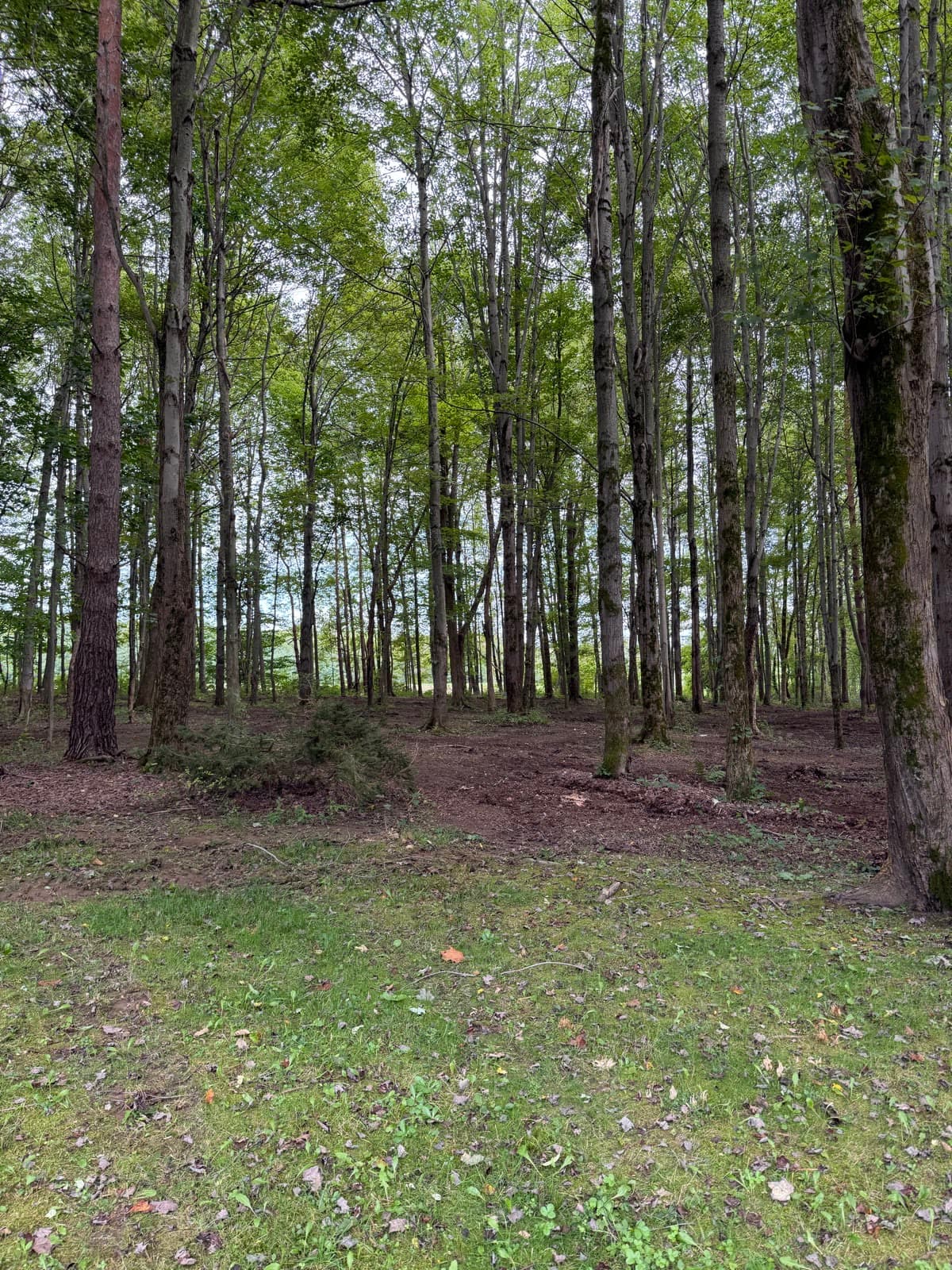
Actual BrushBoss job photograph. Results depend on your property.
Land recovery and property protection · Northeast Ohio
We give you your land back, and we make it safe to use.
The brush, thorn and poison ivy that grew up under your good trees comes out, and what you get back is ground you can walk without watching your step.
From $295 for an afternoon's work to full estate restoration.
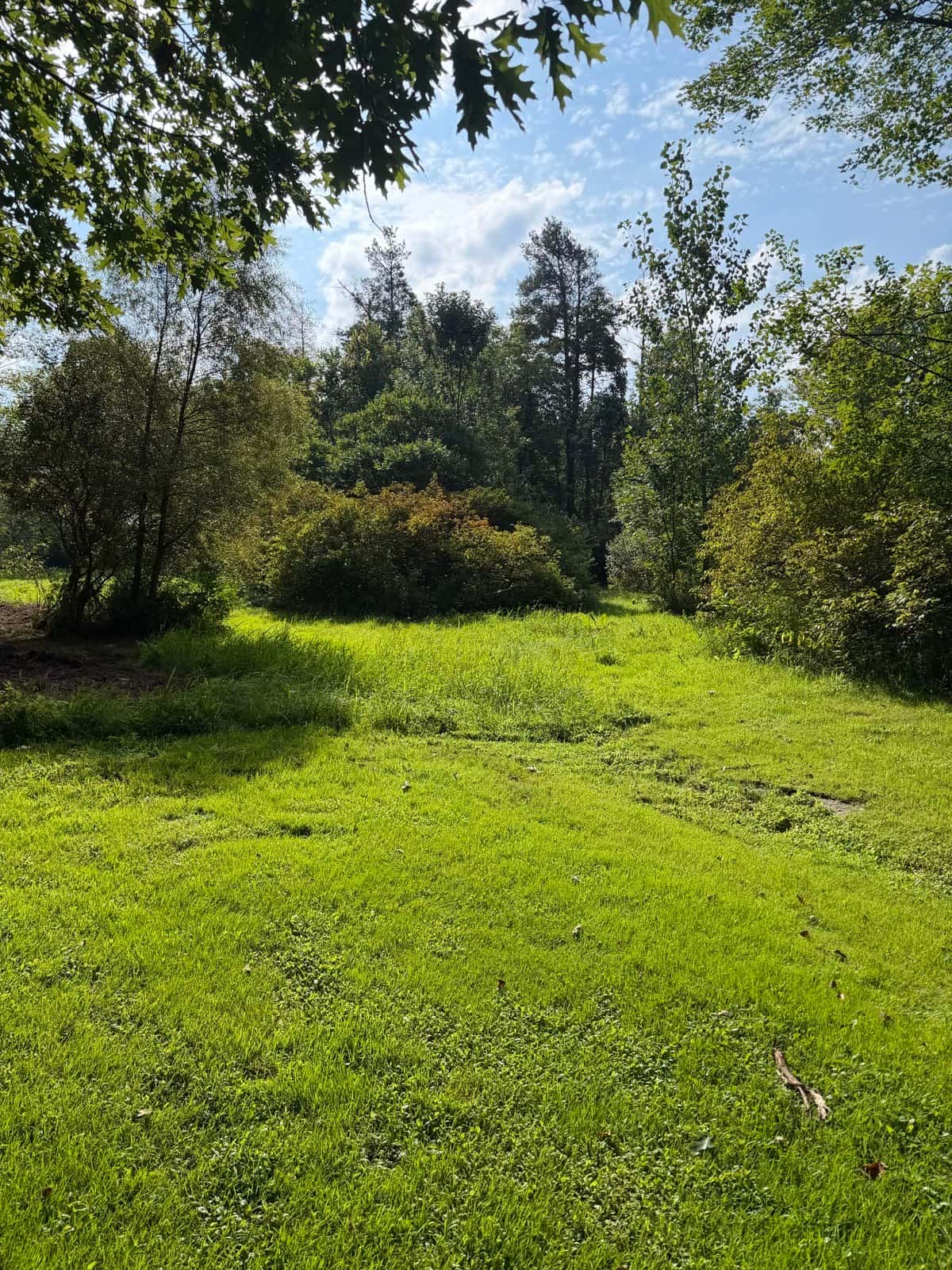 Actual BrushBoss footage · September 2026
Northeast Ohio · Woodland recovery
Real work. Real footage.
See past the tangle.
Brush and vines fill the space beneath your good trees. Start with the ground you want to use again.
Follow the transformation
What each method leaves behind
The real difference between the two is not the machine. It is the ground you are standing on the day after the crew leaves.
Forestry mulching takes the brush, thorn, vines and young trees down to the ground and turns them into mulch where they stood. Nothing is pulled out by the roots and nothing is pushed into a pile. The trees you are keeping are worked around rather than through, so what you walk out onto is the same woods with the floor opened up: light between the trunks, a view through to the back line, ground you can walk and mow.
That mulch layer is not a by-product to be cleaned up. It holds moisture, shades out the next flush of weed seed, keeps rain from hitting bare soil, and breaks down into organic matter over the following seasons. If you plan to seed a lawn, put in a garden or bring a field back to pasture, starting on your own topsoil is a real advantage.
A bulldozer pushes vegetation, topsoil and root masses into windrows or piles with its blade. The piles are then burned where the rules allow it, or loaded onto trucks and hauled to a disposal site, and stumps and root balls come out of the ground with them. What is left is mineral soil or clay: a clean slate for grading and earthwork, but one with the living layer of the soil gone. Getting grass or plantings to take on bulldozed ground usually means buying topsoil back by the cubic yard.
Cost: compare the whole bill, not the headline rate
BrushBoss prices forestry mulching in Northeast Ohio at $2,000 to $2,990 an acre, set by how thick the growth is, and that number is the whole bill for the clearing: nothing to haul, nothing to burn, no topsoil to replace. Your own figure comes from the Land Clearing Cost Calculator. A bulldozer's per-acre rate can look competitive. The difference shows up in the lines that follow it.
| Line on the bill | Forestry mulching | Bulldozing |
|---|---|---|
| Clearing, per acre | $2,000 – $2,990 | $3,000 – $8,000, varies by contractor |
| Debris disposal | None | $200 – $500 or more a truckload |
| Stumps | Brush and young trees taken to ground level | $100 – $400 a stump to grind |
| Topsoil to replace | None | Bought back by the cubic yard |
| Erosion control | Not usually needed; the ground stays covered | Blankets or silt fence, billed separately |
| Burn permission | Not needed | Written Ohio EPA permission where burning is allowed at all |
Other Ohio contractors publish ranges in the same territory. One Central Ohio company puts full clearing with haul-off and grading at $4,000 to $8,000 an acre, and another Ohio contractor lists traditional clearing of medium brush at $3,000 to $6,000 and up, with disposal at $200 to $500 or more a truckload and stump grinding at $100 to $400 a stump. For the full method-by-method breakdown see what land clearing costs, and for how a mulching price is built, the Ohio forestry mulching cost guide.
Trees: what is still standing afterwards
Mulching is selective by nature. Before anything starts, the trees that stay are agreed with you and flagged, and the work goes around them. The understory that was crowding them comes out, and the canopy you already have is what the property looks like from then on.
Bulldozing is not selective. A blade working beneath a tree tears into the roots it stands on, so in practice a dozed area is cleared of everything. That matters for more than looks: studies of home sales consistently associate mature trees with higher prices, which is why clearing that keeps the good trees tends to help a wooded property and clear-cutting tends to work against it.
Soil, erosion and what grows back
Mulching leaves the root mat anchored and the soil covered, so slopes stay put and rain soaks in rather than running off. On the clay soils common across Geauga and the rest of Northeast Ohio, that difference is easy to see after the first heavy storm: covered ground stays where it is, and bare clay sheds water and sediment downhill toward the nearest ditch, pond or creek.
Bulldozed ground is bare until something grows on it, and the first things to grow on bare, disturbed soil are rarely the ones you want. Weed seed, bird-spread seed from the invasive shrubs at the field edge and root fragments left in the soil all get a clean start.
Neither method is permanent on its own. On mulched ground, the cut bases of the woody invasives send up new shoots for the first seasons, and the mulch layer holds most of the rest back while it breaks down. Catching those shoots while they are small is what makes the result last; the plan for that is in how to stop brush growing back after clearing.
Permits and burning rules in Ohio
Most residential clearing in Ohio needs no permit. The rules change when the soil is opened up, when the work comes near water, and when the debris is going to be burned, and all three weigh more heavily on bulldozing than on mulching.
- Disturbing one acre or more of soil brings in Ohio EPA's stormwater rules: an NPDES permit for construction runoff and an erosion and sediment control plan, often filed with the county Soil and Water Conservation District. Mulching leaves the ground covered and does not usually count as that kind of disturbance; dozing an acre bare does.
- Work near streams and wetlands needs a buffer, commonly 50 to 100 feet, and clearing inside it can need Ohio EPA or U.S. Army Corps of Engineers review under Section 404 of the Clean Water Act.
- Ohio EPA does not allow residential open burning inside village or city limits or in the zone around them. Outside those areas, brush from your own residence may only be burned at least 1,000 feet from a neighbor's inhabited building, and land-clearing waste needs Ohio EPA's written permission in advance.
- Under Ohio Revised Code 1503.18, outside municipal limits there is no open burning of brush between 6 a.m. and 6 p.m. in March, April, May, October and November, which is much of the clearing season.
Townships and municipalities can add their own rules, and the permit is always the property owner's responsibility. We flag what we see on your parcel during the assessment; the detail is in our guide to Ohio land clearing permits, and the burning rules are on the Ohio EPA open burning page.
How long each one takes
Most residential mulching projects take one to two days, and the ground is usable the evening the crew leaves. There is no haul-off phase, no trucks cycling past the neighbors, and no pile waiting on a dry week and a permission letter.
Bulldozing typically runs three to five days for the clearing, and then the debris has to go somewhere. Hauling is more trucks and more days; burning depends on where you are, the calendar, and permission that has to be in hand first. Either way the job is not finished when the last tree is down.
When a bulldozer is the right call
We are a mulching company, and we will still tell you when you need a dozer. The test is simple: does the ground itself have to change?
- A building pad or a house site. Where a foundation, a barn slab or a driveway cut is going, the ground has to be leveled and compacted, and that is dozer and excavator work. Mulching often goes first, clearing to the survey stakes so the excavator only touches the footprint and the rest of the lot keeps its trees.
- Stumps and roots have to come out. Mulching takes brush and young trees to ground level, but the roots stay in the soil. Under a foundation, a septic field or anywhere the soil will be dug, they have to be removed, and pulling them is a dozer's job.
- The land needs grading. Drainage swales, a regraded slope, a level field for a riding arena: if the shape of the ground is wrong, clearing alone will not fix it.
- The soil itself has to go. Remediation, fill removal or reclamation work is excavation, not clearing.
- Large sites where grading follows immediately. On a big commercial development where every tree is coming out and earthwork starts the next week, keeping the topsoil and the canopy is not the goal, and a dozer crew may be the more economical tool.
If what you want is the land you already own, opened up and usable, with the good trees still standing, that is mulching. If what you want is different ground, that is a bulldozer. Plenty of properties need a little of each, in that order.
Which one fits your property
Most owners already know the answer once the question is put the right way round. Start from what you want to be standing on next summer, not from the method.
- You want to walk the back of the property again, see the pond or the far tree line from the house, or open a trail through woods you already own: forestry mulching.
- You want a field or a pasture back from the brush that took it, and plan to mow or graze it: forestry mulching, then mowing to keep it open.
- You are building, and the house, barn or drive goes on a small part of the lot: mulching for the lot, a dozer or excavator for the footprint only.
- The whole site is being regraded, every tree is coming out, and earthwork starts straight after: a bulldozer.
- You are not sure: send the address and a few photos, and we will tell you which one the property needs, including when the honest answer is not us.
Questions to ask any clearing contractor
Whichever method you are quoted, these questions turn two very different bids into something you can compare.
- Is the price per acre or for the whole job, and is it fixed in writing before work starts?
- Where does the debris go, and is hauling or burning on this quote or billed later?
- Which trees stay, and how will they be marked before the work begins?
- Is topsoil replacement or erosion control included, and who is responsible if the site is over an acre?
- What will the ground look like the day you leave: mulch, bare soil, or piles?
- What should I expect to grow back in the first seasons, and what is the plan for it?
Forestry Mulching vs Bulldozing: Common Questions
Is forestry mulching cheaper than bulldozing?
Usually, once the whole bill is counted. Forestry mulching is $2,000 to $2,990 per acre in Northeast Ohio with nothing to haul or burn. Published Ohio bulldozing ranges run $3,000 – $8,000 an acre, and disposal, stump grinding and replacement topsoil are billed on top.
Is forestry mulching better than bulldozing?
It is better when you want the land you already own back in use and the good trees kept: the brush becomes cover where it stood and the topsoil stays. A bulldozer is better when the ground itself has to change, for a building pad, stump and root removal, or grading.
Does forestry mulching remove stumps and roots?
No. Brush and young trees are taken to ground level and the roots stay in the soil, which is what keeps the ground from washing. Where a foundation, septic field or driveway cut needs the roots out, that footprint is excavator or dozer work.
Do I need a permit to bulldoze or mulch land in Ohio?
Most residential clearing needs none. Disturbing an acre or more of soil brings in Ohio EPA stormwater rules, work near streams and wetlands can need review, and burning land-clearing debris needs written permission. Bare dozed ground triggers these far more often than mulched ground, which stays covered.
Ready to Get Your Land Back?
Get a Fixed-Price Quote.
No hourly billing, no surprise hauling fees. Enter your address in the Land Clearing Cost Calculator and get your number in under a minute.
You own the land. You just cannot use it.
That is one layer of brush, and it comes off in a morning.
We'll tell you what it costs. From $295, no project minimum.
Ground you can walk without watching your step — because we take the cover out.
Without losing a tree worth keeping.