How Much Does It Cost to Clear Land in Ohio?
By Kyle Abbey · ·
Clearing land in Northeast Ohio costs $2,000 to $2,990 per acre by forestry mulching, the low end for light growth and the top where it is densest, and that one number is the whole bill. Small areas are flat-priced, from $295 up to $750 for a quarter acre. Dozer-style clearing rarely works out that way: debris hauling, burn piles and grading repair after the topsoil is scraped are line items that routinely rival the clearing itself. Mulching turns standing brush into a layer of mulch where it stood, so there is nothing to haul, burn, or regrade. What's left is a per-acre price driven by what's actually growing on your land — and that's something you can estimate standing at the edge of your own property.
Instant QuoteWhat clearing an acre costs, by method
| Method | Per acre | Billed on top |
|---|---|---|
| Forestry mulching (BrushBoss) | $2,000 – $2,990 | Nothing: no hauling, burning or regrading |
| Bulldozing, published Ohio ranges | $3,000 – $8,000 | Disposal, stump grinding, topsoil, erosion control |
| Hand crew | By the hour or the day | Chipping, hauling or burning; stumps left standing |
For a number for your own ground, draw the area in the Land Clearing Cost Calculator and it prices the acreage, growth and terrain on the spot.
Land recovery and property protection · Northeast Ohio
We give you your land back, and we make it safe to use.
The brush, thorn and poison ivy that grew up under your good trees comes out, and what you get back is ground you can walk without watching your step.
From $295 for an afternoon's work to full estate restoration.
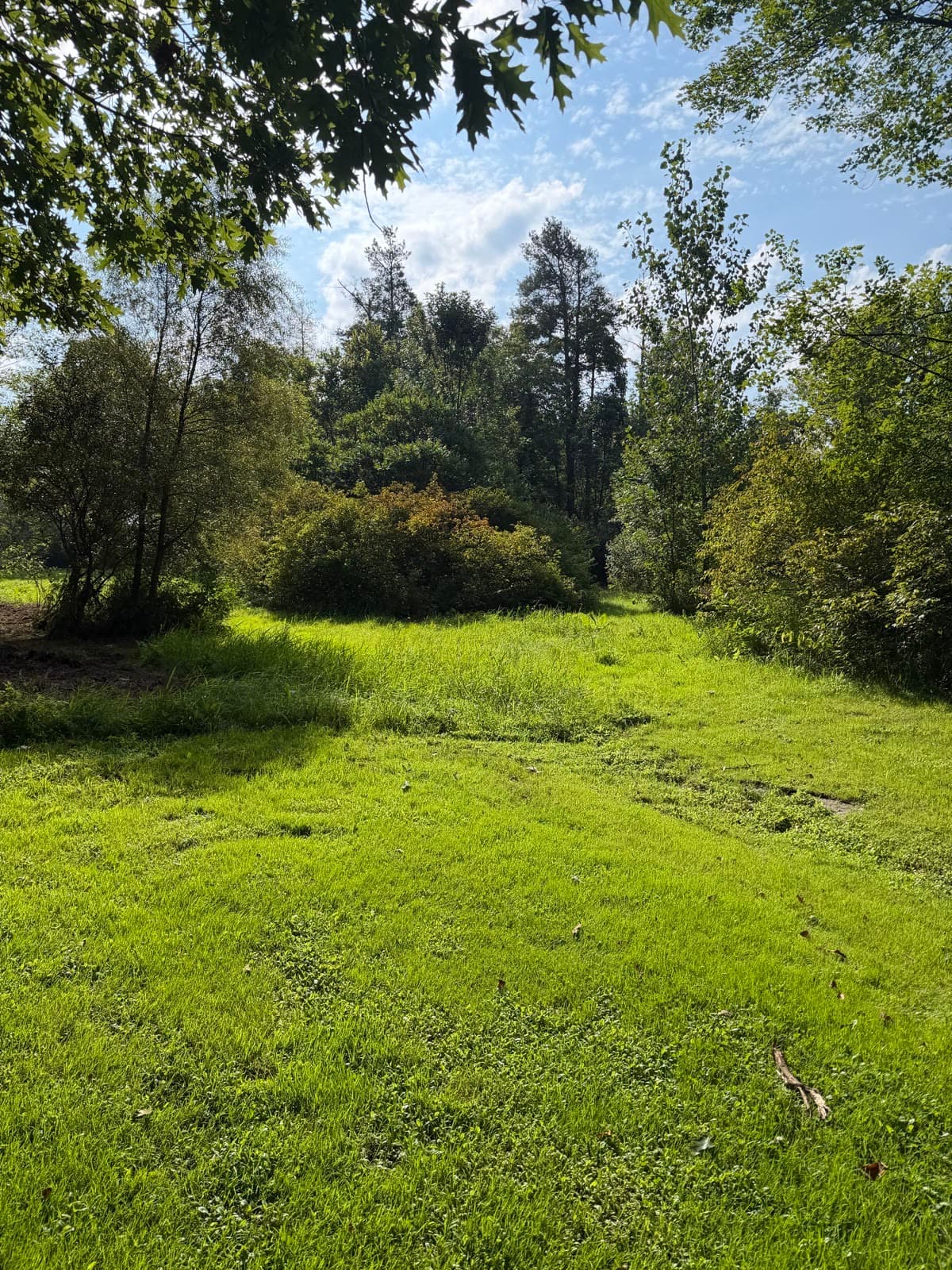 Actual BrushBoss footage · September 2026
Northeast Ohio · Woodland recovery
Real work. Real footage.
See past the tangle.
Brush and vines fill the space beneath your good trees. Start with the ground you want to use again.
Follow the transformation
What does land clearing cost per acre, by method?
The honest way to compare methods is by the whole bill: the clearing, plus everything the clearing leaves behind that someone then has to pay to deal with. Headline per-acre rates hide that second half, and it is the half that decides which method was actually cheaper.
| Method | Clearing | What usually follows, billed separately | What you are left with |
|---|---|---|---|
| Forestry mulching | $2,000 – $2,990 per acre | Nothing for debris. Grading or seed only if you want a lawn. | Open ground under the trees you kept, covered in mulch |
| Bulldozing (push, pile, haul or burn) | $3,000 – $8,000 per acre | Disposal at $200 – $500 or more a truckload and stump grinding at $100 – $400 a stump, then topsoil, erosion control and seed | Bare, graded soil and no understory or trees in the cleared area |
| Hand crew (saws and a chipper or burn pile) | By the hour or the day | Chipping, hauling or burning the brush, and stumps left standing | Cut ground with stumps, and the material still to deal with |
For how a mulching price is built — the density tiers, slopes, volume discounts and worked examples — see what forestry mulching costs per acre in Ohio. The published rates themselves are on the full price schedule.
What do other Ohio contractors publish?
Independent Ohio figures tell the same story about the gap between methods. A Central Ohio contractor puts full land clearing with haul-off and grading at $4,000 to $8,000 per acre, against $1,850 to $3,500 for forestry mulching. Another Ohio contractor lists traditional clearing at $3,000 to $6,000 or more per acre for medium brush, with disposal at $200 to $500 or more per truckload. The ranges are wide because every one of them depends on what is growing and what has to leave.
What hidden costs turn up on a land-clearing bill?
These are the lines that appear after the clearing is priced. None of them is a trick; each is a real cost of a method that moves material off the ground rather than turning it into cover. The question is only whether your quote names them before you sign.
Hauling and dump fees
An acre of dense brush and young trees is a surprising volume of material once it is cut and piled. Loaded, trucked and tipped, it is charged by the ton or by the load, and on a thick acre it can run to many loads. This is the line that most often turns a competitive dozer price into an expensive job.
Burning, and what Ohio requires
Burning looks free and rarely is. Under Ohio's open-burning rule for unrestricted areas, burning land clearing waste requires written permission from Ohio EPA, and the fire must sit at least a thousand feet from any inhabited building that is not on the property. Inside restricted areas, around towns and villages, the rules are tighter still. Ohio EPA's own guidance says permission may take two weeks, and that waste may not be hauled from one site to be burned at another.
On many Geauga and Chagrin Valley properties, with a neighbour’s house inside that distance, the burn pile may simply not be an option, and the brush has to be hauled instead. Where burning is allowed, someone still has to watch the fire and clean up the ash and the scorched ground it leaves.
Stumps
A dozer that pushes trees over pulls much of the root ball with them, and what is left needs grinding or digging out, usually priced per stump. A hand crew leaves every stump standing. Forestry mulching takes brush and young trees down to ground level as part of the clearing, so the ground is walkable and mowable without a separate stump line for that material.
Regrading, topsoil and erosion control
Scraping brush off with a blade takes topsoil with it. The ground then needs regrading, often new topsoil, and something to hold it in the first heavy rain: silt fence, erosion blankets, or both. Disturbing more than an acre of soil can also bring Ohio EPA erosion and sediment requirements into play; our Ohio land clearing permit guide sets out when. Mulching leaves the topsoil where it is, under a layer that slows the rain.
Seeding and getting the surface back
Bare soil does not stay bare. If it is not seeded quickly, it fills with whatever arrives first, which in Northeast Ohio is usually the same brush you paid to remove. Budget for seed and for the time it takes to establish. After mulching, seed is optional: the mulch is the finished surface, and a lawn is a choice rather than a repair.
Is a hand crew cheaper for a small area?
For a patch well under a quarter acre, often yes, or at least comparable, and a capable owner with a saw can do it over a weekend. The arithmetic turns quickly after that. One person working moderate brush clears roughly a thousand square feet an hour, which is forty-plus hours for an acre before any of the cut material has been chipped, piled, burned or hauled, and before the stumps. On hourly billing every one of those hours is yours.
At the small end, a flat price removes the guesswork: a drive edge, a strip or a corner up to a quarter acre each has one published price, listed on the pricing page.
When is bulldozing the right choice?
When the ground itself has to change. A building pad, a driveway cut, a graded field or a site where the roots genuinely have to come out is dozer and excavator work, and for that result it is not overpriced. It is the wrong tool when the aim is the woods you already own, opened up, because it removes the woods along with the brush. The forestry mulching versus bulldozing comparison walks through topsoil, erosion, timeline and regrowth factor by factor. For open fields that only need mowing on a schedule, brush hogging is cheaper than either.
What does clearing cost on an estate compared with a building lot?
The same acreage can be two entirely different jobs. These scenarios are illustrations of the published rates, not past jobs, and are shown with their arithmetic.
An estate: three wooded acres behind the house
The aim is the woods you bought the property for: every good tree kept, the thicket underneath gone, and a floor you can walk on. Three acres on flat ground: 3 acres × $2,000 = $6,000, less 10% ($600) = $5,400 where the growth is light, up to 3 acres × $2,990 = $8,970, less 10% ($897) = $8,073 where it is densest. That is the whole bill. There is nothing to haul or burn, the topsoil never moves, and no seed is needed because the mulch is the finish.
An estate: taking a pond bank back
Opening the water to view from the house is often a narrow band of dense growth on a bank too steep to walk. That is slope work, at $3,900 to $5,100 per acre. Half an acre of bank is $1,950 to $2,550, and the bank keeps its soil, which on a pond edge matters more than almost anywhere else on the property.
A building lot: one wooded acre for a new house
Here clearing is the first line of the bill, not the whole of it. Mulching one dense acre is 1 acre × $2,990 = $2,990, and it leaves a site with no debris to move. The house pad, the drive and the utility runs still need an excavator: stumps out, topsoil stripped and graded. Mulching first means that work starts on clear ground rather than a thicket, and the areas outside the pad, which you may want to keep wooded, are left intact.
How do you compare two land-clearing quotes?
Lay them side by side and ask the same six questions of each. A quote that cannot answer them in writing is not yet a price.
- Is it a fixed number for a defined area, or an hourly or daily rate?
- Where does the cut material go, and is hauling, dumping or burning included?
- What happens to the stumps, and is that priced per stump?
- Will the topsoil move, and who pays for grading, topsoil and seed if it does?
- Which trees stay, and how are they marked before work starts?
- What does the ground look like when the crew leaves, and what happens if something inside the agreed area is missed?
Every BrushBoss clearing project includes a workmanship guarantee. If we miss material within the agreed clearing zone, we come back and finish — free. If you would like a number for your own ground, start with the instant quote or book a walk-through. The land clearing service page shows what the work looks like when it is done.
Reading a Land-Clearing Quote Before You Sign
- 01
Check that the number is fixed for a defined area, not a rate per hour or per day that only totals itself at the end.
- 02
Find where the cut material goes. If it leaves the property or is burned, find the hauling, dumping or burning line and its price.
- 03
Look for the stumps. Per-stump grinding or removal is often quoted separately, after the clearing number.
- 04
Ask whether the topsoil moves. If it does, grading, topsoil, erosion control and seed follow, and each is a cost.
- 05
Confirm which trees stay, how they are marked, and what the ground looks like on the day the crew leaves.
Frequently Asked Questions
How much does it cost to clear an acre of land in Ohio?
By forestry mulching, BrushBoss clears land in Northeast Ohio for $2,000 to $2,990 per acre, set by how dense the growth is, and nothing is hauled, burned or regraded afterwards. Smaller areas are flat-priced from $295. Bulldozing is commonly published at $3,000 to $8,000 an acre in Ohio before disposal and stumps.
What is the cheapest way to clear an acre of overgrown woods?
Counting the whole bill, forestry mulching is usually the least expensive way to clear brush and young trees while keeping the woods. BrushBoss prices it at $2,000 to $2,990 per acre in Northeast Ohio, with nothing hauled, burned or regraded afterwards. Bulldozing can quote a similar headline rate but adds hauling, stumps, topsoil and erosion control. Brush hogging is cheaper still, but only for open ground that needs mowing, not woody thicket. Published rates are on the pricing page.
Do I need a permit to burn brush from land clearing in Ohio?
Generally, yes. Under Ohio EPA open-burning rules, burning land clearing waste outside towns requires written permission from Ohio EPA, and the fire must be at least 1,000 feet from any inhabited building that is not on the property. Inside restricted areas around towns and villages, the rules are stricter. Ohio EPA notes that permission may take two weeks. Forestry mulching avoids the question entirely, because nothing is burned.
What does the price include with mulching?
The clearing, finished: brush, thorn, vines and young trees in the agreed area taken down and turned into a layer of mulch that stays as the ground cover. There is no hauling, burning or dump line because nothing leaves the property. Grading or seed for a lawn, if you want one, is quoted as its own line before work starts.
Is bulldozing ever cheaper than forestry mulching?
For the right job, it is the only sensible choice. When the ground itself has to change, for a house pad, a driveway or a graded field, a dozer is doing work mulching does not do. For opening up woods you want to keep, the dozer usually costs more once hauling, stumps, topsoil and erosion control are added, and it takes the trees with the brush.
How do I get a real number for my property?
Start with the instant quote on the website, which works from a satellite view of the area you draw. For a fixed price, send a few photos and we will measure the area, read the density and check access, then put the number in writing. Work near the house, a pond or a boundary usually gets a walk-through first.