Forestry Mulching & Land Clearing in Lake County, Ohio
BrushBoss works twelve communities in Lake County, the eastern end of Cleveland's suburban reach — the townships and estate villages south of the built-up lakefront, where parcels still run to acreage. Forestry mulching, land clearing, brush hogging, trail cutting and invasive removal, priced per acre and fixed in writing before anything starts.
Land recovery and property protection · Northeast Ohio
We give you your land back, and we make it safe to use.
The brush, thorn and poison ivy that grew up under your good trees comes out, and what you get back is ground you can walk without watching your step.
From $295 for an afternoon's work to full estate restoration.
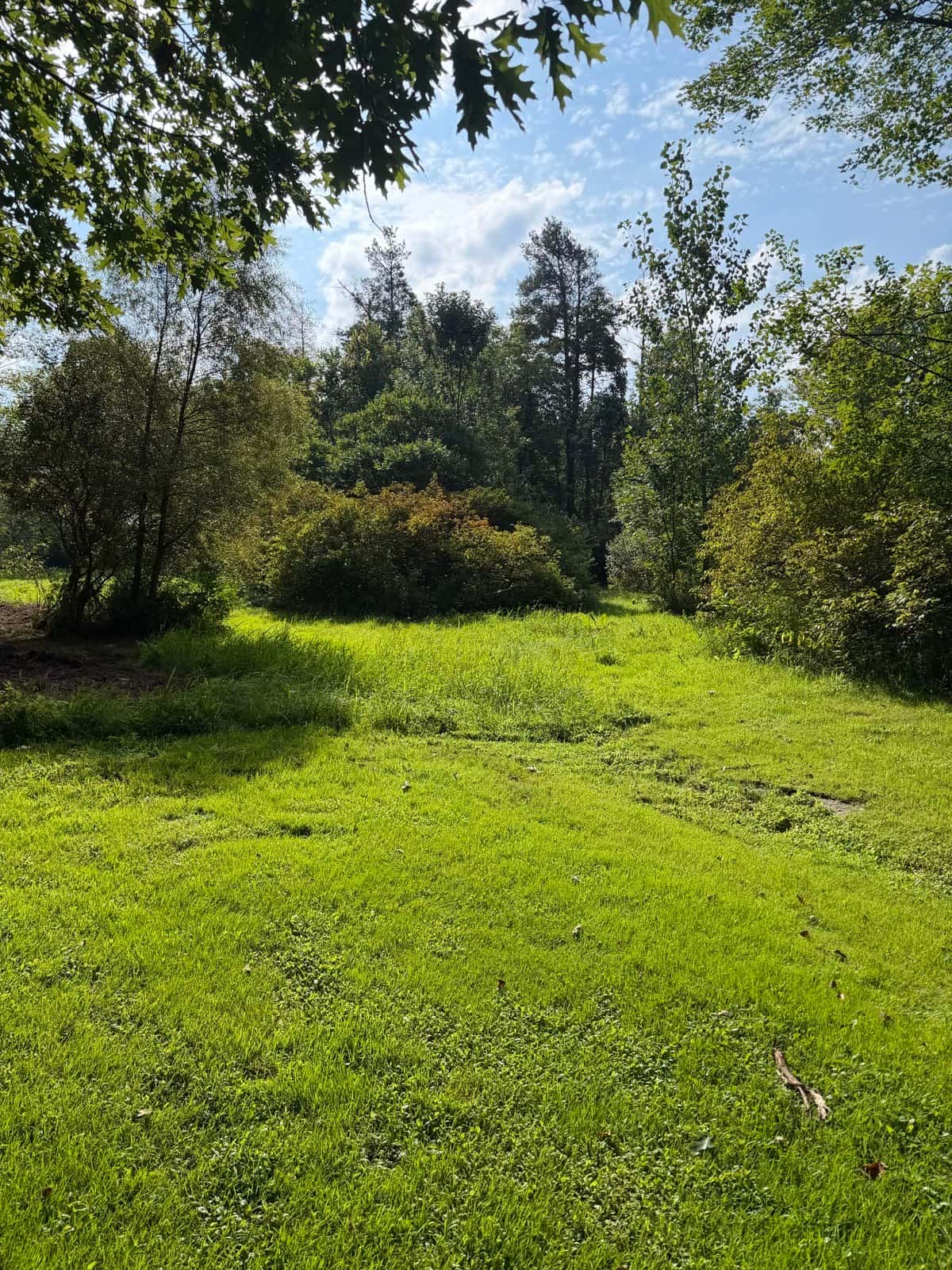 Actual BrushBoss footage · September 2026
Northeast Ohio · Woodland recovery
Real work. Real footage.
See past the tangle.
Brush and vines fill the space beneath your good trees. Start with the ground you want to use again.
Follow the transformation
Lake County runs in bands from the shore inland, and the band a property sits in decides the job. The Lake Plain along the water is flat, sandy and mostly built. Behind it the Escarpment climbs in a belt one to three miles wide. South of that the Allegheny Plateau rises past 1,200 feet in the corner of Leroy Township. Three kinds of ground inside a twenty-minute drive.
The middle band is where the acreage is. Concord, Leroy, Kirtland and the estate villages of Kirtland Hills and Waite Hill sit on moraine and plateau ground with deep parcels, wooded ravines and long boundaries — the shape that closes in from the edges while nobody is watching.
Nursery country is its own problem entirely. Perry, North Perry and Madison hold one of the densest concentrations of ornamental growers in the country, and on those properties the overgrowth is in the windbreak lines, the field margins and the escaped stock, not in any woodlot. A job there is laid out along linear edges rather than in blocks.
The river corridors carry the hardest material. Japanese knotweed runs the Grand River through Painesville and Madison, and it comes back from any root fragment left behind. Anyone quoting knotweed as a one-visit job has not finished one.
What the Work Looks Like in Lake County
Forestry Mulching
Brush, thorn and crowding saplings ground into a mulch layer beneath the trees you keep, $2,000 to $2,990 per acre by density. On the plateau townships where drift is thin and stone sits close to the surface, grinding at grade is the only clean method.
How mulching works →Invasive Removal
Knotweed on the Grand River, phragmites in the wet ground behind the Mentor beach ridges, honeysuckle under the estate canopy at Kirtland Hills and Waite Hill. Different species, different finishes, and a written regrowth plan on every one.
Invasive species →Field Edge and Windbreak Work
Linear clearing for the nursery and vineyard belt, where the encroachment sits in the rows and margins rather than in a block of woods. A flat per-acre rate for ground that still cuts. A working nursery or vineyard is quoted as commercial work, on scope.
Brush hogging →Pasture Recovery
Leroy and Concord hold a lot of ground that was open within living memory and is now thorn and thicket. Reverting pasture clears differently from woodlot, and it is usually cheaper than owners expect.
Land clearing →Ravine and Slope Work
The Chagrin and Grand River banks and the Paine Creek gorge are steep and thickly wooded, with unstable till on the deeper valley sides. Cleared with nobody on the hill, up to 55 degrees, $3,900 to $5,100 per acre, and an edge walked before anything goes near it.
Slope work →Trail Cutting
Ten-foot lanes through wooded acreage for access, riding or hunting, $2,000 to $2,600 per acre, finished walkable rather than left as a rutted track.
Trail cutting →Lake County Communities We Serve
Twelve communities, each with its own page. The line under each is what the ground is actually like there — Mentor and Leroy are barely the same county.
Concord
Little Mountain and the Euclid Moraine, cut through by Ellison and Big Creek. Parcels tend to straddle a creek cut, so there is usually a back section nobody has walked.
Kirtland
Thin till over sandstone, with rock in the road ditches and cliffs at Chapin Forest. Streams have cut straight to bedrock and the valley walls are steep.
Kirtland Hills
Estate ground on subdued moraine, shaped by the East Branch Chagrin ravines. Honeysuckle under good canopy is the whole problem here.
Leroy
The least built township in the county, and the deepest ground in it at the Paine Creek gorge. Mostly reverting pasture rather than woodlot.
Madison
Two counties in one township — flat sandy lake plain to the north, ground moraine climbing south, with the Painesville Moraine at its most pronounced between them.
Mentor
Lake plain, beach ridge and marsh. The fastest regrowth in the county, and phragmites in the wet ground behind the ridges.
North Perry
A narrow strip of sandy plain between the moraine and the shore. Nursery and vineyard country, where the growth is in the windbreaks and field edges.
Painesville
Where the plain meets the Grand River. The corridor and its steep wooded banks carry the growth; the knotweed on that river is the county's hardest finish.
Perry
The Painesville Moraine at its most hummocky, knolls to twenty feet with breached kettles between. Fencerows carry the heaviest invasive load.
Waite Hill
Small, wooded and almost entirely private, laid out around the Chagrin headwater ravines. Long wooded edges relative to open ground.
Willoughby
Mostly built on the plain, but the southern edge climbs onto thin drift and the Chagrin runs through in a cut valley with wooded banks.
Willoughby Hills
The steepest sustained slope in the west of the county, terraces stepping down to the river with abrupt wooded walls between them.
Working in Lake County — What People Ask
Why is my lakefront town not on the list?
Eastlake, Willowick, Wickliffe, Timberlake, Lakeline, Grand River, Fairport Harbor and Mentor-on-the-Lake are dense lakefront suburbs on small platted lots, and there is very little overgrown acreage to recover in them. Writing a land-recovery page about each would be padding. If you are in one of them and have real ground behind the house, ring us and we will tell you straight whether it is worth a visit.
What does a Lake County job cost?
Woodland restoration runs $2,000 to $2,990 per acre by density, and reverting pasture usually lands nearer the bottom of that than owners expect. Brush hogging is a separate mowing service at its own flat rate. Trails are $2,000 to $2,600 per acre. The steep river banks and gorge ground is $3,900 to $5,100 per acre. Below an acre it is flat: $295 for a driveway or fence line, $495 for a strip, $750 for a corner or back edge. No project minimum, and the number comes before anything starts.
Can you deal with the knotweed along the Grand River?
Yes, and we will be honest about what it takes. Knotweed regenerates from root fragments, so one clearing is not a finish — it is the start of a plan. Every knotweed job we quote carries a written follow-up schedule, because grinding a stand once and leaving simply resets it.
Do you work nursery and vineyard properties?
Regularly. The layout is different from a residential job: the work runs along windbreak lines, block edges and field margins rather than across an area, and escaped ornamental stock is a bigger share of the problem here than anywhere else we work. We quote it by the linear layout, not by an area guess.
When is the best time to schedule?
Frozen ground and a dry late-summer stretch are the two clean windows. On the lake plain the constraint is drainage rather than slope, so saturated spring ground is worth waiting out — we will move a date rather than leave ruts across a field you have to look at all year.
Is anything burned or hauled off?
Neither. Standing material is ground into a mulch layer where it grew. No burn permits to chase, no dump trailers going past the neighbours, and no tipping fees hidden in the line items.
More From BrushBoss
You own the land. You just cannot use it.
That is one layer of brush, and it comes off in a morning.
We'll tell you what it costs. From $295, no project minimum.
Ground you can walk without watching your step — because we take the cover out.
Without losing a tree worth keeping.