Land Clearing & Forestry Mulching
Bainbridge Township, OH
We give you your land back, and we make it safe to use.
Draw Your Clearing Area ↗About this service in your area
Bainbridge Township zones much of its open residential land R-5A, five-acre minimum lots, and BrushBoss recovers the wooded part of those parcels that owners have stopped using. On five acres the house and lawn are a small fraction; the rest is hardwood that has filled underneath with honeysuckle, rose and saplings until the view and the walk are both gone. We remove that layer and leave the oaks, maples and hickories standing, so the woods read like a park rather than a thicket. The township's riparian rules set buffers of 25 to 120 feet by stream size, and we flag them before pricing. Acreage is from $2,000 per acre; small work from $295.
Land clearing · Bainbridge Township, Geauga County
Who does land clearing in Bainbridge Township, Ohio?
BrushBoss does. We take overgrown woods, fields and lots in and around Bainbridge Township back from the brush, thorn and poison ivy, and hand them back as ground you can walk and use again. Bainbridge Township zones much of its open residential land R-5A, five-acre minimum lots, and BrushBoss recovers the wooded part of those parcels that owners have stopped using.
Clearing woods and fields runs $2,000 to $2,990 an acre on most ground, depending on how thick the growth is. Smaller jobs are flat-priced from $295, and you get the number before anything starts. Open fields that only need cutting back are brush hogged at $624 an acre.
Land recovery and property protection · Northeast Ohio
We give you your land back, and we make it safe to use.
The brush, thorn and poison ivy that grew up under your good trees comes out, and what you get back is ground you can walk without watching your step.
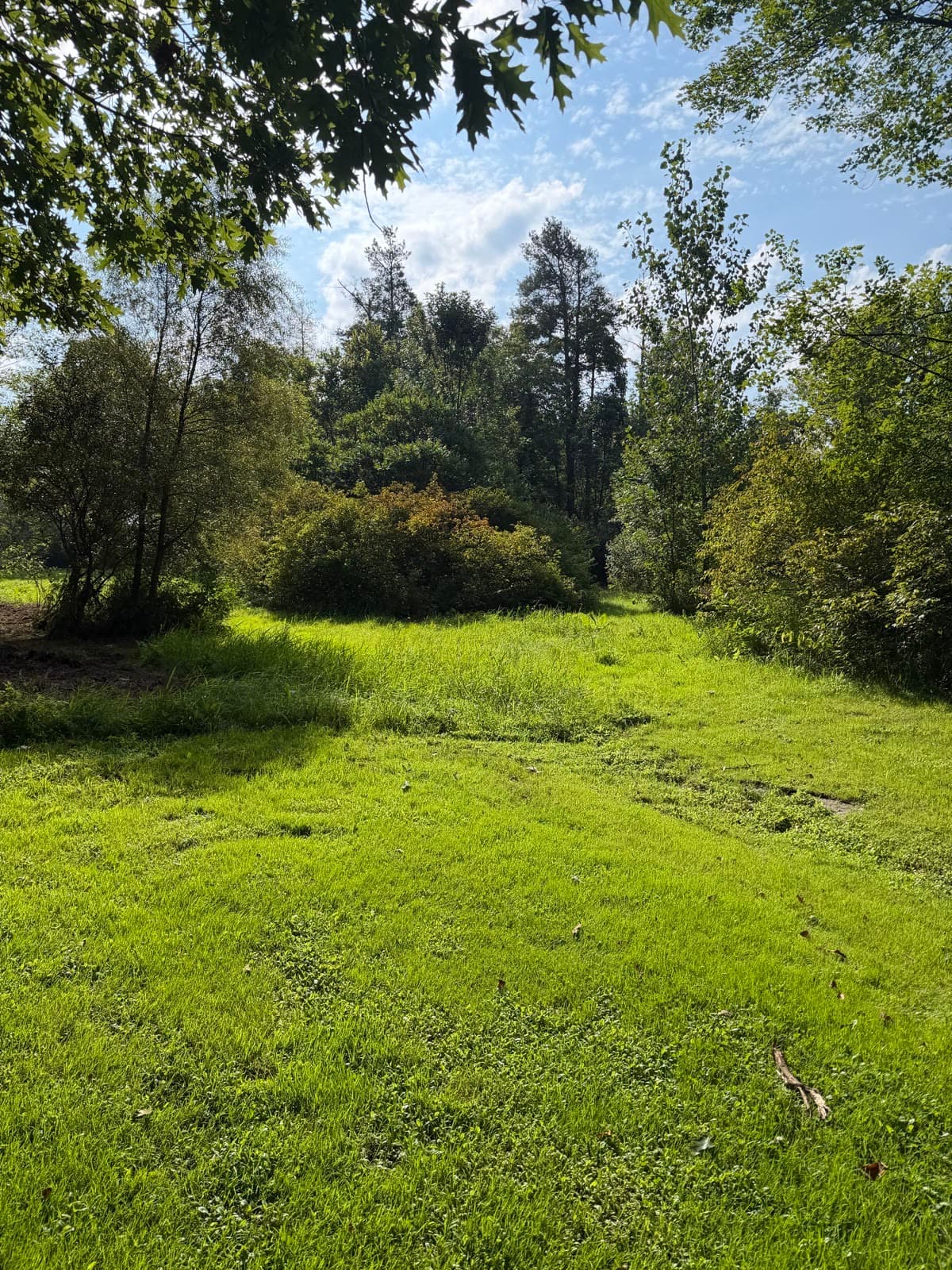 Actual BrushBoss footage · September 2026
Northeast Ohio · Woodland recovery
Real work. Real footage.
See past the tangle.
Brush and vines fill the space beneath your good trees. Start with the ground you want to use again.
Follow the transformation
Bainbridge Township's Unique Land Challenges
Bainbridge Township's landscape is a mosaic of mature woodlands, open fields, and residential areas, often characterized by gently rolling hills and fertile, sometimes clay-heavy, soils. These conditions, combined with ample rainfall, create a challenging environment where vegetation grows rapidly. Properties along the Chagrin River watershed or near protected natural areas frequently contend with dense, woody undergrowth that quickly overwhelms fences, trails, and even usable yard space.
The pressure from invasive species is particularly acute across Bainbridge Township. Honeysuckle forms dense, shading thickets that suffocate native wildflowers and tree saplings, while multiflora rose creates thorny, impassable barriers along property lines and in wooded sections. Autumn olive rapidly colonizes open fields and forest edges, diminishing biodiversity and usable acreage. Forestry mulching turns these nuisances into nutrient-rich ground cover, helping to slow their return.
Property types in Bainbridge range from sprawling multi-acre residential lots and equestrian properties to more suburban parcels that still retain significant natural buffers. Whether you're looking to prepare a site for a new home near Kenston Lake, reclaim an overgrown pasture off Messenger Road, establish new walking trails through your private woods, or simply enhance the aesthetic appeal of your property by clearing dense brush, our services are tailored to meet the diverse demands of the community.
Bainbridge has the most demanding clearing rules in the county alongside Russell. It carries 120/75/25-foot riparian setbacks under Chapter 160 of its zoning, it is an NPDES Phase II community, and the 300-square-foot soil-disturbance trigger applies. Its code also defines the vocabulary precisely — 'earth or soil disturbing activity' explicitly includes clearing, grubbing and stripping, and 'land development activity' explicitly includes removal of vegetation.
The terrain is why. About 12% of Bainbridge has bedrock within five feet — concentrated in the north-west quadrant — and roughly 1,120 acres sit on slopes steeper than 25%, the largest steep-ground inventory documented in Geauga. Elevation ranges about 440 feet across the township. Roughly 75% of the soil is rated slow or very slow permeability, which is why Bainbridge has more mapped drainage ditch than mapped natural creek.
What We Clear in Bainbridge Township, OH
Forestry Mulching
Overgrown brush and crowding saplings ground into a finished mulch layer beneath the trees you keep. No burning, no hauling, no soil disturbance. Bainbridge carries some of the deepest glacial drift in the county — over 300 feet south of Chagrin Falls — so there is soil to work with and stumps grind clean rather than riding on rock.
Brush Clearing
Briars, thickets, and woody growth a mower cannot touch — converted to ground cover that suppresses regrowth while it feeds the soil. Bainbridge brush is mostly the wooded edge between large lots and the Chagrin ravines.
Lot Clearing
Building envelopes, driveways, and septic fields cleared to your survey stakes with topsoil intact, before the excavator arrives. Ground falls toward the Chagrin River corridor, and the valley walls are steep enough that clearing order matters: we take the slope last so nothing washes while it is bare.
Fence Line Clearing
Buried fence rows reclaimed on both sides — posts and wire exposed, with a clean mulched strip a mower can hold from now on. Property-line fences here often run straight into ravine heads; those sections get cleared on foot before the machine follows.
Trail Cutting
Walking loops and ATV routes cut through your own woods with a mulch footing that stays walkable in wet weather. The ravines feeding the Chagrin are the reason most Bainbridge trails need a contour route rather than a straight line down.
Invasive Species Removal
Honeysuckle, multiflora rose, and autumn olive thickets taken to grade — with a written follow-up plan for the regrowth the first season brings. River corridors move invasive seed faster than open ground, and the Chagrin runs right through it.
FAQ — Bainbridge Township, OH
Our land clearing services in Bainbridge Township are typically priced per acre, with the final cost influenced by factors like the density and type of vegetation, and the terrain. Densely overgrown areas with tough invasives will naturally require more effort than lightly wooded parcels. We provide transparent, fixed written quotes after a free, on-site property walk-through, ensuring you know the exact cost upfront without any hourly surprises.
Yes, forestry mulching works safely and effectively on varied terrain, including the gently sloping banks often found near the Chagrin River and its tributaries in Bainbridge. Our process is low-impact, helping to stabilize soil and prevent erosion by leaving a protective layer of mulch, which is crucial for sensitive riparian zones.
Absolutely! BrushBoss proudly serves all areas of Bainbridge Township, from properties near the historic Town Hall and the Kenston Schools campus, out to more rural parcels along Snyder Road, Bell Road, and Messenger Road. Whether you're closer to US-422 or tucked away near the Geauga County line, we bring our expert land clearing services right to your doorstep.
After mulching multiflora rose and honeysuckle to ground level, the resulting wood chip layer acts as a natural weed barrier, suppressing immediate regrowth. For persistent invasive species, we can discuss follow-up, which often means monitoring and a return visit to cut sprouts back. Our goal is not just to clear, but to provide a foundation for long-term control and a healthier native landscape.
Yes. Bainbridge has some of the deepest glacial drift in the county and the ravines feeding the Chagrin are steep, so we clear the slope last and work across the grade rather than up it. That keeps bare ground from washing before cover re-establishes.
It depends on the stream's drainage area. Bainbridge's Chapter 160 sets riparian setbacks of 120 feet each side for watercourses draining 20 square miles or more, 75 feet for half a square mile to 20, and 25 feet for smaller streams with a defined bed and bank. Setbacks must be preserved in their natural state, so healthy trees inside them generally cannot be cleared without a variance. Damaged or diseased trees are treated differently. We establish that line before quoting rather than after.
Because slope and drainage are different problems. Around three-quarters of Bainbridge soil is rated slow or very slow permeability — under 0.2 inches per hour — so water runs across the surface instead of soaking in, and collects wherever the grade flattens. That is also why the township has more mapped ditch than natural creek. Clearing without planning where the water goes usually makes it worse, not better.
It gives you the woods back. With five-acre minimums across much of Bainbridge, most of a typical parcel is hardwood, and beneath it honeysuckle, rose and saplings have usually taken over. We take out that undergrowth and leave the oak, maple and hickory, so you can see deep into the woods and walk them again. The township's code treats removal of vegetation as land development activity, and its soil-disturbance trigger is just 300 square feet, so the paperwork is settled before any work starts.
Yes, where the pasture is still grass with lighter growth coming through. Whether the field is off Messenger Road or elsewhere in the township, brush hogging keeps riding and grazing ground open from one season to the next, for $624 an acre with one acre as the minimum. Much of the township drains slowly, so fields are cut once they are firm. Where autumn olive has claimed the field edge, that section is cleared ahead of the rest.
Price Your Clearing In Two Minutes
Pull up your address on a satellite image, click around the area you want cleared, answer a few questions about the growth, and get a per-acre estimate on screen — no site visit, no phone tag. Overgrown acreage, invasive brush, fence lines and trails, mulched in place with no burn piles and no haul-off.
Per acre on flat terrain, by brush density. Fixed written quotes after a free property walk — no hourly meters.
Draw Your Clearing Area ↗