Forestry Mulching & Land Clearing FAQ
Forestry mulching in Northeast Ohio costs from $2,000 per acre, and small jobs are flat-priced from $295 with no project minimum. Below: straight answers on cost, timing, the roots of the trees you keep, insurance, invasive brush and permits.
Land recovery and property protection · Northeast Ohio
We give you your land back, and we make it safe to use.
The brush, thorn and poison ivy that grew up under your good trees comes out, and what you get back is ground you can walk without watching your step.
From $295 for an afternoon's work to full estate restoration.
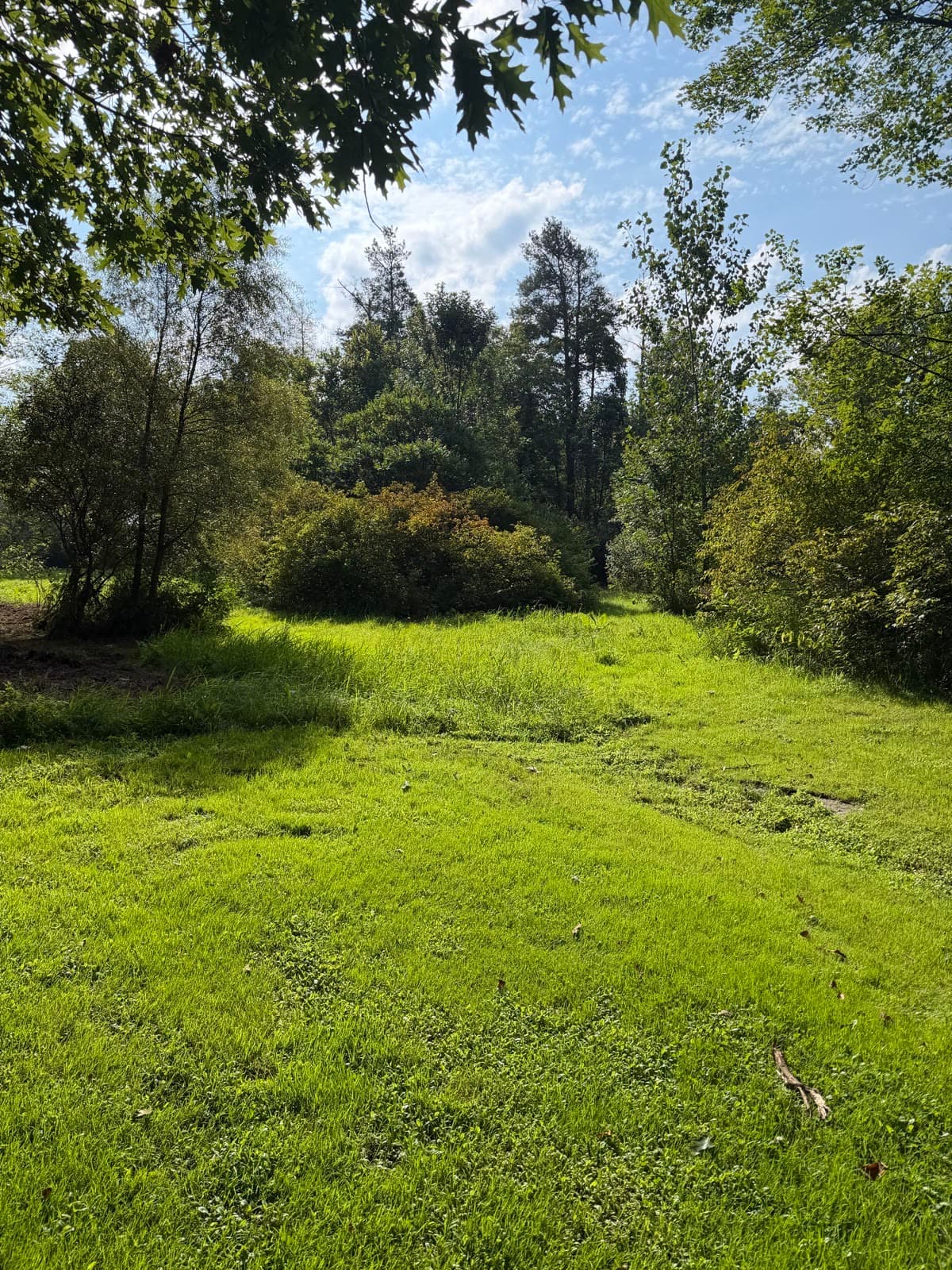 Actual BrushBoss footage · September 2026
Northeast Ohio · Woodland recovery
Real work. Real footage.
See past the tangle.
Brush and vines fill the space beneath your good trees. Start with the ground you want to use again.
Follow the transformation
How much does forestry mulching cost per acre in Ohio?
Standard forestry mulching in Northeast Ohio runs $2,000 to $2,990 per acre depending on brush density. Light brush (saplings and grass) is at the lower end, dense, long-neglected understory is at the top. There is no project minimum — smaller areas are flat-priced instead, from $295 for a driveway or fence line up to 500 sq ft. Volume discounts apply starting at 2.25 acres and scale up to 20% off for projects over 10 acres.
Is there a minimum charge for land clearing?
No. Small jobs are flat-priced instead — $295 for a driveway, fence line or corner up to 500 sq ft, $495 for a longer strip, $750 for up to a quarter acre. We used to carry a $995 minimum to cover trailering the machine out for one small job. We now recover that by working a whole road in a day rather than charging one neighbour for the trip, so the small work is genuinely available at those prices.
Do you offer volume discounts for larger properties?
Yes. Projects from 2.25 to 5.24 acres receive 10% off the per-acre rate. Projects from 5.25 to 9.99 acres get 15% off. Projects over 10 acres receive 20% off. These discounts are applied automatically in your quote because larger projects mean fewer mobilizations per acre and more efficient machine time.
What payment methods do you accept?
We accept all major credit cards, debit cards, and ACH bank transfers. A deposit is collected when you approve your proposal, with the balance due upon completion. Card payments are billed at the listed price — we do not add a card surcharge. Paying by bank transfer (ACH) earns a 2.5% discount off the listed price. We do not accept personal checks as deposits.
What is the difference between forestry mulching and brush hogging?
Forestry mulching grinds standing trees, brush, and stumps into fine mulch where they stand. It takes out the brush and saplings under the trees you keep and leaves a clean, walkable surface. Brush hogging is heavy-duty mowing that cuts tall grass, weeds, and light brush at ground level but cannot process trees, thick brush, or stumps. Brush hogging is maintenance mowing. Forestry mulching is permanent land transformation.
What size brush and trees do you clear?
Brush, thorn, vines and saplings, and trees up to about eight inches in diameter at the base — which covers almost all residential overgrowth in Northeast Ohio. The stumps of what comes out are ground down to ground level and everything becomes a mulch layer on site. Larger trees are usually the ones worth keeping, so they stay standing; where a larger tree does need to come down, it is named in your written scope first and cut and stacked rather than mulched.
Can you remove invasive species like honeysuckle and autumn olive?
Yes. Forestry mulching is the most effective mechanical removal method for bush honeysuckle, multiflora rose, autumn olive, Bradford pear, and other invasive woody species common throughout Ohio. Mulching grinds the entire plant including the root crown, and the resulting mulch layer blocks sunlight to suppress regrowth. Cut stumps of persistent species resprout, so plan on a follow-up for any regrowth in the first seasons — cut back while it is still soft, or treated by a licensed applicator.
How do you quote projects without a site visit?
We use satellite imagery and county property records to measure your land, assess brush density, identify access points, and calculate terrain slope. Combined with a 15-minute phone call and a few photos from you, this gives us everything needed for an accurate fixed-price proposal. About 90% of residential projects are quoted entirely from satellite assessment. Complex sites or projects near structures may require a brief on-site walkthrough.
How long does it take to clear an acre?
Most residential jobs are completed in a single day. Light brush with grass, weeds, and small saplings takes 4 to 6 hours per acre. Medium brush with mixed saplings and honeysuckle takes 6 to 8 hours. Dense brush with mature understory can take 8 to 12 hours. Multi-acre projects may span two days. We provide a specific time estimate with every quote.
Will the work damage my lawn or the ground?
No. The work is light on the ground, so it leaves no ruts in the lawn you cross to get there and no torn soil under the trees you keep, and slopes up to 55 degrees are worked with nobody on the hill.
Can you work around trees I want to keep?
Yes. We work within inches of the trees you are keeping and leave them untouched. Before every job, we walk the property with you and flag any trees, landscaping, or structures to protect. Selective clearing is one of the biggest advantages of forestry mulching over bulldozer clearing, which takes everything in its path.
Will forestry mulching hurt the trees I keep?
Not when the work respects the root zone. Most of a mature tree's large roots sit in the top six to twenty-four inches of soil and reach well past the drip line (Colorado State University Extension), so the injuries that follow clearing come from compacted soil over the roots, bark torn at the trunk or flare, and mulch heaped against the trunk. The understory is taken down around a kept tree, not dug out from under it; the roots of what is removed stay in the ground; the mulch lies thin, in the two-to-four-inch range ODNR recommends; and wooded ground is best worked firm or frozen, late autumn through March. The full answer, with sources, is on the woodland restoration page.
Is BrushBoss insured?
Yes. BrushBoss is insured, and a certificate of insurance is available on request — ask for it before any work starts, as you should of anyone clearing your land. Every job is quoted in writing at a fixed price first, and every clearing project includes a workmanship guarantee: if we miss material within the agreed clearing zone, we come back and finish — free.
How do I choose a brush clearing or forestry mulching contractor in Northeast Ohio?
Choose on what you can check before anyone arrives: a certificate of insurance you have seen, a written fixed-price scope that names what comes out and what stays, an agreement on which trees are kept and how their roots are protected, a plain answer about what happens to the material, and timing that suits the ground — leaf-off, firm or frozen. Be wary of hourly billing with no ceiling and of anyone promising the brush will never come back; woody invasives resprout, and in Ohio anyone applying herbicide on your property for hire must hold a pesticide applicator licence. The full checklist is on the compare page.
Can you mulch on steep slopes?
Yes, up to 55 degrees. Gentle and moderate slopes are worked like any other ground. On banks and ravines too steep to walk, nobody works on the hill itself — the operator stays at a safe distance at the top. The same approach is used on highway embankments, utility corridors, and dam faces.
What happens to the debris after mulching?
Everything is ground into mulch on-site. Trees, brush, stumps, and vines are processed into a 2 to 4 inch layer of organic material that stays on the ground. No burning, no hauling, no dumpster fees. The mulch decomposes naturally over 12 to 18 months, returning nutrients to the soil and suppressing weed regrowth. Most customers are surprised there is nothing to clean up when we leave.
Do I need a permit for land clearing in Ohio?
Most residential clearing on your own property in Ohio does not require a permit. However, permits may be required if you are clearing near wetlands or streams (50 to 100 foot buffer zones), within a municipal tree protection zone, on erosion-prone sites, or disturbing more than one acre (which triggers Ohio EPA erosion and sediment control requirements). We assess permit requirements as part of every satellite assessment and advise you before work begins. See our full Ohio permit guide for details.
Will brush grow back after mulching?
Some regrowth is natural, especially from root systems of aggressive species like honeysuckle and autumn olive. The mulch layer suppresses most regrowth by blocking sunlight. For the best long-term result, we recommend seeding the cleared area with grass or clover within 30 days of mulching. Established ground cover competes with brush seedlings and makes it much harder for new growth to take hold. We provide guidance on follow-up seeding and maintenance with every project.
Every price above comes from one published schedule — the pricing page has all of it. To ask something not covered here, book a walk-through.
Stop Wondering. Price The Job Now.
Every question above comes down to what your property costs. Pull up the address and get that number right now — no site visit, no waiting.
You own the land. You just cannot use it.
That is one layer of brush, and it comes off in a morning.
We'll tell you what it costs. From $295, no project minimum.
Ground you can walk without watching your step — because we take the cover out.
Without losing a tree worth keeping.