How to Clear Overgrown Land: The Landowner’s Playbook
By Kyle Abbey · ·
To clear overgrown land, decide what stays before anything is cut, then match the method to what is growing: hand tools for small patches, brush hogging for grass and light brush, forestry mulching for thickets and saplings under trees you want to keep, and a dozer only when the ground is being stripped bare to build on. Do it between late fall and winter, when the leaves are down and the ground is firm, and plan on following up for the first few seasons. This guide walks that order for a Northeast Ohio estate owner: what to flag, which rules apply, how to handle poison ivy and the brush pile, and when to hire it out.
Instant QuoteLand recovery and property protection · Northeast Ohio
We give you your land back, and we make it safe to use.
The brush, thorn and poison ivy that grew up under your good trees comes out, and what you get back is ground you can walk without watching your step.
From $295 for an afternoon's work to full estate restoration.
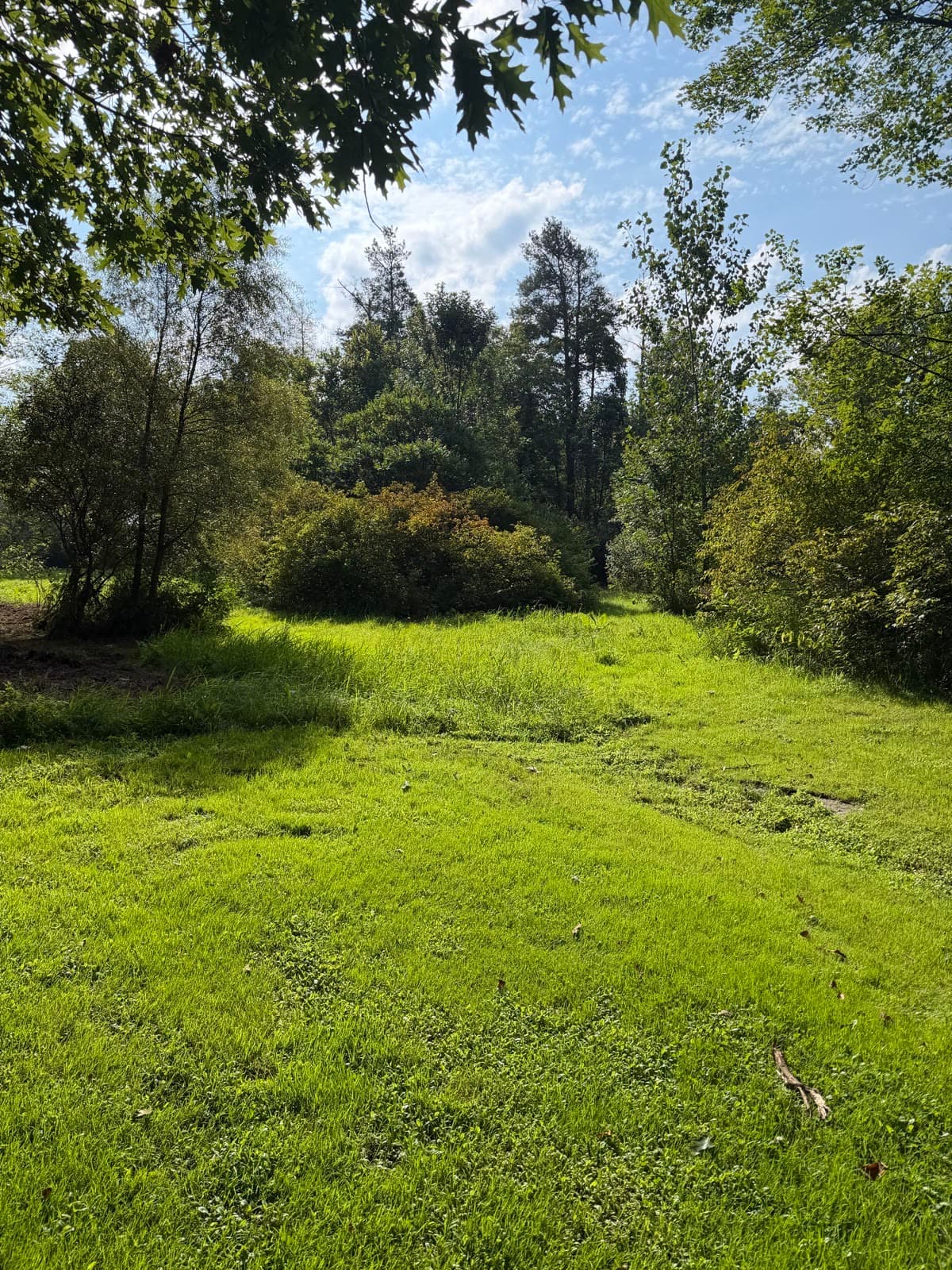 Actual BrushBoss footage · September 2026
Northeast Ohio · Woodland recovery
Real work. Real footage.
See past the tangle.
Brush and vines fill the space beneath your good trees. Start with the ground you want to use again.
Follow the transformation
What should you decide before anything is cut?
What the ground is for. A park-like woods you can walk through, a pasture taken back, a pond you can see from the house and a building site are four different jobs, even on the same acre, and each keeps different things. Say it first, because every later choice — method, season, what stays — follows from it.
Then walk the whole parcel with that goal in mind, ideally with the leaves down, when trunks, stone walls and old fence wire show. Take flagging tape. The walk is the cheapest hour of the project, and the one most often skipped.
Which trees are worth keeping?
Flag them before anything else happens. The trees that make a property feel like an estate are usually already there — oaks, sugar maples, a shagbark hickory, a beech at the edge of a clearing — lost behind a wall of brush that grew up underneath them. Tie tape at eye height on every one you want, and on the young trees you would like to become the next generation.
- Keep: healthy native hardwoods with a clear trunk and a full crown, and any tree that frames a view you want.
- Question: trees leaning over the house, drive or a fence line; dead trees you might leave standing well away from paths for wildlife.
- Remove: the understory crowding the keepers — the thorny, the tangled and the fast-growing shrubs that have closed the view.
A good contractor walks the flags with you and repeats them back. Anything not flagged is a conversation, not an assumption.
Where are the property lines?
Find the survey pins, or have a surveyor stake the line if they are gone. Ohio takes this seriously: under Ohio Revised Code 901.51, anyone who recklessly cuts down or injures a bush, shrub, sapling or tree on the land of another is liable in treble damages. A fence line that wandered decades ago is exactly where that happens. When the line is uncertain, clear to a few feet short of it and talk to the neighbour first.
What about streams, wet ground and ponds?
Mark them on the walk and leave a buffer. Vegetation along a stream or wetland holds the bank, and clearing inside that strip can bring state or federal review into what was a private project. Buffers of 50 to 100 feet are common, and some counties and townships set their own. Our Ohio land clearing permits guide covers the setbacks, the one-acre soil-disturbance threshold and when a local zoning call is worth making.
Wet ground also sets the calendar. Soft soil ruts under any heavy equipment, and spring in Northeast Ohio is soft for weeks. Frozen or dry, firm ground is when that part of the property should be worked.
Does nesting season or bat season matter?
On wooded ground in Ohio, yes, and it points to the same answer as everything else. The endangered Indiana bat and northern long-eared bat roost in trees across the state in summer. The U.S. Fish and Wildlife Service Ohio Field Office recommends that trees of three inches in diameter or more be cut between October 1 and March 31, outside what its Ohio bat guidance calls the bat active season. Brush and thickets are also where songbirds nest in late spring and summer, and active nests of most native birds are protected under the Migratory Bird Treaty Act.
A private residential project with no federal permit or funding is rarely reviewed by anyone. Working from late fall through winter simply keeps the question from arising — and it is the best season for the work on every other count too.
Which clearing method fits what is growing?
Match the method to the material and the scale, not to what happens to be in the barn. Almost every disappointing clearing job is a tool built for one kind of growth used on another: a mower sent into a thicket, or a bulldozer sent into woods the owner wanted to keep.
| What is growing | Scale | Method | What it leaves |
|---|---|---|---|
| Seedlings, vines, a few shrubs | A patch, a bed, a fence corner | Hand tools and a weekend | Cut stems; roots in place |
| Tall grass, weeds, finger-thin brush | Open ground, fields | Brush hogging | A rough-mown field |
| Thickets, briars, crowding saplings | Under standing trees, or open ground | Forestry mulching | Trees kept, a mulch layer, walkable ground |
| Everything, including trees and stumps | A building pad or full site | Dozer clearing | Bare soil, brush piles, grade work |
When is hand work enough?
For small patches and young growth, it is the right answer. Loppers, a pruning saw and a good pair of gloves will clear seedlings, vines and a few shrubs from a garden edge or a stone wall in an afternoon. Young bush honeysuckle and other shallow-rooted shrubs can often be pulled whole when the soil is moist. Hand work is also the best follow-up tool you own, for the years after any larger clearing.
When is brush hogging the right call?
When the ground is open and the growth is grass, weeds and light brush — a hayfield gone rank, a meadow you mow once a year. It is quick and economical, and it gives the field a haircut rather than a reset: woody stems are knocked down and torn, and they come back. Our Brush Hogging page carries its flat per-acre rate.
When is forestry mulching the right call?
When the problem is a thicket, or brush grown up under trees you want to keep — the typical Northeast Ohio estate edge. Prickly briars, scrub and the unwanted trees crowding your good ones go in one end, and clean mulched wood chips come out the other. Nothing is burned, nothing is hauled away, and no roots are pulled — the chips are spread where they fall and left as cover, so what you walk out onto is groomed rather than merely cut. Forestry mulching works around flagged trees one at a time, which is why it is the method for opening woods rather than removing them.
When does a site need a dozer, and what does that cost you?
Only when the goal is bare, graded ground: a house pad, a driveway cut, a pond dig. Pushing brush out with a blade takes the trees with it, pulls stumps and roots, and scrapes off the topsoil that took centuries to build. It leaves brush piles and bare soil, and across more than an acre that bare soil brings erosion-control requirements into play. For land you want to use rather than build on, land clearing without the blade keeps the soil and the trees in place.
When is the best time of year to clear overgrown land?
Late fall through winter. From mid-October the leaves come down and the structure of the woods appears — the trunks worth keeping, the dead trees, the old fence wire and stone walls. From December the ground firms or freezes, so it carries the work without ruts. Growth is dormant, songbirds are not nesting, and the work falls inside the October-to-March tree-cutting window. Our seasonal guide goes season by season.
Summer works on dry upland ground, and spring is the season to seed what winter opened. The only genuinely wrong season is next year: brush tends to close in a little further every season it is left.
What happens in the years after clearing?
Regrowth, then a choice about what fills the ground. Cut stumps of shrubs such as honeysuckle and buckthorn resprout from the crown, usually in the first season. Cut that regrowth back on a follow-up visit while it is ankle-high and soft; the first clearing knocks brush back, it does not finish it. Meanwhile, open, sunlit ground is an invitation, and whatever reaches it first wins. Seed native grasses into the open ground in early fall or spring, plant native shrubs at the woodland edge, and walk your edges each autumn with a pair of loppers.
Those first one to three seasons are the difference between land cleared once and land cleared every decade. Our guide to stopping brush regrowth after clearing covers them in detail.
How do you handle poison ivy safely?
Assume it is there: on overgrown Ohio ground it usually is, running under the brush and climbing the trunks as a hairy, rope-like vine. Its oil, urushiol, is released whenever the plant is cut, crushed or burned, and it travels.
- Wear long sleeves, long trousers, boots and gloves, and wash that clothing separately in hot water with detergent.
- Clean every tool afterwards with rubbing alcohol, or soap and plenty of water. The CDC notes urushiol can remain active on the surface of objects for up to five years — handles, gloves and boots included.
- Never burn it. The CDC’s instruction is direct: do not burn plants that may be poison ivy, poison oak or poison sumac, because inhaling the smoke can cause severe allergic respiratory problems.
Source: CDC/NIOSH, Poisonous Plants and Work. The same rules apply to the brush pile: anything with poison ivy tangled in it should not go on a fire.
What should you do with all the wood and brush?
Leave it on the ground as mulch, if the method allows. Forestry mulching turns the brush into a layer of chips where it stood, so nothing is piled, burned or hauled, and the layer covers the soil while it breaks down. Hand clearing and dozer clearing both leave you a pile, and a pile has three exits: chip it, haul it, or burn it.
Can you burn brush in Ohio?
Sometimes, under rules that rule out most estate settings. Ohio EPA does not allow residential open burning inside village or city limits, or in the zone around them. Outside those areas, brush from your own residence may be burned only at least 1,000 feet from any neighbour’s inhabited building, and never with poison ivy, plastics or building materials in the pile. Brush from a land-clearing job is treated separately and needs Ohio EPA’s written permission in advance. See the Ohio EPA open burning rules.
The calendar narrows it further. Under Ohio Revised Code 1503.18, outside municipal limits there is no open burning of brush between 6 a.m. and 6 p.m. in March, April, May, October and November — much of the clearing season. The ODNR open burning page summarises it, and your township fire department will have its own rules. On most wooded lots in Geauga County, mulching the material in place is simpler than any of this.
Should you clear it yourself or hire it out?
Do the edges yourself; hire the core. Seedlings, vines, a fence corner and every year of follow-up are genuinely good weekend work, and they are how you keep a cleared property looking the way it did on the first day.
The thicket itself is different. Renting heavy clearing equipment for a weekend means learning to run it on your own slope, among the trees you most want to keep, with a rental clock running and the damage deposit riding on every stump you do not see under the leaves. Dead standing trees are the genuinely dangerous part of any overgrown lot, and they are never a first-weekend project. Hand clearing a dense acre is a season of weekends, not one.
Hiring buys the part that is hard to rent: judgement about what to keep, and the job done in a day or two rather than a season. Most residential parcels are one to three days of work. If you want a second opinion on your own plan, send us the address and we will tell you which parts are worth doing yourself.
What does it cost to clear overgrown land?
With BrushBoss, small work is flat-priced and larger work is priced per acre by how dense the growth is. These are the same published numbers used everywhere on the site:
| Work | Price |
|---|---|
| A driveway or fence line, up to 500 sq ft | $295 |
| A strip, up to 1,000 sq ft | $495 |
| A corner or back edge, up to a quarter acre | $750 |
| Woodland restoration, per acre by density | $2,000 – $2,990 / acre |
| Slopes and banks, per acre | $3,900 – $5,100 / acre |
| Acres at a time | Quoted after a walk-through, volume rates apply |
No project minimum. Small jobs are flat-priced, larger work is priced by the acre, and you get the number before anything starts. The full breakdown, including what moves a price within its range, is on the pricing page.
The Recovery Sequence, Step by Step
- 01
Decide what the land is for: a walkable woods, a pasture, a pond view or a building site.
- 02
Walk and flag it: every tree worth keeping, the survey pins, streams and wet ground.
- 03
Check the rules: stream and wetland buffers, and the October-to-March tree-cutting window.
- 04
Match the method to the growth: hand work, brush hogging, forestry mulching or, for bare building ground only, a dozer.
- 05
Clear in the dormant season, late fall through winter, in one visit.
- 06
Follow up for one to three seasons, then seed or plant the open ground.
Frequently Asked Questions
Can I clear overgrown land myself?
The edges, yes: seedlings, vines, a fence corner and every year of follow-up are good weekend work. The thicket core is different. Rented heavy equipment has to be learned among the trees you most want to keep, dead standing trees are genuinely dangerous, and hand clearing leaves a brush pile you may not be allowed to burn.
How long does it take to clear overgrown land?
Most residential parcels are one to three days of professional work: a back edge in a day, a few mixed acres in two or three. The planning takes longer than the clearing — the walk, the flags, and a check on property lines and water — and the follow-up runs through the first one to three seasons afterwards.
What is the best time of year to clear overgrown land in Ohio?
Late fall through winter. The leaves are down from mid-October, so you can see what is worth keeping; the ground firms or freezes, so it carries the work without ruts; growth is dormant; and songbirds are not nesting. It also sits inside the October 1 to March 31 window the U.S. Fish and Wildlife Service recommends for cutting trees in Ohio.
Will the brush grow back after clearing?
Some of it, in the first season. Cut shrubs such as honeysuckle and buckthorn resprout from the crown. Plan on cutting that regrowth back on a follow-up visit while it is ankle-high, and on seeding the open ground so something you chose occupies it. The first clearing knocks brush back; the first few seasons of follow-up are what keep it open.