Brush Hogging vs Forestry Mulching: Which Do You Need?
By Kyle Abbey · ·
Brush hogging is heavy mowing for open ground, at a flat $624 per acre; forestry mulching is removal, taking brush, thorn and saplings down to the ground beneath the trees you keep, from $2,000 to $2,990 per acre. The first cuts grass, weeds and thin brush back to a stubble and is meant to be done again next season. The second is done once, with light follow-up while the roots settle. On an estate the difference shows in what is left behind. A mown woods keeps its damp leaf layer and a stubble of cut stems; a mulched woods has an open floor, light between the trunks and a view through to the back of the property. Plenty of properties want both, in that order: mulching once to take the woods back, then brush hogging to keep the open ground open.
Instant QuoteLand recovery and property protection · Northeast Ohio
We give you your land back, and we make it safe to use.
The brush, thorn and poison ivy that grew up under your good trees comes out, and what you get back is ground you can walk without watching your step.
From $295 for an afternoon's work to full estate restoration.
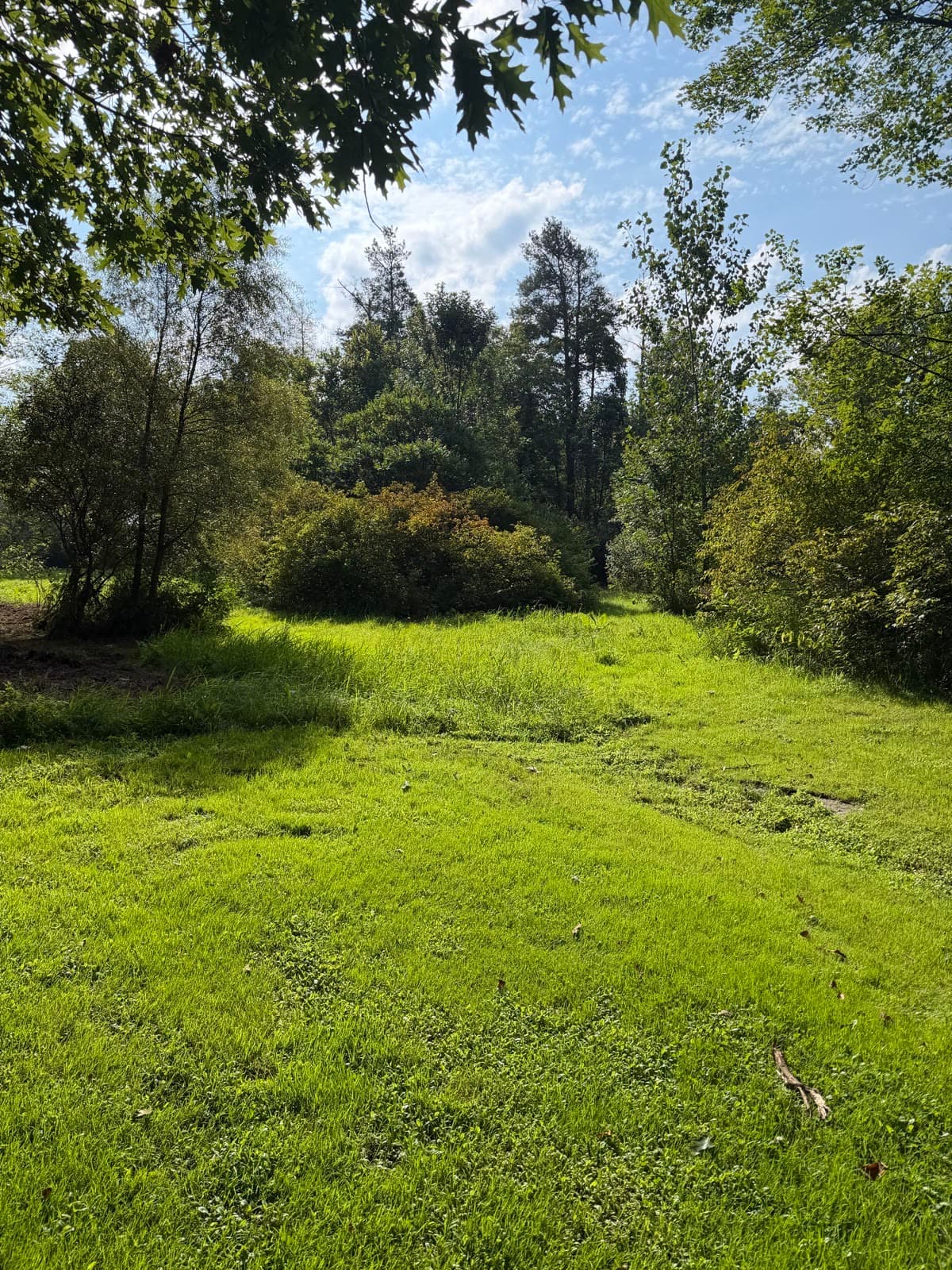 Actual BrushBoss footage · September 2026
Northeast Ohio · Woodland recovery
Real work. Real footage.
See past the tangle.
Brush and vines fill the space beneath your good trees. Start with the ground you want to use again.
Follow the transformation
What is the difference between brush hogging and forestry mulching?
Brush hogging mows. Forestry mulching removes. Everything else — the price, the look of the ground afterwards, how often you pay for it again — follows from that one distinction.
Brush hogging is mowing at the scale of a field. It cuts grass, weeds and light brush, nothing woody, drops the cut material where it falls, and leaves a stubble. It is quick and inexpensive per acre, and on open ground it is exactly the right service: a meadow that has grown tall, a paddock, a lot that needs keeping presentable, the verge along a long drive.
Forestry mulching works where a mower cannot. It takes standing brush, thorn and saplings down to the ground and turns them into a layer of wood chips spread where they stood. Nothing is burned and nothing is hauled away. Because it works stem by stem rather than in a swath, it can go into a woods and take the understory out while the trees you are keeping stay exactly where they are.
Mowing and removal, side by side
| At a glance | Brush hogging | Forestry mulching |
|---|---|---|
| What it handles | Grass, weeds and light brush, nothing woody | Brush, thorn and saplings, beneath the trees you keep |
| Where it works | Open ground: fields, meadows, lots, verges | Anywhere, including beneath trees you are keeping |
| What is left on the ground | Cut stubble over the existing leaf layer | An open floor under a layer of wood chips |
| How it looks afterwards | A mown field | Open woods: clear trunks, light, a view through |
| How often it is repeated | Once or twice a season, every season | Once, then light follow-up in the first seasons |
| Price | $624 per acre, flat | From $2,000 per acre, up to $2,990 by density |
What does each leave behind?
The difference is most visible the morning after. Stand at the edge of each and the two services could hardly look less alike.
After brush hogging: a mown field
Brush hogging leaves a stubble of cut stems with the clippings lying on top, and underneath, whatever was on the ground before. In a meadow that is exactly right — it reads as a field that has been looked after, and it greens up again as the season goes on.
Taken into a woods, it gives a different result. The mower tops what it can reach and leaves the rest: the damp, shaded leaf layer where it was, the cover ticks live in, a ring of growth around every trunk, and splintered stubs wherever it met a woody stem it was not built for. The woods is shorter, not opener.
After forestry mulching: the woods, opened
Forestry mulching leaves the look most estate owners are actually after: the trunks standing clear, light reaching the floor, and a line of sight through to the pond, the back fence or the neighbouring field. The chips lie as a groomed layer rather than as debris, and the floor opens to sun and air, so it dries. You can walk it in ordinary shoes, and see where you are putting your feet.
It is the European-woods look — mature trees kept, everything that grew up beneath them gone. More on how that work is done is on the forestry mulching page.
What neither one does
Neither service kills roots. Brush hogging leaves the whole plant in place below the cut, and forestry mulching, which takes the growth down to the ground, still leaves the root systems of woody invasives such as bush honeysuckle, buckthorn and multiflora rose able to resprout. That is why the first seasons after clearing matter, and why the right follow-up is part of the plan from the start. Our guide to stopping brush from growing back sets out what that looks like, season by season.
Which one do I need for my property?
Walk out to the growth and take hold of a stem. Thinner than your thumb, with grass around it, on open ground: brush hogging will handle it. Thicker than your wrist, woody, taller than you, or standing beneath trees you mean to keep: that is forestry mulching. Most properties sort themselves out within a minute of that test.
Brush hogging is the right call when…
- The ground is open — a field, meadow, paddock or lot — with no trees in the way.
- The growth is grass, weeds and thin brush, not established woody stems.
- You want the ground kept as it is, and you are happy to have it mown again next season.
- The ground was cleared recently and what is coming back is soft first-year growth.
Forestry mulching is the right call when…
- The growth is woody — saplings, thorn, bush honeysuckle, buckthorn — and past the thickness of your thumb.
- It is growing beneath trees you want to keep, and the aim is to see between them again.
- You stopped walking into that part of the property because you could not.
- You want the ground recovered once, not mown back to knee height every year.
You probably need both when…
Many estates in Northeast Ohio have a bit of each: an open meadow or lawn edge that has grown tall, running into a tree line that has filled in beneath. The sensible answer is to quote each area at its own rate — mulching for the woods and the thicket edges, brush hogging for the open grass — rather than pay woodland rates across the whole parcel. After that, brush hogging is often the tool that keeps the whole property looking cared for.
What does each cost?
Brush hogging is $624 per acre, flat. Forestry mulching is from $2,000 per acre, rising to $2,990 where the growth is densest. Both are fixed numbers for the acre, given to you before anything starts — neither runs on an hourly meter.
Brush hogging: one flat rate
The brush-hogging rate is $624 an acre, with a one-acre minimum, no density multiplier and no terrain surcharge, because open field work does not vary the way woodland work does. A tall meadow and a short one take much the same time. The full detail is on the brush hogging page.
Forestry mulching: priced by density
Woodland work is priced by how much is growing in it, because that is what sets the time on the ground. The band runs from light growth to dense, and the Land Clearing Cost Calculator prices your own ground anywhere along it:
| Density | What it looks like | Per acre |
|---|---|---|
| Light | Grass, weeds and small saplings | $2,000 |
| Medium | Mixed saplings, honeysuckle and multiflora rose | Between the two, priced in the calculator |
| Dense | Mature understory, thick vine cover, the heaviest stems | $2,990 |
Ground too steep to walk — creek banks, ravines, the fall of a pond edge — is its own work at $3,900 – $5,100 per acre. Everything else is on the pricing page, including the volume tiers for larger properties.
Smaller pieces of ground
Not every job is measured in acres. A fence line that closed in, a strip along the drive or the corner behind the garage is priced flat:
| Work | Price |
|---|---|
| Driveway or fence line, up to 500 sq ft | $295 |
| A strip, up to 1,000 sq ft | $495 |
| A corner or back edge, up to a quarter acre | $750 |
No project minimum. Small jobs are flat-priced, larger work is priced by the acre, and you get the number before anything starts.
Why the cheaper rate is not always the cheaper choice
Per acre, brush hogging is plainly the less expensive service, and on a field it is the right one. The arithmetic changes in a woods. Mowing a woody thicket does not remove it; it shortens it, and the stems come back from the same roots the following season. Paying the mowing rate every year to hold brush at knee height, and never getting the woods back, is the costly version. Paying once to take the understory out, and then the mowing rate on the open parts afterwards, is usually the economical one.
Can brush hogging keep cleared ground open afterwards?
Yes — and it is the best use of it once a woods has been mulched. What comes back in the first seasons after clearing is soft, young growth, exactly the material a mower handles well. On the open parts of a property — the meadow, the ground between the lawn and the tree line, the surround of a pond — brush hogging once or twice a season keeps light regrowth from ever becoming a mulching job again.
Timing helps. OSU Extension’s bush honeysuckle factsheet notes that cutting and mowing are most effective when started in early summer, when the plant’s food reserves are at their lowest. A pass then, and another later in the season if the growth warrants it, spends the roots’ reserves rather than simply trimming the tops.
What mowing can and cannot do after clearing
Be clear about what the follow-up achieves. Penn State Extension puts it directly: occasional mowing or brush hogging will suppress, but often not kill, invasive shrubs, because of their established, persistent root system. Mowing holds the ground open. It does not finish the roots, and the extension services pair it with other measures for persistent species — set out in our guide to stopping brush from growing back after clearing.
When is brush hogging the wrong tool?
Brush hogging is a good service used in the wrong place more often than any other. Three situations call for something else.
Standing saplings
Once the stems turn woody, thicker than your wrist, a mower is being asked to do something it was not built for. The usual result is splintered stubs rather than a clean cut, and the stumps resprout from the base regardless. Saplings are a mulching job: taken to the ground, and the stems turned into cover where they stood.
Thorn thickets
Multiflora rose and the other thorny brush grow into mounds a mower can only top. OSU Extension notes it can quickly form dense thickets over six feet high, and that stems in contact with the ground can root and become new plants. Knocking the top off leaves a mat of thorny canes on the ground and a crown that grows straight back. Taking the thicket down to the ground is the only version that gives you ground you can walk on.
Under the trees you are keeping
This is the estate case, and the clearest one. The whole point of the work is to keep the oaks, maples and beech and lose the tangle beneath them. A mower cannot get between trunks, cannot take the saplings standing among them, and leaves the damp, shaded leaf layer where it was. Taking the understory out stem by stem, around the trees you keep, is what forestry mulching is for.
How do I get a straight answer for my property?
Describe the ground, or send a few photographs, and we will tell you which service it needs — or which parts need which. BrushBoss offers both, so the answer is not shaped by what happens to be on the trailer. Get in touch here, or compare the full numbers on the pricing page.
The Short Version
- 01
Take hold of a stem: Thinner than your thumb, with grass around it, on open ground — brush hogging. Thicker than your wrist, woody, taller than you, or standing beneath trees you want to keep — forestry mulching.
- 02
Brush hogging is maintenance: It mows a field, a meadow or a lot back to a manageable height, and it is meant to repeat. Once or twice a season keeps open ground from reverting.
- 03
Forestry mulching is recovery: It takes the growth down to the ground instead of giving it a haircut, though woody roots can resprout and the first seasons still want a follow-up.
- 04
Used in that order, they work together: Mulch once to take the woods back; brush hog the open parts afterwards to catch the regrowth while it is still soft.
Frequently Asked Questions
Why is brush hogging so much cheaper than forestry mulching?
Because it is mowing, not removal. One flat rate — $624 per acre, no density multipliers — takes light growth on open ground back to a manageable height. It does not remove woody plants; it holds them back, which is exactly right for fields you keep on a schedule and the wrong tool for a woods you want to see into again.
My property has patches of both. Which do I book?
Both, usually in one visit. Forestry mulching takes the woody thickets and the tree line; brush hogging handles the open grass. Quoting each area at its own rate costs far less than paying woodland rates across the whole parcel.
If I keep brush hogging every year, will the brush eventually go away?
Usually not. Penn State Extension notes that occasional mowing or brush hogging will suppress, but often not kill, invasive shrubs, because of their established root systems. Mowing keeps woody growth short while the roots persist. If the aim is to get the woods back rather than hold a field, mulch once and use mowing as the follow-up on the open ground.
Can you brush hog under trees?
Not well. A mower works open ground; among trunks it leaves a ring of growth around every tree, cannot take the saplings standing between them, and leaves the damp leaf layer where it was. Clearing beneath trees you are keeping is what forestry mulching is for — the trees you are keeping are flagged and worked around.
Will forestry mulching stop the brush from coming back?
Not by itself, and nobody should promise that it will. Woody invasives such as bush honeysuckle and buckthorn resprout from the crown, and birds keep bringing in seed. What mulching does is turn a thicket into occasional ankle-high regrowth, which is cut back in the first seasons — on open ground, brush hogging is often the tool for it.