Tree of Heaven in Ohio: Identification and Removal
By Kyle Abbey · ·
Tree of heaven in Ohio is the fast-growing invasive tree with long compound leaves of ten to forty-one leaflets, each smooth-edged except for one or two small bumps at the base, pale smooth bark, and a strong rotten-peanut smell when a twig or leaf is crushed; it is often mistaken for sumac or black walnut. Cut it down and the roots answer with dozens of new stems, spread across more ground than the tree ever covered. This guide covers the two tests that separate it from black walnut in thirty seconds, the order of operations that works, what the clearing costs, and which native species go back into the ground afterwards.
Instant QuoteLand recovery and property protection · Northeast Ohio
We give you your land back, and we make it safe to use.
The brush, thorn and poison ivy that grew up under your good trees comes out, and what you get back is ground you can walk without watching your step.
From $295 for an afternoon's work to full estate restoration.
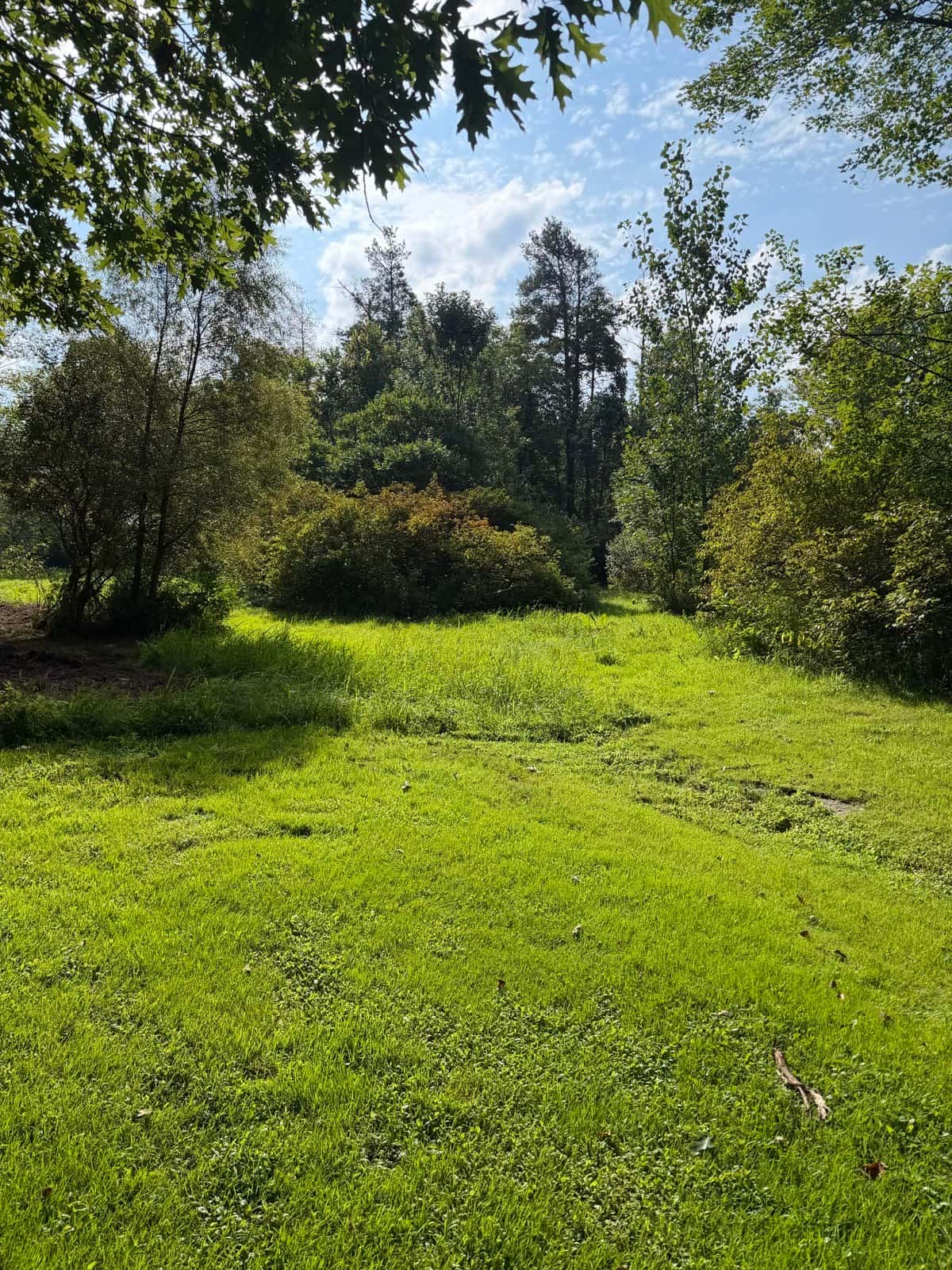 Actual BrushBoss footage · September 2026
Northeast Ohio · Woodland recovery
Real work. Real footage.
See past the tangle.
Brush and vines fill the space beneath your good trees. Start with the ground you want to use again.
Follow the transformation
The quick answer
Tree of heaven (Ailanthus altissima) is the invasive that gets worse when you attack it. It grows faster than anything native here — Ohio State University (OSU) Extension records sprouts putting on six to twelve feet in their first year and three or more feet every year after, on a tree that finishes at sixty to eighty feet. It pushes root suckers up to fifty feet from the parent trunk, a mature female can throw more than 300,000 wind-borne seeds in a year, and it releases chemicals that suppress whatever tries to grow beneath it.
Cutting it down without treating it first is the classic mistake: the stump and the roots answer a cut by sending up dozens to hundreds of new stems, and one tree becomes a colony spread across more ground than the tree ever covered. The method extension services describe runs in the reverse order — the standing tree is treated first, between 1 July and the first turn of fall colour when it is moving food down into its roots, by you on your own land or by a licensed applicator; about thirty days later it is cut. Then come back in year two, because it is a two-season job and always has been.
The mechanical side — clearing the thicket it hides inside, so the stems are reachable at all — is ordinary woodland restoration work, and it is the half that makes the rest possible.
What tree of heaven is, and why a landowner should care
Three mechanisms make this species different from every other invasive on a Northeast Ohio property. It was planted here deliberately, it grows faster than the trees it displaces, and it changes the ground so the replacements cannot come back on their own.
A tree that was planted on purpose
Ailanthus is not an accident. OSU Extension records it arriving in the United States from Asia in the late 1700s as an urban landscape tree, and later used in strip-mine reclamation across the eastern states. It was chosen for exactly the qualities that now make it a problem: it grows in relatively infertile, shallow soils of varying pH, it tolerates poor air, and it grows faster than anything native to Ohio.
How fast is worth sitting with. Six to twelve feet in the first year, three or more feet every year after, on a tree that can finish six feet in diameter. That is the difference between a fence line you glanced at last spring and a stand of trees you cannot see through this spring.
What it does to the ground under it
Ailanthus does not simply outgrow its neighbours. OSU Extension notes that it produces an allelopathic compound that suppresses seed germination and the growth of many native woody and herbaceous species. The compound has a name — ailanthone — and the US Forest Service Fire Effects Information System records it and related compounds concentrated in the roots and in young trees, with young stems producing more than older ones. Penn State Extension locates the same chemistry in the leaves, roots and bark.
In practice that means the ground under a mature ailanthus colony does not fill back in with the oaks, maples and hickories that would otherwise be waiting there. The tree edits what that patch of woods is capable of growing next, which is what separates it from the other Northeast Ohio invasives. A honeysuckle wall is ugly and impassable and the woods recovers when you take it out. An ailanthus colony leaves the ground working against you.
Why it is illegal to sell in Ohio
Ohio Administrative Code 901:5-30-01 lists the sixty-three plants the Director of the Ohio Department of Agriculture has declared invasive. Ailanthus altissima, tree of heaven, is item (A)(1). Under paragraph (B), no person may sell, offer for sale, propagate, distribute, import or intentionally cause the dissemination of a listed invasive plant in Ohio.
(A)(1) is not a ranking. The list is alphabetical by botanical name — Ailanthus, then Alliaria, Ampelopsis, Azolla, Berberis, Butomus, Celastrus, and on to Vincetoxicum at (A)(63). Tree of heaven sits at the top because A comes first, not because the state graded it the worst thing on the list. Nothing in the rule ranks risk at all.
To be clear about what the listing does and does not mean for you: having tree of heaven on your land is not an offence, and nobody is going to cite you for it. Paragraph (D) expressly permits you to dispose of the plant and to control it — with a condition attached that matters more here than almost anywhere else on the list. The permission is to do those things "in a manner that does not result in the further spread of those species." For a tree that answers a chainsaw with a hundred root suckers, that condition is the whole argument for getting the order of operations right.
How to identify tree of heaven in Ohio
Get this right before you spend a dollar. The most common error on a property walk is a landowner ready to treat a native black walnut or a stand of staghorn sumac because the leaves looked similar from the driveway.
The leaf: one to four feet long, with a lot of leaflets
Tree of heaven has pinnately compound leaves — one central stalk with leaflets ranged along both sides. OSU Extension describes them as twelve to thirty-six inches or more, carrying eleven to twenty-seven leaflets; Penn State puts the range at one to four feet and ten to forty leaflets. Either way the whole leaf is enormous by Ohio standards, and people routinely mistake one leaf for a small branch.
The leaflets are lance-shaped and tapered, green on top and greyish-green underneath, with lobed bases.
The glandular teeth at the base of each leaflet
This is the feature to learn. Run a finger along the edge of a single leaflet. It is smooth — botanists call it "entire" — for its whole length, except right at the base near where it joins the central stalk, where there are one or two protruding bumps. Penn State calls them glandular teeth; OSU records one to several of them.
None of the natives it is commonly confused with carries them. Penn State names staghorn sumac, black walnut and hickory; OSU adds butternut. The leaflet edges of all of those are serrated from base to tip, with no smooth run and no bumps at the bottom. Pair the smooth edge with the smell below and you have your answer without a book.
The smell
Break a twig or crush a handful of leaves. OSU Extension describes the odour of all parts of the plant, and particularly the male flowers, as strongly offensive — commonly likened to rotting peanuts or cat urine. Penn State records the same, and calls the foul odour from crushed foliage and broken twigs unique to the species among the look-alikes. It is not subtle. If you crush the foliage and get nothing, you are probably holding a native tree.
The bark
Pale grey and smooth, with vertical streaking that develops into light-tan fissures as the tree ages, per OSU Extension. Penn State gives the memorable version and the sequence matters: the bark is smooth and brownish-green when young, and it is the older bark — light brown to grey, with age on it — that resembles the skin of a cantaloupe. A young stem will not show you that texture.
What both descriptions share is that ailanthus bark reads as smooth from thirty feet away, which is what separates it at a distance from the deeply furrowed grey-brown of a mature black walnut or the shaggy plates of a hickory.
The twigs and leaf scars
Twigs are very stout but easily broken. OSU Extension describes them as light chestnut brown, smooth to velvety, dotted with large tan lenticels, and — this is the winter tell — carrying big heart-shaped leaf scars where last year's leaves came off. Snap one and the pith inside is spongy and salmon-coloured.
The seeds
Ailanthus is dioecious: a given tree is either male or female, and Penn State notes every tree in a single clonal patch is the same sex. Female trees carry clusters of single-seeded winged fruits called samaras, one to two inches long and twisted, yellow-green to reddish-brown, visible from mid to late summer and often hanging on through late winter. A reddish-tan haze in the top of a tree in January, at the edge of a field, is very often ailanthus.
Telling it apart from sumac, black walnut and hickory
Penn State names the confusion directly: tree of heaven is easily mistaken for native trees with compound leaves and many leaflets. Here is how each one separates.
| Tree | Leaflet edge | The other tell |
|---|---|---|
| Tree of heaven | Smooth, with one or two glandular teeth at the base only | Strong offensive smell from crushed foliage; pale smooth bark |
| Staghorn sumac | Serrated the whole length | Upright red fruit cluster held like a candle; no smell |
| Black walnut | Serrated the whole length | Green husked nuts; dark, deeply furrowed mature bark |
| Hickory | Serrated the whole length | Fewer, larger leaflets; shaggy or ridged mature bark |
| Butternut | Serrated the whole length | Sticky husked nuts; OSU lists it among the common mix-ups |
Tree of heaven vs staghorn sumac
Sumac leaflets are serrated along their entire edge. Tree of heaven leaflets are smooth except for the bumps at the base. Staghorn sumac also carries an upright, dense red fruit cluster at the tip of the stem, held like a candle; ailanthus carries drooping papery samaras. And sumac does not smell.
Tree of heaven vs black walnut
Same rule: walnut leaflets are toothed the whole way along. Walnut also produces the unmistakable green husked nuts, and its mature bark is dark and deeply furrowed rather than pale and smooth. This is the mistake with the highest cost attached, because black walnut is the most valuable timber tree most Ohio landowners will ever own. Do not treat a walnut.
Tree of heaven vs hickory
Hickory leaflets are serrated, and hickories generally carry fewer, larger leaflets than the long ranks on an ailanthus leaf. Hickory bark on a mature tree is shaggy or ridged — never the smooth pale grey of ailanthus.
The one test that settles it in the field
Two steps, thirty seconds, no equipment. Look at one leaflet edge: smooth with bumps at the base, or toothed all the way along? Then crush the foliage and smell it. Smooth edge plus offensive smell is tree of heaven. Toothed edge and no smell is one of the natives, and you should leave it alone.
Why tree of heaven is so hard to kill
Three mechanisms compound, and each one defeats a different half-measure. Understand them in this order and the method in the next section stops looking fussy.
Root suckers up to fifty feet from the parent tree
An established tree of heaven spreads underground continuously, sending up root suckers that Penn State Extension records emerging as far as fifty feet from the parent tree. That distance is why so many removals fail. The owner deals with the trunk they can see, and the following spring a ring of new stems comes up in the lawn, along the fence, at the edge of the drive — ground they never associated with the tree at all.
It also means what looks like a grove is frequently one organism. Penn State notes that ailanthus typically grows in dense clonal colonies and that every tree in a single clone is the same sex.
Allelopathy: it changes the ground for its neighbours
The ailanthone described earlier is not an academic footnote — it is why a cleared ailanthus patch does not simply revert to woods. Suppressed germination and growth in nearby native species is part of the reason the tree holds ground so effectively once it has it, and the whole reason replanting is a step rather than an afterthought.
300,000 seeds, and a tree that breeds at two
Penn State puts the seed output of a mature female at more than 300,000 annually, wind-dispersed. Both Penn State and OSU Extension note the tree begins bearing fruit remarkably young — Penn State records sprouts as young as two years capable of producing seed, OSU records fruiting beginning at age two to three.
Combine the three and you have the whole problem in one sentence: it seeds prolifically at an age when you still think of it as a sapling, it spreads sideways underground faster than you can see it happen, and it suppresses whatever might have competed with it.
Removal methods that actually work
The order of operations is the entire game. Almost every failed tree of heaven removal in Ohio failed because the cutting happened before the treating.
Where BrushBoss sits in this. We do the mechanical half: clearing the brush a colony hides inside, then coming back on follow-up visits to cut the seedling and sucker flushes while they are small. We do not apply herbicide; the treating half is yours on your own land, or a licensed applicator's. Every method below is written on that basis.
Seedlings: pull them, in moist soil, roots and all
Penn State confirms hand-pulling works on young seedlings when the soil is moist and the entire root system comes out — with the warning that small root fragments are capable of generating new shoots. Spring, after rain, on ground you can still get a hand into.
One caution that matters: seedlings are easily confused with root suckers, which are attached to a living parent root system and, in Penn State's words, nearly impossible to pull by hand. If it will not come, stop pulling and start looking for the tree it belongs to.
Standing trees: treat first, cut later
This is the sequence, and Penn State states it plainly: when cutting tree of heaven is necessary — a hazard tree over a building, say — it is best to have the tree treated first, wait roughly thirty days for symptoms to develop, and then cut. Treatment in mid to late summer travels with the carbohydrates the tree is moving into its roots, which is how the root system dies rather than merely the top.
Done in the wrong season, or after the tree has already been cut, the same treatment does far less.
What extension services say about root treatment
Penn State Extension and OSU Extension both describe the treatment side in detail, and both put it in the same late-summer window, from 1 July to the onset of fall colour, when the tree is drawing food down into its roots. That work is not ours: on your own land it is yours to do by the product label, and anything larger is a job for a licensed applicator or a consulting forester, who will choose the method for the stems in front of them. Read their factsheets before anything is cut.
Where mechanical clearing fits
Mechanical work is not a control method for a mature ailanthus. It is the method for everything else on the ground, and for the aftermath.
Forestry mulching clears the tangle of bush honeysuckle, multiflora rose, briar and brush that a tree of heaven colony hides inside — which is what makes the ailanthus stems visible, reachable and treatable in the first place. It clears the seedling and sucker flushes that follow a treatment year, on follow-up visits, mechanically. And on ground where the ailanthus stems are small and dense, it takes the standing material out so what remains is a low, mapped patch instead of a wall.
What it will not do on its own is kill a mature tree. Read the next section before you point a machine at one.
Whether to hire this out at all
There is a genuine do-it-yourself case here, and it is narrower than the one for getting rid of honeysuckle. If you have a handful of small stems in reach, you can identify them confidently, you follow the extension guidance and the product label, and you are willing to come back next year, you can do this yourself on your own property. Above that — a colony, a mature female seeding into the neighbourhood, big stems near buildings, or anything that needs a machine to get to — it is worth the phone call.
What NOT to do
This is the section that saves people the most money, so it is the bluntest one. Every item below is something an owner does with good intentions and pays for twice.
Do not just cut it down
The single worst thing you can do to a tree of heaven is take a chainsaw to it and walk away. OSU Extension records that cutting large stems often stimulates the production of hundreds of sprouts. Penn State's language is that mechanical methods such as cutting or mowing are ineffective, because the tree responds by producing large numbers of stump sprouts and root suckers. You will replace one trunk with a thicket, and the thicket will be spread across a wider footprint than the tree was.
Do not mow a patch of it
Mowing is cutting, repeated. OSU Extension notes cutting and mowing will likely cause an abundance of resprouting from both the existing stump and the underground root system, and can create a situation where control becomes more difficult. Mechanical control only works on ailanthus as a war of attrition — repeated frequently until the plant's food reserves are exhausted — and most owners quit before the plant does.
Do not rely on a cut-stump treatment
This one surprises people, because cut-stump is the standard answer for honeysuckle and it is genuinely good there. It is not good here. Penn State states that cut-stump treatments do not prevent root suckering and should not be utilised on tree of heaven. OSU is consistent: cut-stump keeps the stump itself from resprouting but causes the root system to send up multitudes of sprouts, requiring multiple follow-up treatments. Treating the stump treats the wrong part of the plant.
Worth knowing because contractor pages get this wrong: cut-stump is frequently listed as the middle option for tree of heaven, between hack-and-squirt for small jobs and mulching for large ones. Both extension services say the opposite. If a quote leads with stump treatment on ailanthus, ask what happens to the roots.
Do not treat in spring
It feels like the right time — everything is greening up and you can finally see what you are dealing with. But Penn State is explicit that treatments made outside the late-growing-season window will only injure aboveground growth. Spring treatment is expensive pruning.
Do not walk away after year one
Penn State names treatment timing and following up in the second year as critical to success, and repeated site monitoring after treatment as critical to preventing re-infestation. A first-season kill that looks total in October routinely produces suckers in June. Budget the second visit at the start, not as a disappointment later.
What tree of heaven removal costs in Ohio
Honest answer first: nobody can price this from a species name. What sets the number is whether you have a mature tree standing over a garage, a patch of young stems in a fence line, or ten acres with ailanthus threaded through honeysuckle. Those are three different trades at three different prices, and only one of them is ours.
What the clearing side costs
BrushBoss publishes one price per unit of work, so these are the same numbers the Land Clearing Cost Calculator uses and the same ones on the full pricing guide:
| Work | Price |
|---|---|
| Driveway or fence line, up to 500 sq ft | $295 |
| A strip, up to 1,000 sq ft | $495 |
| A corner or back edge, up to a quarter acre | $750 |
| Woodland restoration, per acre by density | $2,000 – $2,990 |
No project minimum. Small jobs are flat-priced, larger work is priced by the acre, and you get the number before anything starts.
What the treatment side costs
Root treatment is not work BrushBoss offers, so we publish no figure for it. On your own trees it is your own afternoon, done by the product label; hired out, it is a licensed applicator’s or a consulting forester’s quote, and it will turn on stem count, stem size, access and how far the colony runs. Get the stem count before you get the quote.
What a big tree next to a building costs
A mature ailanthus leaning over a roof, a driveway or a power line is tree-service work, and it is priced on the specifics of that tree — height, lean, what is underneath it, whether a crane or a bucket is needed. We do not publish a figure for it, because any figure would be invented. Get a tree service to look at it, and tell them the tree needs treating before it is felled — that instruction is the difference between one job and five years of suckers.
The neighbour credit
Ailanthus does not respect a property line. With root suckers ranging up to fifty feet and seeds travelling on the wind, a colony on one side of a fence is a colony on both.
Two or more on the same road the same day and you each get a $50 credit toward your next visit. The machine only comes out once, so the saving is real.
Treating a colony on both sides of the line in the same season is also the only version of this that actually works. One owner clearing alone is re-seeded by the other.
The best time of year for tree of heaven in Ohio
One window in the year does the real work and everything else in the calendar is arranged around protecting it. The same logic runs through our season-by-season guide for land work generally, but ailanthus is the species where getting the month wrong wastes the whole effort.
July to the first fall colour: the treatment window
Penn State Extension is precise about this: root treatment belongs in mid to late summer, 1 July to the onset of fall colour, when the tree is moving carbohydrates to the roots. Every method it describes carries that same timing.
In Northeast Ohio that is roughly the second week of July through late September, ending when the maples start to turn. That local reading is our application of the published window to Geauga phenology rather than a sourced Ohio date range — treat it as approximate and watch the maples, not the calendar.
Winter: the survey
Leaves down is when a property reads honestly. The pale, smooth, vertically streaked bark stands out against the furrowed grey of the natives, the big heart-shaped leaf scars are visible on the twigs, and the persistent samaras hang in the tops of the females like a reddish haze. Winter is when you count the stems and map the colony, so that come July the treating follows a plan rather than a guess.
Spring: the season to resist
Green-up is when ailanthus is most obvious and least vulnerable. It is a fine time to pull genuine seedlings out of wet ground and an actively bad time to treat a standing tree. If you can only do one thing in spring, walk the ground fifty feet out from every known trunk and mark where the suckers come up. That map is what you treat in July.
Late spring into early summer: seedlings and mechanical work
Moist soil is pulling weather for genuine seedlings. It is also the sensible season for the mechanical work — clearing the brush a colony is hiding inside, so that when July arrives the stems are visible and reachable. OSU Extension adds that where mechanical control is used at all, initiating it in early summer, when food reserves are at their lowest, is the most effective timing.
Preventing regrowth after removal
A first season that looks like total success and a second season nobody budgeted for is the standard shape of a failed ailanthus removal. Three habits prevent it.
Year two is not optional
Say it once more, because it is the difference between a solved problem and an annual one: Penn State Extension names treatment timing and second-year follow-up as critical to success, and repeated site monitoring as critical to preventing re-infestation. Put the second visit in the calendar the same week you do the first treatment, not the following June when the suckers make the decision for you.
Watch fifty feet out, not just the stump
The regrowth almost never appears where the tree was. Walk a fifty-foot radius from every treated trunk — into the lawn, along the fence, across the drive, over the property line if your neighbour will let you. That is where the suckers come up, and they are easy to kill while they are ankle-high and nearly impossible once they are ten feet tall, which takes them a single season.
Close the canopy
Ailanthus is a disturbance species. OSU Extension describes it as an aggressive competitor that thrives in full sunlight and flourishes with disturbance. An open, sunlit patch of bare ground with a seed bank underneath it is precisely the invitation it is waiting for.
So give that ground a job. Let the native canopy close, replant it, put it into lawn, or run a trail through it with regular traffic. Land with a job stays clear, which is the same principle behind stopping brush regrowth on any cleared ground. Shade is the cheapest long-term control you will ever buy.
What to plant after the ailanthus is gone
"Close the canopy" is the principle; this is the list. Every species below appears on the Ohio Department of Natural Resources' own selected Ohio native plants lists for landscape and restoration use, which is the check worth making before you buy anything: a great many nursery plants are native to somewhere, and somewhere else is what put ailanthus here in the first place.
Match the planting to the light you actually have after clearing, not the light you expect in ten years.
Sunny, open ground
Where the ailanthus was the canopy, taking it out leaves full sun. That is the hardest ground to hold and the fastest to seed, so cover it quickly with plants that like the conditions.
- Black-eyed Susan (Rudbeckia hirta) — on ODNR's field and prairie species list. Establishes fast from seed and holds open ground while slower plants catch up.
- Wild bergamot (Monarda fistulosa) — same list. A clumping perennial for dry, sunny edges, and one of the better pollinator plants available in Ohio.
- Little bluestem (Schizachyrium scoparium) — same list. A warm-season native bunchgrass that puts roots deep, takes poor soil, and stands through winter.
These are the plants for the middle of a cleared opening, a reclaimed field edge, or the sunny bank where the colony ran. They will not stop a mature ailanthus, but they take the bare soil that its seedlings need.
Part shade and the woodland edge
Under a canopy that is still partly standing, plant into the understory the ailanthus was suppressing. All three below appear on ODNR's upland woods list, and OSU Extension's native shrubs factsheet covers what they do for wildlife.
- Spicebush (Lindera benzoin) — ODNR records it found throughout all of Ohio, usually as an understory shrub of moist to wet woodlands, and one of the first shrubs to bloom. It is one of the few woody plants that genuinely thrives in full shade.
- Pawpaw (Asimina triloba) — ODNR records it found throughout all of Ohio as a native understory or woodland-edge tree, often in moist places such as ravine bottoms, steep hillsides and creek banks. It suckers into a colony over decades, which is exactly the behaviour you want holding ground.
- Native viburnums — arrowwood (Viburnum dentatum), blackhaw (V. prunifolium) and mapleleaf viburnum (V. acerifolium) are all on the ODNR upland woods list. OSU Extension notes they are adaptable from full sun to part shade, and that mapleleaf viburnum in particular is shade-tolerant and suckering.
Creek banks and ravines are where this list earns its place in Geauga County, because that is where ailanthus travels and where bare soil does the most damage downstream.
Putting the woods back
For reforestation, plant the trees that will hold the site for a century. All four are on ODNR's upland woods list and all four are covered in OSU Extension's native trees factsheet.
| Species | Where it belongs on the property |
|---|---|
| Northern red oak (Quercus rubra) | The faster of the two oaks and a major timber tree of the eastern and midwestern states, per ODNR. Good on the open ground an ailanthus colony leaves behind. |
| White oak (Quercus alba) | ODNR records it found throughout all of Ohio, from dry forests and fields to mesic woodlands and downslopes. Slow, long-lived, and the tree the woods is measured by. |
| Tulip poplar (Liriodendron tulipifera) | OSU Extension notes it grows best in full sun and is not shade-tolerant — which makes a cleared opening the right place for it and the shaded understory the wrong one. |
| Sugar maple (Acer saccharum) | ODNR records it throughout all of Ohio but flourishing in the cooler climates and more acidic soils of northeastern Ohio. This is the local tree on this list. |
They are all slower than tree of heaven. Every one of them will outlast it by centuries, and none of them will have to be killed twice.
Seeding into the mulch layer
There is a practical reason planting and clearing belong in the same season rather than two years apart. Forestry mulching leaves the ground covered in chipped material rather than scraped to bare soil — nothing is burned, nothing is hauled away, and the chips are spread where they fall. That layer is a seedbed, and it is already there the day the machine leaves.
Broadcasting a native seed mix into it while it is fresh is the natural follow-on to the work: the ground is open, the competition is down, and the sun that would otherwise start the next generation of ailanthus seedlings is going into something you chose. Left bare instead, the same opening is simply an invitation, and the seed bank underneath it is not empty.
Sequence it properly on ground that still has live ailanthus roots under it. Seed after the treatment has done its work and the sucker flush has been dealt with — not before, or you will be walking through your own new planting with a sprayer.
Tree of heaven and the spotted lanternfly
This is the reason most people arrive at the species, and it is worth being straight about what the connection is and what it is not.
What the connection actually is
Spotted lanternfly is a plant pest, and tree of heaven is its primary host. That is the whole of the relationship worth stating, and it is enough. The Ohio Department of Agriculture issued a statewide quarantine effective 17 February 2026, extending to all of Ohio what had been an 18-county quarantine. The release names tree of heaven as the primary host, and describes the insect as a pest of grapes, hops and apples — the concern is the state’s grape and wine industry.
Penn State Extension supplies the caveat that most contractor pages leave out, and it is worth knowing before you spend money on the strength of it: tree of heaven is a strongly preferred host, but it is not required for the insect’s development, and the insect has been recorded feeding on over seventy different plant species. Penn State also states plainly that there is currently no data on whether removing or treating tree of heaven reduces lanternfly populations.
Remove your ailanthus because it is displacing your woods and taking your ground. Any effect on lanternfly pressure is a second reason, not the first one, and nobody can promise you the first.
What the statewide quarantine means for a landowner
Practically, very little on your own property. The quarantine governs movement: under it, products such as trees and nursery stock may not be moved out of Ohio without a compliance agreement, permit or inspection certificate, and producers shipping to non-regulated areas must have stock inspected and certified. It does not require you to do anything about a tree in your own woods. OSU Extension relayed the announcement in full on the day it was issued, which is the easiest place to read it alongside the horticultural context.
It is a useful signal of how the state now reads the risk, and a good reason to know what a tree of heaven looks like. It is not, on its own, a reason to reach for a chainsaw — see the order of operations above.
Tree of heaven in Geauga County and Northeast Ohio
Ailanthus is a disturbance and edge species, and Geauga County has edges everywhere. Where it turns up here is predictable enough to walk straight to.
Where it turns up here
On properties around Chardon, Chesterland, Newbury, Burton, Russell, Bainbridge, Munson and Auburn the places are the same ones every time: the back fence line where the mowing stops, the strip between a field and the woods, the bank of a drainage ditch, the road frontage along US-322, SR-306, SR-44 and SR-87, and the sunny gap left where a big tree came down in a storm two winters ago and nobody replanted it.
Old field edges are the classic Geauga case. A property that was pasture a generation ago and is now half-woods has exactly the disturbed, sunlit, unmown margin ailanthus wants, and it has usually had twenty years of nobody looking at it.
The river corridors carry it
Geauga sits on the headwaters of three watersheds — the Chagrin, the Cuyahoga and the Grand — and moving water plus disturbed bank is how a seeding female becomes a valley full of them. If your property runs down to a creek or a ravine, the bank is the first place to look and the last place anybody checks, because it is the part nobody walks.
What we do, and what we don't
BrushBoss does the mechanical half. We clear the brush and the invasive understory an ailanthus colony is hiding inside, we take out the seedling and sucker flushes, and we open the ground back up so you can walk it — every mature tree worth keeping left standing.
Tree of heaven is the exception that proves that promise. Our guarantee is that we do not take a tree worth keeping, and ailanthus is not one: it is a listed invasive that suppresses the trees that are. Removing it is how the woods you want gets its ground back.
Our work is mechanical: the clearing, and follow-up visits to cut the seedling and sucker flushes while they are small. We do not apply herbicide, so the treating half belongs to you on your own land, or to a licensed applicator or consulting forester you hire.
What we will do is schedule the clearing around that treatment rather than across it, which for tree of heaven is the whole difference between a job finished and a job repeated. If you want the ground opened up first so you can actually see what you have, that is the call to make — start with a walk of the property and a count of the stems, in winter if you can.
Tree of heaven removal in Northeast Ohio
We clear the brush, briar and honeysuckle a tree of heaven colony hides inside, take the seedling and sucker flushes down mechanically, and come back on follow-up visits through the seasons that follow, timed around any treatment you or your applicator have planned. Every good tree around the colony stays standing. See how that work is done on our woodland restoration service page, or price your own ground in the Land Clearing Cost Calculator.
The Order of Operations
- 01
Identify it before you spend anything. Smooth leaflet edges with one or two bumps at the base, and a strong offensive smell from crushed foliage. Toothed edges and no smell means you are looking at a native — most expensively, a black walnut.
- 02
Map the colony in winter. Leaves down is when the pale smooth bark, the heart-shaped leaf scars and the persistent seed clusters read honestly. Count the stems and mark where the suckers come up, fifty feet out from every trunk.
- 03
Clear what is hiding it. Forestry mulching takes out the honeysuckle, briar and brush a colony sits inside, which is what makes the ailanthus stems visible and reachable. Late spring into early summer is the sensible season for it.
- 04
Settle the root treatment before anything is cut. Extension guidance puts it between 1 July and the first fall colour, when the tree moves food into its roots; it is your own work on your own land, or a licensed applicator’s, and BrushBoss does not apply herbicide. Wait about thirty days for symptoms before anything gets cut.
- 05
Come back in year two. Penn State Extension names second-year follow-up as critical to success. The suckers that survived come up in a ring well away from where the parent tree stood, and our follow-up visits cut them back while they are ankle-high.
- 06
Plant the ground you opened. Bare, sunlit soil over a seed bank is the invitation ailanthus is waiting for. Native cover in the mulch layer is the cheapest long-term control available.
Frequently Asked Questions
How do I identify tree of heaven in Ohio?
Look at the edge of a single leaflet. Staghorn sumac, black walnut and hickory all have teeth — small serrations running the whole length of the leaflet edge. Tree of heaven's leaflet edges are smooth, with one or two bumps called glandular teeth only at the very base, near the stem. Then break a twig. Every part of tree of heaven gives off a strong offensive smell, usually described as rotting peanuts or cat urine. Sumac and walnut do not. In winter, look for pale smooth bark and large heart-shaped leaf scars on thick twigs.
Will tree of heaven grow back if I cut it down?
Almost certainly, and worse than before. OSU Extension notes that cutting a large stem often stimulates the production of hundreds of sprouts, from the stump and from the root system both. Penn State Extension is blunter still: mechanical methods such as cutting or mowing are ineffective because the tree responds by producing large numbers of stump sprouts and root suckers. Cutting alone is the single most common way a small tree of heaven problem becomes a large one.
What is the best time of year to kill tree of heaven?
For the roots, mid to late summer — 1 July through the first turn of fall colour. That is when the tree is moving carbohydrates down into its roots, and Penn State Extension warns that treatment outside that late-season window will only injure the aboveground growth and leave the root system intact. For the clearing around it, late spring into early summer, so the stems are visible and reachable by July.
How do you get rid of tree of heaven?
In order, and over more than one season. Identify it and map the colony in winter; clear the brush it hides inside in late spring or early summer; settle the root treatment in the late-summer window before any standing tree is cut, which is your own work on your own land or a licensed applicator’s; then come back in the second year for the suckers. Cutting a standing tree first, on its own, is how one tree becomes a colony. BrushBoss does the mechanical side: the clearing and the follow-up visits that cut the seedling and sucker flushes while they are small.
Can I just pull tree of heaven seedlings?
Yes, if they are genuinely seedlings, the soil is moist, and you get the entire root system out. Penn State Extension notes that small root fragments are capable of generating new shoots, and that seedlings are easily confused with root suckers — which are attached to a parent tree's root system and are nearly impossible to pull by hand. If it fights you, it is a sucker, and there is a bigger tree somewhere within about fifty feet.
Is tree of heaven invasive in Ohio?
Yes, and selling it is illegal. Ailanthus altissima is one of the sixty-three plants listed in Ohio Administrative Code 901:5-30-01, the state invasive plant rule, and under paragraph (B) no person may sell, offer for sale, propagate, distribute, import or intentionally cause the dissemination of a listed invasive plant in Ohio. It appears at item (A)(1) because the list is alphabetical by botanical name — Ailanthus, then Alliaria, Ampelopsis and so on — not because the state ranked it first for risk. Nothing in the rule ranks risk. Having one on your property is not an offence, and paragraph (D) expressly permits you to dispose of the plant and to control it, provided you do so in a manner that does not result in the further spread of the species.
Does tree of heaven really attract spotted lanternfly?
It is the insect’s primary host plant. The Ohio Department of Agriculture issued a statewide spotted lanternfly quarantine effective 17 February 2026, extending what had been an 18-county quarantine to all of Ohio, and names tree of heaven as the primary host. Penn State Extension adds an honest caveat worth knowing: tree of heaven is a strongly preferred host but is not required for the insect to complete its development, the insect feeds on over seventy plant species, and there is currently no data on whether removing it reduces lanternfly populations. Removing your ailanthus is worth doing on its own merits.
How much does tree of heaven removal cost in Ohio?
It depends entirely on whether you are dealing with a thicket of young stems or a mature tree next to a building. BrushBoss prices the clearing side off a published ladder: $295 for a driveway or fence line up to 500 sq ft, $495 for a strip up to 1,000 sq ft, $750 for up to a quarter acre, and $2,000 to $2,990 per acre for woodland restoration. There is no project minimum, and the Land Clearing Cost Calculator prices your own ground. A large hazardous tree over a roof or a driveway is tree-service work, quoted by the tree service on the specifics of the tree.
Does BrushBoss spray herbicide on tree of heaven?
No. BrushBoss works mechanically: clearing the thicket and the understory around it, then cutting the seedling and sucker flushes on follow-up visits. We do not apply herbicide. On your own land you may treat your own trees yourself, following the product label; for anything larger, a licensed applicator or a consulting forester does that part, and we time the clearing around their treatment rather than against it.
How long does it take to get rid of tree of heaven for good?
Plan on two full seasons at minimum, and expect to be walking the ground for a third. Penn State Extension calls following up in the second year critical to success. The first season kills the top and much of the root system; the second season is for the suckers that survived, which will come up in a ring well away from where the parent tree stood.
What should I plant after removing tree of heaven?
Something that closes the canopy, chosen off a native list rather than a nursery shelf. For sunny openings: black-eyed Susan, wild bergamot and little bluestem, all on the ODNR field and prairie native list. For part shade and woodland edge: spicebush, pawpaw and native viburnums such as arrowwood or blackhaw. For reforestation: northern red oak, white oak, tulip poplar and sugar maple, the last of which ODNR records as flourishing in the cooler, more acidic soils of northeastern Ohio. Ailanthus is a disturbance species that thrives in full sunlight, so bare ground is the invitation. Shade is the cheapest long-term control you will ever buy.