Forestry Mulching Cost & Pricing in Ohio (Per Acre)
By Kyle Abbey · ·
Forestry mulching costs $2,000 to $2,990 per acre in Northeast Ohio with BrushBoss, set by how thick the growth is, and smaller work such as a drive edge or a corner of the yard is flat-priced from $295. That is one fixed number for the ground, never an hourly meter, and it should never depend on how long a crew decides to take. BrushBoss quotes every job up front, based on what we can see and measure on your property, with no surprise change orders. Here is how the pricing works, so you can budget before you ever pick up the phone.
Instant QuoteForestry mulching cost per acre in Ohio, October 2026
The short answer: forestry mulching costs $2,000 to $2,990 an acre in Ohio, set by how thick the growth is, with one written number before anything starts. These are the prices BrushBoss publishes for Northeast Ohio as of October 2026. For your own ground, the forestry mulching cost calculator gives an estimate from your address in a few minutes.
| Density | What you see from the edge | Per acre |
|---|---|---|
| Light | You can walk in. Saplings, field regrowth, scattered brush with daylight between it | $2,000 |
| Medium | You can see in but not walk in. Brush to head height, some thorn, young trees crowding the good ones | Between the two |
| Heavy (dense) | You cannot see in. A solid wall of prickers, vines and thicket | $2,990 |
Less than a quarter acre is not priced by the acre at all. Small jobs are flat-priced, with no project minimum:
| Small job | What it covers | Flat price |
|---|---|---|
| Driveway or fence line | Up to 500 sq ft | $295 |
| Strip | Up to 1,000 sq ft | $495 |
| Corner or back edge | Up to a quarter acre | $750 |
The same schedule applies on Cleveland's east side, where smaller lots mean most jobs land on the flat rungs, and in Geauga County, where five-, ten- and twenty-acre parcels are ordinary and the work is usually priced by the acre.
Land recovery and property protection · Northeast Ohio
We give you your land back, and we make it safe to use.
The brush, thorn and poison ivy that grew up under your good trees comes out, and what you get back is ground you can walk without watching your step.
From $295 for an afternoon's work to full estate restoration.
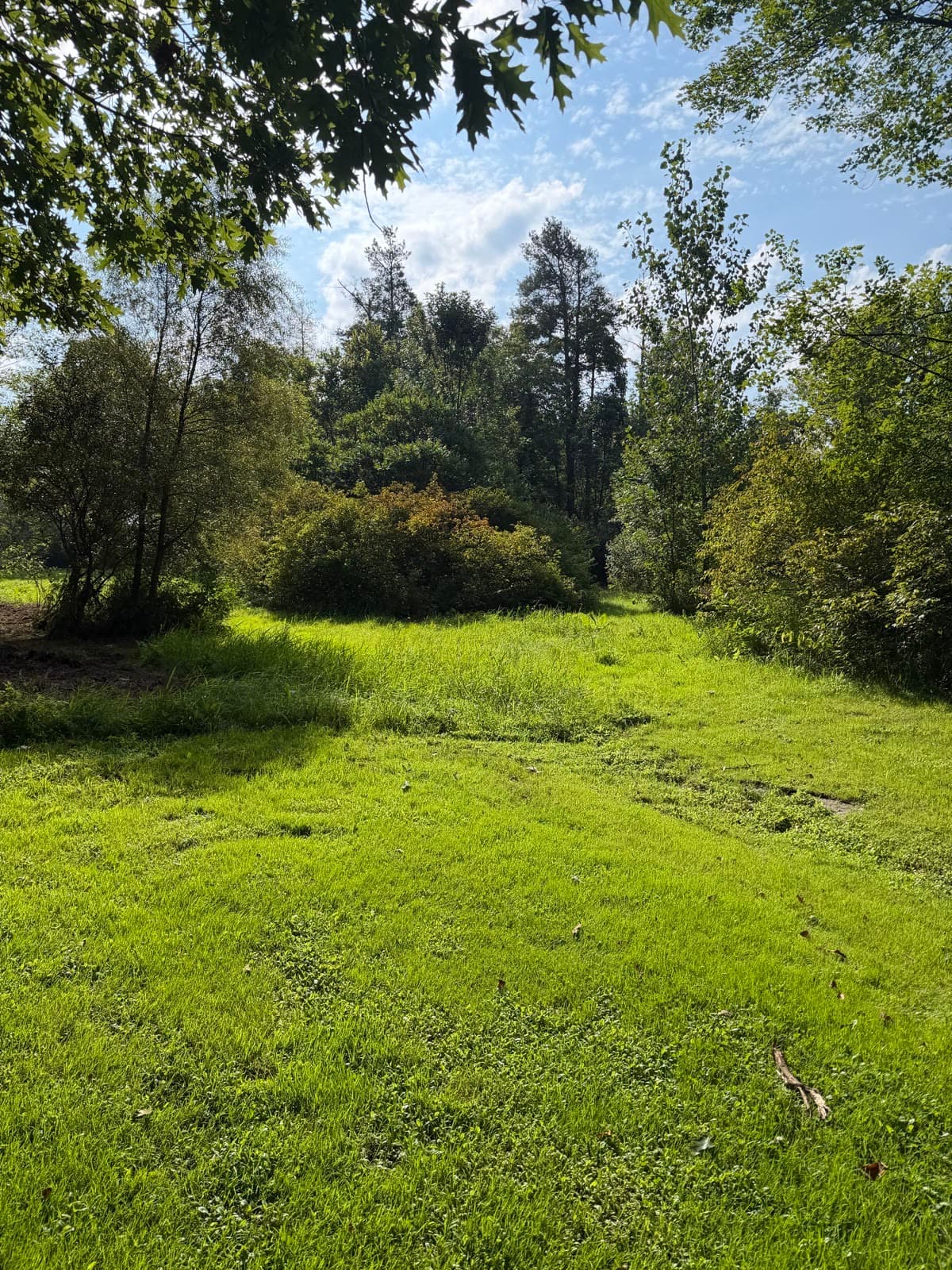 Actual BrushBoss footage · September 2026
Northeast Ohio · Woodland recovery
Real work. Real footage.
See past the tangle.
Brush and vines fill the space beneath your good trees. Start with the ground you want to use again.
Follow the transformation
Why density sets the price
BrushBoss prices forestry mulching in Northeast Ohio at $2,000 to $2,990 per acre on flat, walkable ground. Where an acre falls in that band depends on one thing more than any other: how much is growing on it. The density tiers in the table at the top of this page are described the way the ground looks when you stand at its edge rather than in trade terms, because that is a judgement you can make yourself before anyone visits. The thicker the growth, the more there is to take down for every acre of ground you get back, and that, not the hour, is what the price follows.
The same numbers sit on the full price schedule, alongside the terrain adjustments and the volume tiers, and they are what the land clearing cost calculator works from. One number per unit of work, published, is the point: a price you can check before anyone visits is a price nobody can quietly move after they arrive.
What do other Ohio contractors charge?
Published ranges elsewhere in the state sit in the same neighbourhood, with a wider top end. A Central Ohio contractor publishes $1,850 to $3,500 per acre for forestry mulching, and a Lorain County contractor lists $2,000 to $3,500 per acre for medium brush and small trees. Treat any range, including ours, as a starting point rather than a promise. The number that matters is the one written against your ground, with the scope stated beside it.
What makes one acre cost more than another?
Two properties of the same size can price thousands of dollars apart. Four things set where an acre lands, in roughly this order of weight.
How thick is the growth?
Density is the largest lever by a distance. An acre of scattered saplings is quick, open work. An acre of thorn, prickers and berry brush grown together into one tangle (usually honeysuckle, multiflora rose and autumn olive) holds several times the material, and every stem of it has to be taken to the ground and turned into cover. That is the whole difference between the light and dense tiers, and it is why we ask for photos taken from inside the growth, not just from the lawn.
How big are the stems?
Brush, thorn and young trees are the ordinary work, and the per-acre tiers assume them. Anything larger is usually a tree you want to keep, which costs nothing extra because it simply stays. Where a larger tree genuinely needs to come down, it is named and agreed on the quote rather than discovered on the day.
Is the ground flat, rolling or steep?
Rolling ground adds about 10% to the per-acre rate and steep but walkable ground about 25%, as the matrix on the pricing page shows. Ground too steep to walk, such as a ravine, a creek bank or the fall of a pond edge, is slope work, priced separately at $3,900 to $5,100 per acre and done with nobody standing on the hill.
How wet is it, and how do we get in?
Wet corners rarely cost more, but they decide when the work happens: a swale firm in August or frozen in January can be soft in April, and waiting is cheaper than repairing ruts. Access works the same way. A wide enough gate and a route clear of the septic field and new plantings keep the job simple, and both are written into the quote.
What does a 1-acre and a 5-acre job cost?
These are worked examples on flat ground, with the arithmetic shown so you can check it. They are illustrations of the published rates, not past jobs. Volume discounts apply automatically: 10% from 2.25 to 5.24 acres, 15% from 5.25 to 9.99 acres, and 20% from 10 acres up.
| Example | Arithmetic | Total |
|---|---|---|
| 1 acre, light | 1 acre × $2,000 = $2,000, no volume discount | $2,000 |
| 1 acre, dense | 1 acre × $2,990 = $2,990, no volume discount | $2,990 |
| 5 acres, light | 5 acres × $2,000 = $10,000, less 10% ($1,000) = $9,000 | $9,000 |
| 5 acres, dense | 5 acres × $2,990 = $14,950, less 10% ($1,495) = $13,455 | $13,455 |
| 6 acres, light | 6 acres × $2,000 = $12,000, less 15% ($1,800) = $10,200 | $10,200 |
| 12 acres, light | 12 acres × $2,000 = $24,000, less 20% ($4,800) = $19,200 | $19,200 |
Real properties are usually a mix — an acre of light regrowth along an old field edge, two acres of dense thicket under the canopy. Each area is priced at its own tier, added together, and the volume discount applies to the total acreage.
What about less than an acre?
Between a quarter acre and a full acre, the work is priced at the per-acre rate for the area actually cleared, with $750 as the floor. A half acre of light growth is half of $2,000, which is $1,000; a half acre of dense thicket is half of $2,990, which is $1,495. The flat rungs cost more per square foot than acre work, deliberately: small jobs genuinely cost more per foot to do.
What is included in the per-acre price, and what is never billed?
The per-acre price is the clearing, finished. Brush, thorn, vines and young trees within the agreed area are taken down and turned into a layer of mulch, spread where it falls. That layer is the cleanup: it shades the soil, holds it in the rain, and breaks down over the following year or so. You walk out onto groomed ground the same day.
- No haul-off charge. Nothing leaves the property, so there are no truck loads to pay for.
- No burning. No burn piles to watch, and no open-burning permission to arrange.
- No dump or tipping fees, because nothing goes to a dump.
- No separate cleanup crew. The mulch layer is the finished surface.
What sits outside the per-acre price is anything that is not clearing: finish grading for a lawn, seed, a large tree over a roof that belongs to a tree service, or any treatment of regrowth, which is not clearing at all. If any of it is part of your plan, it is named on the quote as its own line before anything starts, not added afterwards.
Every BrushBoss clearing project includes a workmanship guarantee. If we miss material within the agreed clearing zone, we come back and finish — free.
How does forestry mulching compare with bulldozing, brush hogging and hand crews on cost?
The headline per-acre figures are not like for like, because each method leaves a different job behind it. The short version is below.
| Method | Headline cost | What is left afterwards |
|---|---|---|
| Forestry mulching (BrushBoss) | $2,000 – $2,990 per acre | Open ground under the trees you kept, covered in mulch. Nothing to haul, burn or repair. |
| Bulldozing | Varies by contractor; hauling, burning and regrading usually billed on top | Piles to haul or burn, bare soil, and stumps and topsoil to deal with, each usually billed separately. |
| Brush hogging | A flat per-acre rate, lower than mulching (on the Brush Hogging page) | Grass and light brush mown down. Woody stems are cut, not removed, and come back. |
| Hand crew | Billed by the hour or the day | Cut material to drag, pile, burn or haul, and stumps left standing. |
Bulldozing is the right tool when the ground itself has to change, for a building pad or a driveway cut, and it is the wrong one when you want the woods back, because it takes the woods with it. The forestry mulching versus bulldozing comparison covers the topsoil, erosion and regrowth differences in detail.
Brush hogging is genuinely cheaper, and for an open field kept on a schedule it is the right answer. It is mowing, though, and a woody thicket above thumb thickness is beyond it. The brush hogging versus forestry mulching guide has a ten-second test for which one your ground needs.
A hand crew is the honest choice for a small patch. Past a quarter acre the hours stop adding up: one person in moderate brush clears roughly a thousand square feet an hour, which is forty-plus hours an acre before the piles are dealt with. For the whole bill by method, including hauling, burning, stumps and regrading, see how much land clearing really costs.
Why BrushBoss does not bill by the hour
An hourly rate hands every risk in the job to the person paying for it. A slow start, a wet morning, a crew that works to the clock rather than to the finish: all of it lands on your invoice, and you cannot know the total until the work is over. A per-acre price agreed in writing reverses that. We carry the risk of the job taking longer than planned, because we are the ones who can control it.
How is a forestry mulching job quoted?
Most residential work is quoted from satellite imagery and county property records, together with a short phone call and a few photos you take on your phone. From those we measure the area you want back, read the density, find the access and check the slope. You receive a fixed number in writing, per acre and in total, with the scope stated: where the clearing starts and stops, which trees stay, and what the finished ground looks like.
Properties with work close to the house, a pond, a watercourse or a boundary usually get a walk-through before the number is final, and you are welcome to book a walk-through on any job. The trees you want kept are flagged with you before work starts. BrushBoss is insured, and a certificate of insurance is available on request.
Is there a minimum job size?
No project minimum. Small jobs are flat-priced, larger work is priced by the acre, and you get the number before anything starts.
| Small work, flat-priced | Price |
|---|---|
| A drive edge or fence line, up to 500 sq ft | $295 |
| A strip, up to 1,000 sq ft | $495 |
| A corner or back edge, up to a quarter acre | $750 |
The old project minimum existed to cover coming out for one small job. Working several properties on the same road on the same day now covers it instead, which is why neighbours who book together are rewarded for it.
Two or more on the same road the same day and you each get a $50 credit toward your next visit. The machine only comes out once, so the saving is real.
What drives cost on estate property?
On a larger Geauga or Chagrin Valley property the per-acre rate is only part of the conversation. The rest is about what the clearing is for, and a few decisions there change the number more than acreage does.
- Trees to keep. Working carefully around a stand of mature oaks and maples, and the young ones worth growing on, is the work itself rather than a surcharge. It is also why an estate clearing is flagged with you, tree by tree, before it starts.
- Sightlines and the pond. Opening a view from the house or taking a pond bank back is usually a narrow band of dense growth, and often some of it is slope. It prices by its real area, not by the acreage of the property.
- The edge you look at every day. Where the lawn meets the woods, a cleaner finish matters more than it does at the back line. That is agreed on the quote, so you pay for polish only where you will see it.
- Phasing. Several acres can be done in stages, a season apart, with each stage quoted on its own acreage. Doing it in one programme earns the volume tier; doing it in stages spreads the cost.
The first seasons after clearing are also worth budgeting for. Cut stumps of some species resprout, and catching that regrowth while it is ankle-high is a small job; leaving it for five years is a large one. The guide to keeping brush from coming back explains what to expect, and the forestry mulching service page shows what the finished ground looks like.
How to Budget Before You Call
- 01
Trace the ground you want back on a satellite view and note the acreage. The drawn area is what gets priced, not the parcel.
- 02
Judge the density from the edge: walk in is light, see in is medium, neither is dense.
- 03
Note the slope, the wet corners and the way in, and decide which trees and which view the clearing is for.
- 04
Get one written number for the defined area, and compare quotes by scope, not by headline rate.
Frequently Asked Questions
How much does forestry mulching cost per acre in Ohio?
Forestry mulching costs $2,000 to $2,990 per acre in Northeast Ohio on flat ground: $2,000 for light growth you can walk into, rising to $2,990 for dense thicket you cannot see into at all, with medium brush in between. Rolling and steep ground add to that, and volume discounts reduce it from 2.25 acres. The full schedule is on the pricing page.
Do you charge by the hour or by the job?
By the job. Hourly pricing puts every delay on your invoice. We measure the area, read the density and give you one written number for the defined scope. If it takes us longer than we planned, that is our problem, not yours.
Is there a minimum job size?
No. Small jobs are flat-priced instead: $295 for a drive edge or fence line up to 500 sq ft, $495 for a strip up to 1,000 sq ft, and $750 for up to a quarter acre. Above a quarter acre the work is priced by the acre. Two or more on the same road the same day and you each get a $50 credit toward your next visit. The machine only comes out once, so the saving is real.
Do larger properties cost less per acre?
Yes. The per-acre rate drops by 10% from 2.25 to 5.24 acres, 15% from 5.25 to 9.99 acres, and 20% from 10 acres up, applied automatically to the whole job. Five acres of dense thicket, for example: 5 acres × $2,990 = $14,950, less 10% ($1,495) = $13,455. The tiers are listed on the pricing page.
Is there a forestry mulching cost calculator?
Yes. The land clearing cost calculator on the instant quote page prices forestry mulching for your own address: find the property on the satellite map, mark the area you want back and choose the density, and it returns an estimated range from the same $2,000 to $2,990 per acre schedule, before you are asked for a phone number.
Are there hauling, burning or dump fees on top of the per-acre price?
No. Everything cleared is turned into a layer of mulch that stays where it falls, so nothing is hauled, nothing is burned and nothing goes to a dump. Work outside clearing, such as finish grading or seeding for a lawn, is quoted as its own line before anything starts.