Land Clearing Equipment Cost
and What It Means for Your Price Per Acre
A forestry mulcher costs $50,000 to $175,000 as an entry setup built on a compact track loader, and about $280,000 to $595,000 for a purpose-built tracked machine, before a $72,500 to $87,800 lowboy trailer to move it. That investment is why a specialist clears acreage faster, and usually for less per acre, than a crew working by hand. BrushBoss clears land in Northeast Ohio for $2,000 to $2,990 an acre.
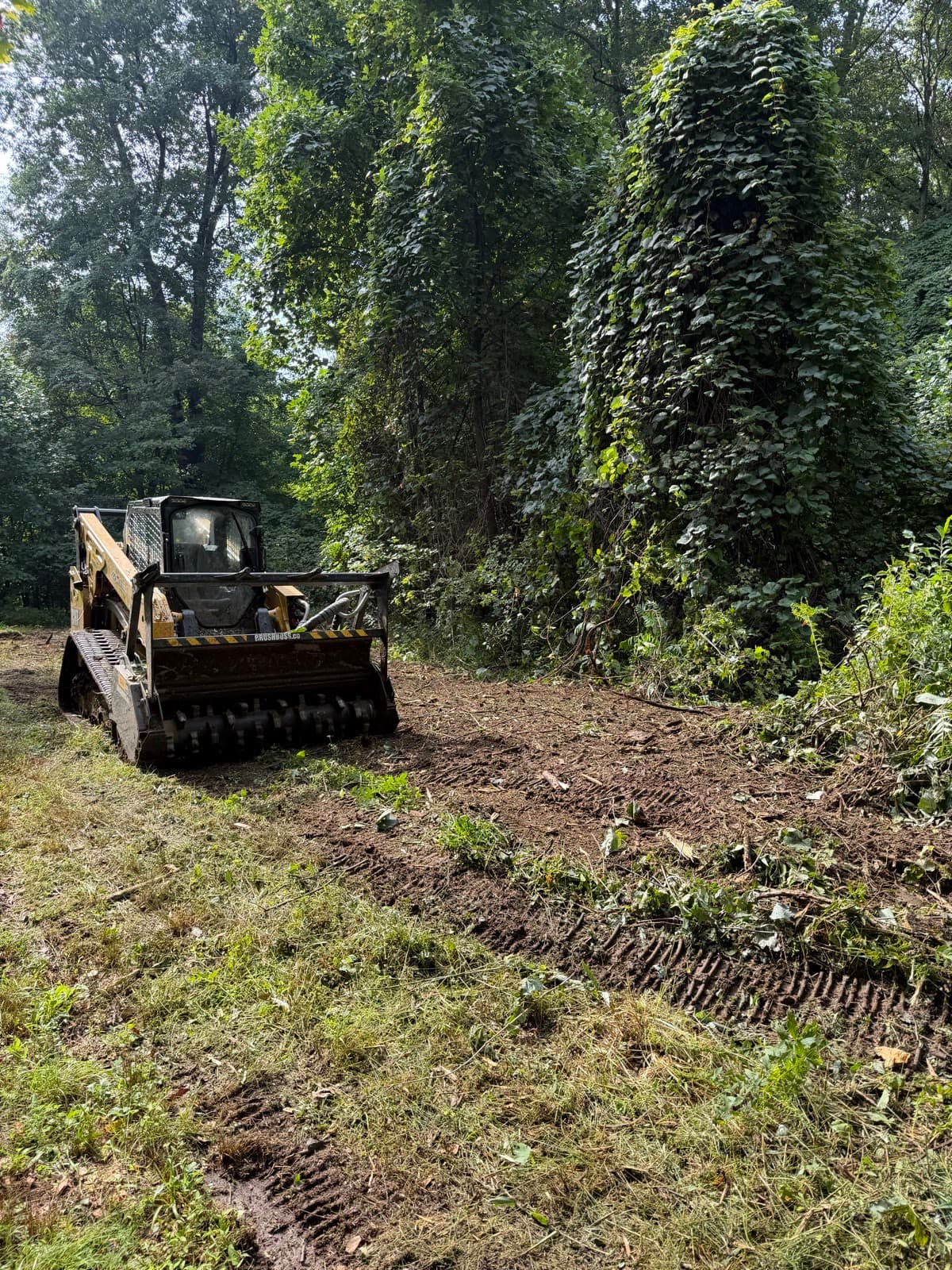
Actual BrushBoss job photograph. Results depend on your property.
Land recovery and property protection · Northeast Ohio
We give you your land back, and we make it safe to use.
The brush, thorn and poison ivy that grew up under your good trees comes out, and what you get back is ground you can walk without watching your step.
From $295 for an afternoon's work to full estate restoration.
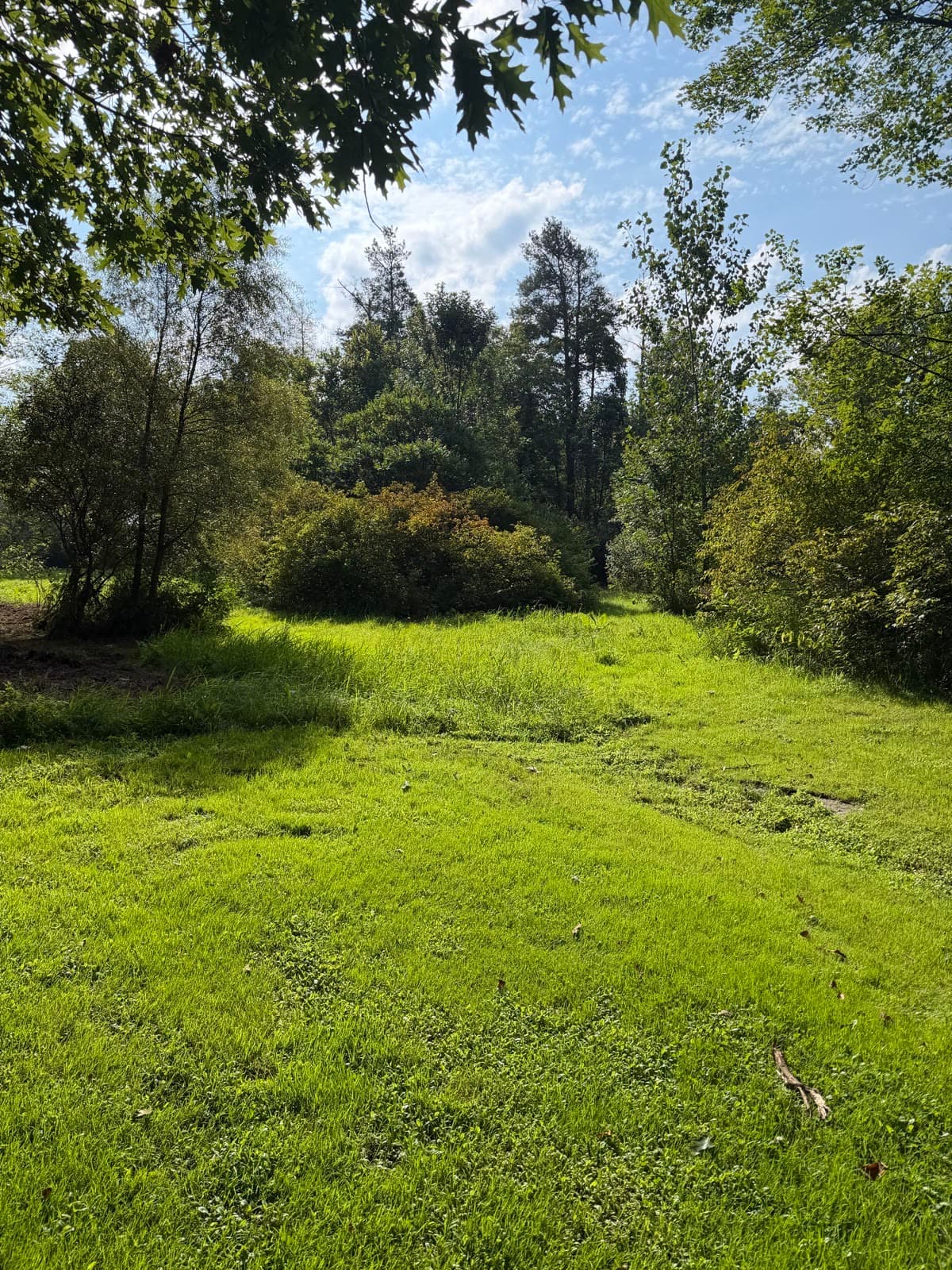 Actual BrushBoss footage · September 2026
Northeast Ohio · Woodland recovery
Real work. Real footage.
See past the tangle.
Brush and vines fill the space beneath your good trees. Start with the ground you want to use again.
Follow the transformation
How much does a forestry mulcher cost?
An entry setup costs $50,000 to $175,000, and a purpose-built machine costs several times that. One startup budget puts a compact track loader, a mulching head and a trailer at $50,000 to $175,000 [1]. Purpose-built tracked mulching machines run from $279,900 for a used one [2] to a $595,000 auction bid on a 2023 machine [3].
Two classes of machine do most of this work. The price gap between them is mostly a gap in how much ground each one gets through in a day.
| Factor | Entry tier | Purpose-built tier |
|---|---|---|
| What it is | A compact track loader, the tracked cousin of a skid steer, with a mulching head mounted on the front | A tracked machine designed around the mulching head, with no other job |
| Machine price | Loader $30,000 to $80,000 and head $12,000 to $35,000 [1]; $80,000 to $120,000 for the pair in one operator tool [4] | $279,900 for a used 2016 machine with 2,520 hours [2]; a 2023 machine bid to $595,000 [3]; "$400,000 or more" in one operator tool [4] |
| Trailer | An equipment trailer at $6,000 to $15,000 [1], towed by a one-ton pickup [5] | A new lowboy at $72,500 [6] to $87,800 [7], pulled by a heavy truck |
| Acres a day, light growth | 0.5 to 1.5 for a rental rig [5]; 2 to 3 for a skid steer in light brush [4] | 3 to 5 or more in typical Texas brush [5]; 4 to 6 in light brush [4] |
| Acres a day, dense hardwood | 0.5 to 2 with trees over 12 inches, for either class [4] | The same range: big trees slow every machine down [4] |
The $50,000 to $175,000 figure covers the entry tier, which is the setup most new operators start with [1]. Put a new lowboy trailer behind the purpose-built machines listed above and the pair comes to roughly $352,000 to $683,000 before the truck (our arithmetic). We found no source pricing a complete purpose-built setup, so we have not rounded that up to a bigger number.
The difference shows up on the ground. In a Forest Service bulletin, a clearing contractor says operators with a skid steer and a head bid work at a hundred dollars an acre, then find they get a quarter to half an acre a day done in heavy material, where he gets about five or six [8]. That is one contractor's account from western forest work, not a measured study. An operator tool puts large dedicated machines at two to four times the speed of a skid-steer rig [4].
Moving the machine: lowboy trailers and Ohio permit rules
A purpose-built mulcher travels on a lowboy trailer behind a heavy truck, and the trailer alone lists at $72,500 to $87,800 new [6][7]. If the loaded rig is wider, taller or heavier than Ohio's legal limits, it needs a Special Hauling Permit from ODOT [9].
ODOT's published limits for a vehicle and its load are 8 feet 6 inches wide, 13 feet 6 inches high and 80,000 pounds gross [10]. An oversized load on a state, US or interstate highway needs ODOT's permit, and on county, township or city streets the hauler has to contact the authority responsible for each street it uses [9]. Ohio's BMV also treats any combination of vehicles rated at 26,001 pounds or more as a Class A commercial vehicle [11], a licence class of its own for whoever drives it.
The entry tier is easier to move. At the Texas rental house, the loader rig tows behind a one-ton pickup, while the dedicated machines go out on a lowboy and the largest need heavy haul, quoted per project [5]. An operator tool notes that the big dedicated machines take more effort to mobilize [4], and the startup budget prices a used one-ton diesel pickup at $20,000 to $45,000 [1].
For you, moving the machine is a cost per trip, not per acre. On five acres it disappears into the price. On a driveway edge it would be most of the bill, which is why we schedule small jobs road by road so several properties share one trip. That lets BrushBoss flat-price the small work, $295 for a driveway or fence line, $495 for a longer strip and $750 for up to a quarter acre, with no project minimum.
Wear and running costs, from teeth to fuel
A mulcher wears out its cutting parts fast. A set of teeth lasts roughly 200 to 500 hours, and as little as 30 to 50 hours in hardwood or stumps, according to a parts vendor's guide [12].
- The same guide puts tooth wear at about $8 for every hour the machine runs, oil, filters and grease at about $10 an hour, and track wear on rough ground at around $400 a month [12].
- A rock hidden under the leaves can break a carbide tooth, and each one costs about $20 [4].
- An owner-operator's insurance adds general liability at $2,500 to $6,000 a year, cover for theft, rollover or fire on the machine at $1,500 to $4,500, and commercial auto for the truck and trailer at $2,000 to $5,000, in the startup budget's estimate [1].
- Fuel is the renter's to buy at the Texas rental house [5]. We did not find a government or university figure for how much these machines burn an hour, so we have not printed one.
A contractor's hourly machine rate rolls all of this into one number. In a 2006 Forest Service study, the rate was $300 an hour, including the operator's wage and a dedicated shop truck [13]. Virginia Tech's extension service puts clearing and mulching contractors at $200 to $400 an hour, and up to $1,200 for the largest equipment [14]. Both are older and from other regions; read them for how the cost is built, not as an Ohio price.
Wear also depends on who is at the controls. A Forest Service review of the research describes the work as violent, since it shatters and shreds wood, and notes that an inexperienced operator can damage a machine within a few weeks [15]. The same review says hard days wear these machines, and that replacing broken teeth makes easy road access to the site necessary [15].
Renting a forestry mulcher vs hiring a contractor
You can rent one, but the day rate is the smallest part of the job. One Texas rental house lists a track-loader mulching rig at $1,750 a day, requires the renter to carry $250,000 of equipment coverage and $2 million of general liability insurance, and leaves fuel, transport and the operator out of the rate [5].
Its dedicated machines rent by the week, at $11,000 to $14,000, and require $500,000 of equipment coverage with the same $2 million of liability [5]. Before you assume a homeowner's policy covers either, ask your agent in writing.
Then there is the learning curve. The Forest Service review describes an operator with hundreds of hours on these machines as the one who moves through a job efficiently, and concludes that the more experienced the operator, the more cost efficient the project, whatever the machine [15]. A new operator may need a spotter on the ground, and the spotter then stands within range of material thrown from the head [15]. The rental house includes an operating orientation on delivery [5]; that is a start, and the hours come afterwards, on your own ground.
Our arithmetic, not a quote. At $1,750 a day and 0.5 to 1.5 acres a day [5], rental alone works out to roughly $1,170 to $3,500 an acre, before fuel, transport, insurance or your own days at the controls. The same rental house will send its operator with that rig for $3,000 a day, transport included [5], which at the same output is $2,000 to $6,000 an acre. Its largest machine with an operator is $4,000 for an eight-hour day plus transport, at 3 to 5 or more acres a day [5], or roughly $800 to $1,330 an acre. These are Texas rates for Texas brush.
| Option | How you pay | What you carry | Cost per acre |
|---|---|---|---|
| Rent the machine and run it yourself | $1,750 a day for an entry rig [5] | Insurance, fuel, transport, the learning curve and any damage | About $1,170 to $3,500 in rental alone (our arithmetic) |
| Hire a tree service to clear by hand | $225 to $575 a crew-hour in one pricing analysis [16] | Whatever is done with the cut material; ask whether hauling is on the quote | No published figure we would stand behind |
| Hire a general contractor with an entry-tier rig | A day rate; $3,000 a day operated at the Texas rental house [5] | Little beyond the quote; ask whether transport is included | About $2,000 to $6,000 at that rate (our arithmetic) |
| Hire a land clearing specialist | By the acre. BrushBoss: $2,000 to $2,990. Other Ohio mulching contractors publish $1,850 to $3,500 [17] | Nothing beyond the written price | As quoted, fixed before work starts |
Renting can make sense for a confident operator with a small, open patch and an easy trailer drop. For a wooded acre or more, or ground with trees you want to keep, the hours behind the controls are what you are paying a contractor for. The landowner's guide to clearing overgrown land covers which parts are worth doing yourself.
What the investment means for your price per acre
An expensive machine lowers the price per acre when it clears enough ground to spread its cost. Virginia Tech's extension service puts it plainly: larger equipment costs more per hour, and it also works faster [14].
The Texas rates show the effect. The large operated machine costs a third more per day than the operated entry rig, $4,000 plus transport against $3,000 with it, and by our arithmetic it comes out lower per acre at every point in the two ranges, about $800 to $1,330 against $2,000 to $6,000, because it clears several times the ground [5].
Clearing by hand has the opposite cost structure: little capital, and a bill that grows with every hour on site. One pricing analysis found tree companies selling crew time at $225 an hour for a crew of three, and up to $575 for a larger crew [16]. Those rates do not fall as the acreage grows. Where the evidence is thin: we found no source publishing how many acres a day a hand crew clears in Northeast Ohio brush, so we have not put a per-acre number on it.
In Northeast Ohio, BrushBoss clears land for $2,000 to $2,990 an acre, set by how thick the growth is, and $3,900 to $5,100 an acre on ground too steep to walk. A Central Ohio contractor publishes forestry mulching at $1,850 to $3,500 an acre [17]. Both run above the Texas arithmetic. We have not found a source that explains the gap, so read the Texas figures as a picture of how machine size moves the price, not as what an Ohio acre should cost.
Whoever you hire, these questions get at the equipment behind the number:
- Is the price for the whole area, in writing, and fixed before work starts?
- What kind of machine will do the work, and is getting it here included?
- Who will run it, and how long have they run this kind of machine?
- Can I see a certificate of liability insurance?
- Which trees stay, and how will they be marked?
Where BrushBoss fits
BrushBoss is a land clearing company in Northeast Ohio. We give owners back the use of wooded and overgrown ground, priced at $2,000 to $2,990 an acre, with small jobs flat-priced from $295 and no project minimum, and the work is done without losing a tree worth keeping. If the job is one tree by the house, our guide to land clearing companies and tree services explains when an arborist is the better call. Every price is on the pricing page, and the Land Clearing Cost Calculator prices your own ground from a map.
Methodology and sources, updated October 2026
BrushBoss prices on this page come from our published price schedule. Every other figure comes from the sources below, each read on October 10, 2026, and is marked in the text with its number. We used government and university extension sources first: the Ohio Department of Transportation and the Ohio BMV for hauling rules, and the U.S. Forest Service and Virginia Tech for machine rates and operator skill. Machine and trailer prices, rental terms and wear costs have no public record outside listings, a rental house, vendor guides and startup budgets, so those are labeled as what they are.
Listings and auction bids are a point in time and will change, and an auction bid is not a sale price. The rental rates come from one Texas company, and the per-acre figures built from them are our arithmetic, not an Ohio price. We found no government or university source for fuel burn or for a hand crew's acres per day, and left both out rather than estimate them.
Sources
- Land Clearing Equipment Cost: 2026 Startup Budget. ReliableStartup.com (a startup-advice site), August 2026.
- Used 2016 purpose-built tracked mulcher, dealer listing. DDI Equipment (Colorado), listed as of October 10, 2026.
- 2023 purpose-built tracked mulcher, auction listing. Ritchie Bros. auction via BidProwl, bid as of October 10, 2026.
- Acres Per Day Calculator for Forestry Mulching. MulchDeck (operator software), accessed October 2026.
- Forestry Mulcher Rental Rates. Pierce Equipment Rentals (Texas), rates as of October 10, 2026.
- New lowboy trailer, dealer listing. NextTruck, listed as of October 10, 2026.
- New flip-neck lowboy trailer, dealer listing. Fastline, listed as of October 10, 2026.
- Is Mastication Right for Your Site? (Science You Can Use, Issue 45). USDA Forest Service, Rocky Mountain Research Station, November 2020.
- Special Hauling Permits. Ohio Department of Transportation, accessed October 2026.
- Legal Dimension and Weight Limits for Highway Vehicles (Form OS-8). Ohio Department of Transportation, Special Hauling Permit Section, rev. January 2019.
- Commercial Driver (CDL) Classes. Ohio Bureau of Motor Vehicles, accessed October 2026.
- Replacing Mulcher Teeth: How Often, How Much. Machine Mulcher (a parts vendor's guide), September 2025.
- Mastication: A Fuel Reduction and Site Preparation Alternative. USDA Forest Service, Rocky Mountain Research Station (Halbrook et al.), 2006.
- Options for Clearing Land to Establish Pasture (465-341). Virginia Cooperative Extension, Virginia Tech, 2021.
- To Masticate or Not: Useful Tips for Treating Forest, Woodland, and Shrubland Vegetation (RMRS-GTR-381). USDA Forest Service, Rocky Mountain Research Station (Jain et al.), 2018.
- Tree Service Cost Per Hour: Man-Hour vs Crew-Hour. TrueTradeCost (a pricing-tool vendor), September 2026.
- How Much Does Land Clearing Cost Per Acre in Central Ohio?. Fortress Level Construction (an Ohio contractor), reviewed July 2026.
Land Clearing Equipment Cost: Common Questions
How much does a forestry mulcher cost?
An entry setup, a compact track loader with a mulching head and a trailer, runs $50,000 to $175,000 in one startup budget. Purpose-built tracked mulching machines run from $279,900 for a used 2016 machine at one dealer to a $595,000 auction bid on a 2023 machine as of October 10, 2026, before a lowboy trailer listed at $72,500 to $87,800 new.
Can I rent a forestry mulcher?
Yes. One Texas rental house lists a track-loader mulching rig at $1,750 a day and dedicated machines at $11,000 to $14,000 a week. It requires the renter to carry equipment coverage of $250,000 to $500,000 and $2 million of general liability insurance, and fuel, transport and the operator are not in the rate.
Do you need a permit to haul a forestry mulcher in Ohio?
Only if the loaded truck and trailer exceed Ohio's legal limits, which ODOT publishes as 8 feet 6 inches wide, 13 feet 6 inches high and 80,000 pounds gross. Above those, a Special Hauling Permit from ODOT is needed on state, US and interstate highways, and the county, township or city has to be contacted for its own streets.
How long do forestry mulcher teeth last?
A parts vendor's guide puts a set at roughly 200 to 500 hours, and as little as 30 to 50 hours in hardwood or stumps. The same guide estimates tooth wear at about $8 for every hour the machine runs.
Is it cheaper to rent a mulcher or hire a land clearing company?
For a small, open patch and an experienced operator, renting can be. For a wooded acre or more, rental alone at one Texas rate works out to roughly $1,170 to $3,500 an acre by our arithmetic, before fuel and transport, and before you have insured the machine and learned to run it. BrushBoss clears land in Northeast Ohio for $2,000 to $2,990 an acre, priced in writing before work starts.
Skip the Rental Counter.
Get a Fixed-Price Quote.
Draw the area in the Land Clearing Cost Calculator and see the number in under a minute, with nothing to haul, insure or learn to run.
You own the land. You just cannot use it.
That is one layer of brush, and it comes off in a morning.
We'll tell you what it costs. From $295, no project minimum.
Ground you can walk without watching your step — because we take the cover out.
Without losing a tree worth keeping.