Do I Need an Arborist?
When to Call One Instead of Us
You need an arborist when the job is one tree that matters or one tree that could hurt someone: pruning a tree you are keeping, a dead, cracked or leaning tree that could reach the house or drive, a storm tree hung up in another, or a question about a tree's health. Look for an ISA Certified Arborist. A tree touching a power line is a call to the electric utility first. Brush and unwanted growth across acreage, with the good trees kept, is land clearing work, which BrushBoss does for $2,000 to $2,990 an acre.
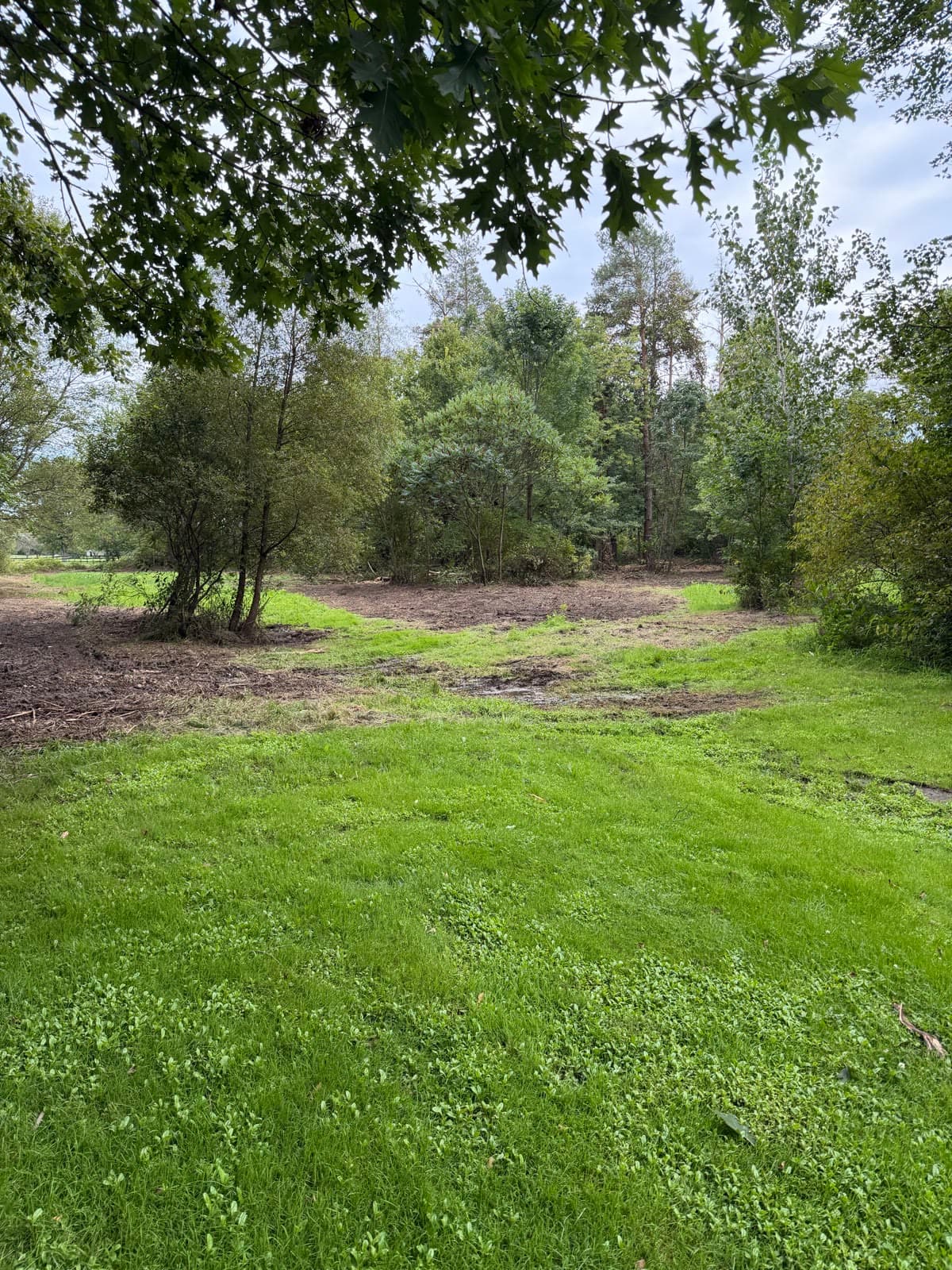
Actual BrushBoss job photograph. Results depend on your property.
Land recovery and property protection · Northeast Ohio
We give you your land back, and we make it safe to use.
The brush, thorn and poison ivy that grew up under your good trees comes out, and what you get back is ground you can walk without watching your step.
From $295 for an afternoon's work to full estate restoration.
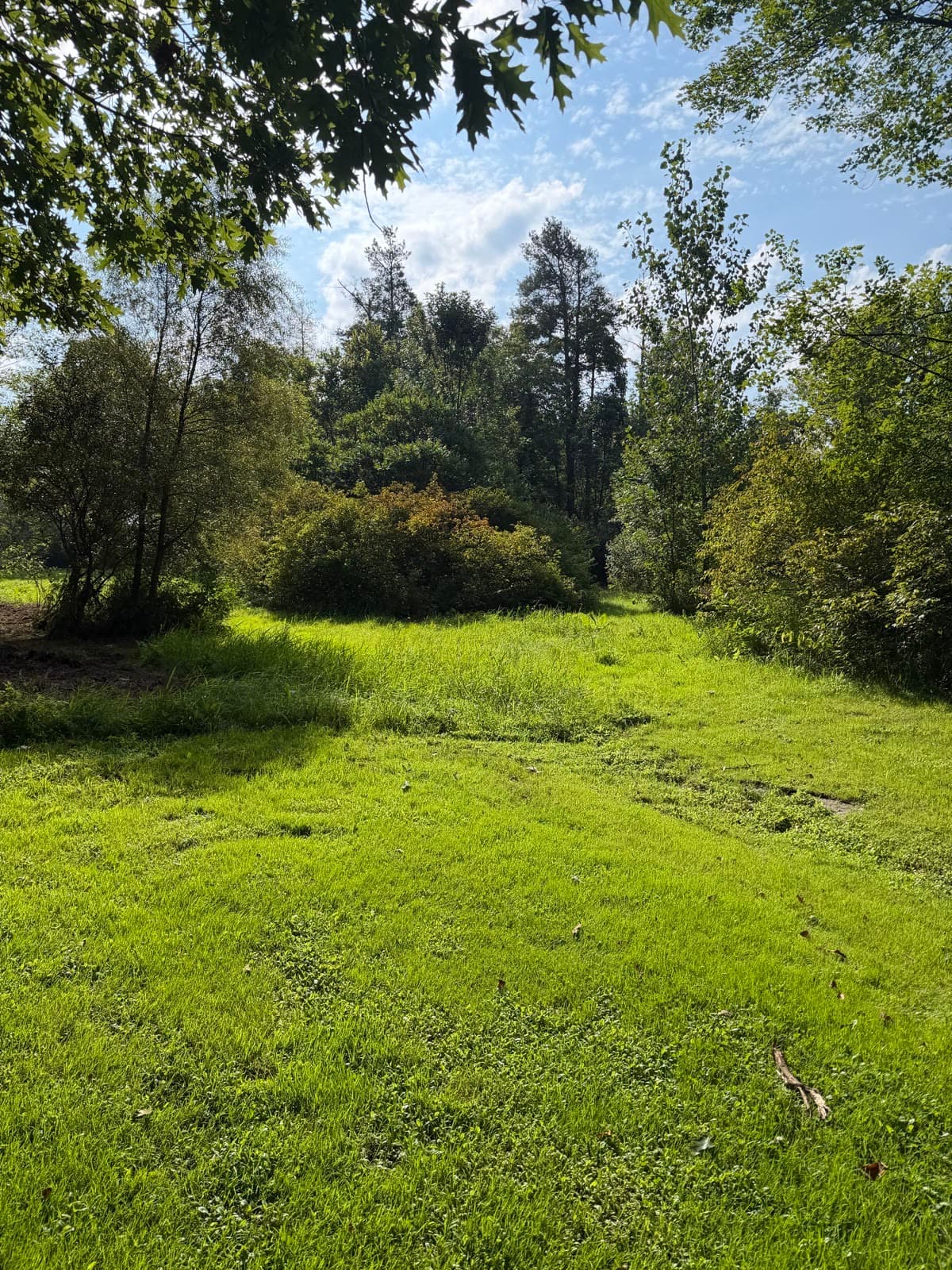 Actual BrushBoss footage · September 2026
Northeast Ohio · Woodland recovery
Real work. Real footage.
See past the tangle.
Brush and vines fill the space beneath your good trees. Start with the ground you want to use again.
Follow the transformation
Do I need an arborist? Sort the job first
Sort by the tree and by what it could hit. One tree you want to keep, or one that could fall on something, is arborist work. Ground taken over by brush and unwanted young trees is land clearing work. Anything touching a power line belongs to the electric utility before anyone else.
Tree care companies prune and remove trees, look after plant health, and install cabling and bracing [1]. Ohio State University Extension defines an arborist as someone trained in selecting, planting and maintaining individual trees [2].
| The job | Who to call | Why |
|---|---|---|
| Pruning or thinning a tree you are keeping | An arborist | An arborist can decide what kind of pruning the tree needs [3] |
| A dead, cracked or leaning tree that could reach the house, garage, drive or a play area | An arborist, and for an opinion on whether it will fail, one who holds TRAQ | OSU Extension says tree risk assessment should be done only by a professional with the TRAQ credential [2] |
| A storm-damaged tree hung up in another tree or resting on a roof | An arborist | Removing or pruning storm-damaged trees is dangerous work [3] |
| A tree or limb on or near a power line | The electric utility, first | Never approach a fallen tree that may be touching a line [4] |
| A question about a tree's health | An arborist | Certified Arborists are trained in tree diagnostics and treatment [2] |
| Taking down one large tree in a tight yard | An arborist or a tree service with one on staff | Large trees taken down by non-professionals put lives and property at serious risk [2] |
| One stump in a lawn | A stump grinding or tree service company | We grind stumps only inside ground we are already clearing |
| Brush, thorn and crowding young trees across an acre or more, with the good trees kept | A land clearing company | Priced by the acre. The land clearing company vs tree service guide compares the two |
What an ISA Certified Arborist is, and what TRAQ and Master Arborist add
An ISA Certified Arborist has passed the International Society of Arboriculture's certification exam and keeps the credential through continuing education. TRAQ, the Tree Risk Assessment Qualification, adds training in a standard method for judging tree risk, and Board Certified Master Arborist is the highest certification ISA offers.
The word arborist on a truck door proves nothing by itself. The Better Business Bureau notes that titles such as arborist or tree surgeon require no certificate or training [5]. ISA certification is voluntary and nongovernmental, and a Certified Arborist has to keep up continuing education to hold it [3]. OSU Extension lists the training behind it: tree biology, soils and fertilization, planting, pruning, diagnosis and treatment, protecting trees from construction damage, and worker safety [2].
| Credential | What it shows | When to ask for it |
|---|---|---|
| ISA Certified Arborist | Training across all of tree care, under a code of ethics [6]. No other ISA credential can be earned without it [2] | Any pruning, removal or tree health question |
| ISA Certified Tree Worker Climber Specialist | Skill at climbing, pruning and safely taking down large trees [2] | Branch removal on a large, mature tree that means climbing it [2] |
| ISA Certified Tree Worker Aerial Lift Specialist | The same work, done from an aerial lift [2] | Before anyone uses a lift on your property [2] |
| ISA Tree Risk Assessment Qualification (TRAQ) | A two-day course, then written and performance-based assessments, in a standard process for assessing tree risk [7] | A tree that could hit the house, the drive or a place people gather |
| ISA Board Certified Master Arborist | ISA's highest certification. Fewer than two percent of Certified Arborists hold it [8] | Tree appraisals, a hard diagnosis, or a second opinion on a tree you value [2] |
Certification is a floor, and ISA says as much: it shows the minimum knowledge and skill for the scope of the credential [9]. It does not insure the crew or settle the price. Use it to build a shortlist, then hire on the checks further down this page.
Hazard and storm trees near the house and wires
A tree that could hit the house, the drive, a play area or a line needs an arborist, and the call on whether it is likely to fail should come from one who holds TRAQ. These are the jobs where tree work injures people.
OSHA names falls, electrocutions and being struck by trees as the ways tree workers get hurt or killed [10]. Its guidance to crews is to keep work at least 10 feet from power lines or have the power company de-energize them, and to secure a drop zone at least twice the height of the tree [10]. ISA says removing or pruning storm-damaged trees is dangerous, and that a professional arborist can do it while reducing the risk to people and property [3].
Call an arborist, not a clearing crew, when you see any of these:
- A tree or a large limb hung up in another tree after a storm.
- A trunk leaning over the house, the garage, the drive or a fence, particularly a lean that is new.
- A split trunk, a big dead limb over a path, or a tree resting on a roof.
- A tree you think is dead or dying, close to where people walk or park.
Do not wait a season to see. OSU Extension notes that a live tree usually costs less to remove than a dead one, because brittle wood makes the work riskier, so a tree with life-ending problems is best taken down while it is still alive [2].
We do not take these jobs, and that includes hung-up trees and trees leaning over a structure. A tree that has to be climbed, rigged and lowered in pieces beside a roof needs a climber and an arborist's judgement.
Utility-line trees: who to call in Ohio
If a tree or limb is on or near a power line, keep away from it and call the electric utility. The utility looks after its lines and the clearance around them. The debris, and any tree work you order yourself, are yours.
Ohio law requires electric utilities to keep their lines safe, and that can mean trimming or removing trees in the right-of-way, even on your property, according to the Office of the Ohio Consumers' Counsel [4]. Each utility files a vegetation management plan with the Public Utilities Commission of Ohio (PUCO). Utilities often give notice before routine trimming but are not required to, and notice is rare in an emergency. The OCC's advice is to call the utility as soon as you are notified, because waiting until the crew is in the yard is too late [4].
FirstEnergy's Ohio companies include The Illuminating Company and Ohio Edison [11], and your electric bill names yours. FirstEnergy says its vegetation program does not clean up trees and limbs brought down by storms, that storm debris is the property owner's job, and that wood too big for the chipper is cut and left near the base of the tree [12]. If you hire your own tree work near the wires to your house, FirstEnergy offers to disconnect service temporarily for a nominal fee, booked several business days ahead [13].
A fallen tree that may be touching a line is an emergency. Do not go near it. Call the utility straight away. Complaints about utility tree trimming go to PUCO at 1-800-686-7826 [4].
How to hire an arborist
Check the credential yourself, get at least three written quotes, see proof of liability and workers' compensation insurance, and sign a written contract before work starts. Do not pay in advance.
- Describe the job, then look up credentials. ISA's Find an Arborist directory exists to locate and verify ISA credential holders [9], and OSU Extension suggests searching by ZIP code or city to see which credentials local arborists hold [2]. Listing is voluntary, so if someone is missing, ask which credential they hold and check it.
- Get several quotes. Virginia Tech's extension guide and the BBB both advise three [14] [5]. OSU warns that you may have to pay for an estimate, and says it is worth it [2].
- Ask for certificates of insurance covering liability for personal and property damage, and workers' compensation, then phone the insurer to confirm the policy is current [2]. The BBB points out that your homeowner's policy is not enough if someone is hurt doing tree work on your property [5].
- Get a written contract with start and finish dates, the exact cost, the work to be done, and what cleanup and stump work it includes [5] [2].
- Ask about local permits. If anything will be sprayed, the company needs a current pesticide applicator license from the Ohio Department of Agriculture [2].
- Pay as the work is finished, never up front [2].
Red flags: topping and storm chasers
Walk away from a crew that recommends topping, and from anyone who knocks after a storm offering to cut today for cash.
Topping means cutting a tree's branches back to stubs to make it smaller. ISA calls it perhaps the most harmful tree pruning practice known: it can remove 50 to 100 percent of the leaf-bearing crown, and the shoots that grow back are weakly attached and prone to breaking in wind and ice [15]. OSU Extension says an ISA-credentialed arborist would never recommend it, and that it raises the risk of breakage it is meant to reduce [2]. The BBB adds lion's-tailing, and climbing spikes on a tree being pruned, to the practices outside industry standards [5]. The accepted exception is utility clearance, where tops sometimes have to come off to keep lines clear [2].
OSU warns about door-knocking salespeople, who are especially common after storms, and advises against being rushed by bargains or deadlines [2]. The Ohio Attorney General described the usual pattern: a trimmer comes to the door, quotes a low price, takes payment, cuts a few trees, leaves the stumps and limbs on the lawn and never comes back [16].
Under Ohio's Home Solicitation Sales Act you generally have three business days to cancel a contract that came from a door-to-door sale, and the seller generally cannot start work until that period ends. The Attorney General also advises a second opinion from another company [16]. That warning dates from 2015. The office issued a fresh caution about storm-related scams in August 2026, and complaints can be filed at OhioAttorneyGeneral.gov [17].
Jobs where both trades are involved
On wooded property the two trades often work the same ground, one after the other. The arborist assesses and prunes the trees you are keeping and takes down any hazard tree near the house. The land clearing company then opens up the understory around what stays.
Say brush has closed in around a few big oaks, and one has a dead limb over the path to the pond. The arborist deals with the limb and says which trees are worth keeping. We take out the brush, thorn and crowding young trees around them, and the woods can be walked again.
Order matters. Marking the trees to keep comes before any machine work, and Texas A&M Forest Service gives flagging the individual plants to protect as part of preparing for a mulching job [18]. On a BrushBoss job the trees that stay are agreed with you and flagged before anything starts, and a larger tree comes down only if it is named in your written scope, in which case it is cut and stacked rather than mulched. If an arborist has marked trees for you, bring the list and it goes into the scope as written.
Diagnosing a tree's health is the arborist's work, not ours. We also apply no herbicide. A treatment is work for a licensed applicator.
We have not found a public study comparing results when the two trades work in this order, so treat it as practice rather than proof. The woodland restoration and underbrush clearing pages show the clearing half on estate woods.
Where BrushBoss fits
BrushBoss is a land clearing company in Northeast Ohio. We give owners back the use of wooded and overgrown ground, without losing a tree worth keeping. Acreage is priced at $2,000 to $2,990 an acre by density, small jobs start at $295, and every price is on the pricing page. Single trees, hazard trees and anything near wires fall outside that work. If you call us about one of these jobs, we will tell you it is tree-service work and point you to a local arborist.
Methodology and sources, updated October 2026
BrushBoss prices come from our published price schedule. Every other claim comes from the sources below, each read in October 2026 and marked with its number. We favored ISA, university extension, Ohio state offices and federal safety guidance, and used the Better Business Bureau and FirstEnergy where they are the direct public record.
Some of the evidence is older. The Attorney General's tree-trimming warning dates from 2015 and Virginia Tech's hiring guide from 2014, and we use them only for advice that newer sources repeat. The credential descriptions come from the body that issues them. Nothing here is legal advice about easements or a utility's rights on your land.
Sources
- Tree Care Industry: Overview. U.S. Occupational Safety and Health Administration, accessed October 2026.
- How and Why to Hire an Arborist (HYG-1032). Ohio State University Extension (Boggs, Stone and Meyer), March 2025.
- Why Hire an Arborist?. International Society of Arboriculture (TreesAreGood.org), accessed October 2026.
- Utility Line Clearing and Tree Trimming. Office of the Ohio Consumers' Counsel, accessed October 2026.
- BBB Tip: How to hire a reputable arborist or tree service company. Better Business Bureau, 2023.
- ISA Certified Arborist. International Society of Arboriculture, accessed October 2026.
- ISA Tree Risk Assessment Qualification. International Society of Arboriculture, accessed October 2026.
- ISA Board Certified Master Arborist. International Society of Arboriculture, accessed October 2026.
- Find an Arborist. International Society of Arboriculture (TreesAreGood.org), accessed October 2026.
- Tree Care Work: Know the Hazards (OSHA 3752). U.S. Occupational Safety and Health Administration, 2014.
- About FirstEnergy. FirstEnergy, accessed October 2026.
- Homeowner Rights and Responsibilities. FirstEnergy, accessed October 2026.
- Temporary Disconnection for Tree Work. FirstEnergy, accessed October 2026.
- Hiring an Arborist to Care for Your Landscape Trees (ANR-131). Virginia Cooperative Extension, Virginia Tech, 2014.
- Why Topping Hurts Trees. International Society of Arboriculture (TreesAreGood.org), accessed October 2026.
- Attorney General DeWine Warns Consumers of Tree-Trimming Scams. Ohio Attorney General, August 14, 2015.
- Attorney General Andy Wilson's Statement on Storm-Related Scams. Ohio Attorney General, August 12, 2026.
- Mulching and Shredding. Texas A&M Forest Service, accessed October 2026.
Do I Need an Arborist? Common Questions
Do I need an arborist to cut down a tree?
For one tree near the house, the drive, a fence or wires, yes, or a tree service with ISA Certified Arborists on staff. Ohio State University Extension warns that large trees taken down by non-professionals put lives and property at serious risk. Brush and young trees spread across open acreage, with nothing to fall on, are land clearing work instead.
Is an arborist the same as a tree service?
Not always. An arborist is a person trained in the care of individual trees. A tree service is a company, and it may or may not employ ISA Certified Arborists. The Better Business Bureau notes that the title arborist needs no certificate, so ask which credential the person doing your work holds and check it in ISA's Find an Arborist directory.
Who handles a tree touching a power line in Ohio?
The electric utility. Do not go near a fallen tree that may be touching a line. Call the utility at once. Ohio law requires utilities to keep their lines safe, and complaints about utility tree trimming go to the Public Utilities Commission of Ohio at 1-800-686-7826, according to the Office of the Ohio Consumers' Counsel.
Will BrushBoss remove a leaning or storm-damaged tree?
Not one that is hung up in another tree, leaning over a structure or near wires. Those are arborist jobs, and we will say so and point you to a local arborist. Our work is clearing brush and unwanted growth across acreage, with the good trees kept.
Can BrushBoss clear around trees an arborist has told me to keep?
Yes. The trees that stay are agreed and flagged before work starts, and we take out the brush, thorn and crowding young trees around them. Bring the arborist's list and it goes into the written scope.
Brush Around Trees You Are Keeping?
Get a Fixed-Price Quote.
Draw the area in the Land Clearing Cost Calculator and see the number in under a minute. One tree by the house or near the wires? Call an arborist; we will tell you the same.
You own the land. You just cannot use it.
That is one layer of brush, and it comes off in a morning.
We'll tell you what it costs. From $295, no project minimum.
Ground you can walk without watching your step — because we take the cover out.
Without losing a tree worth keeping.