How to Get Rid of Bush Honeysuckle in Ohio — and Keep It Out
By Kyle Abbey · ·
To get rid of bush honeysuckle, pull the seedlings by hand, clear established shrubs and thickets, and then cut back the resprouts for the next two to three seasons, because a cut honeysuckle crown grows back with more stems than it had. In Northeast Ohio that usually means Amur honeysuckle, with Morrow’s and Tatarian mixed in: the shrubs that green up first in spring, stay green last in fall, and turn an open woods into a wall you cannot see through. Below: the ten-second stem test, the method for each scale, the follow-up calendar, extension guidance on herbicide, and what to plant back.
Instant QuoteLand recovery and property protection · Northeast Ohio
We give you your land back, and we make it safe to use.
The brush, thorn and poison ivy that grew up under your good trees comes out, and what you get back is ground you can walk without watching your step.
From $295 for an afternoon's work to full estate restoration.
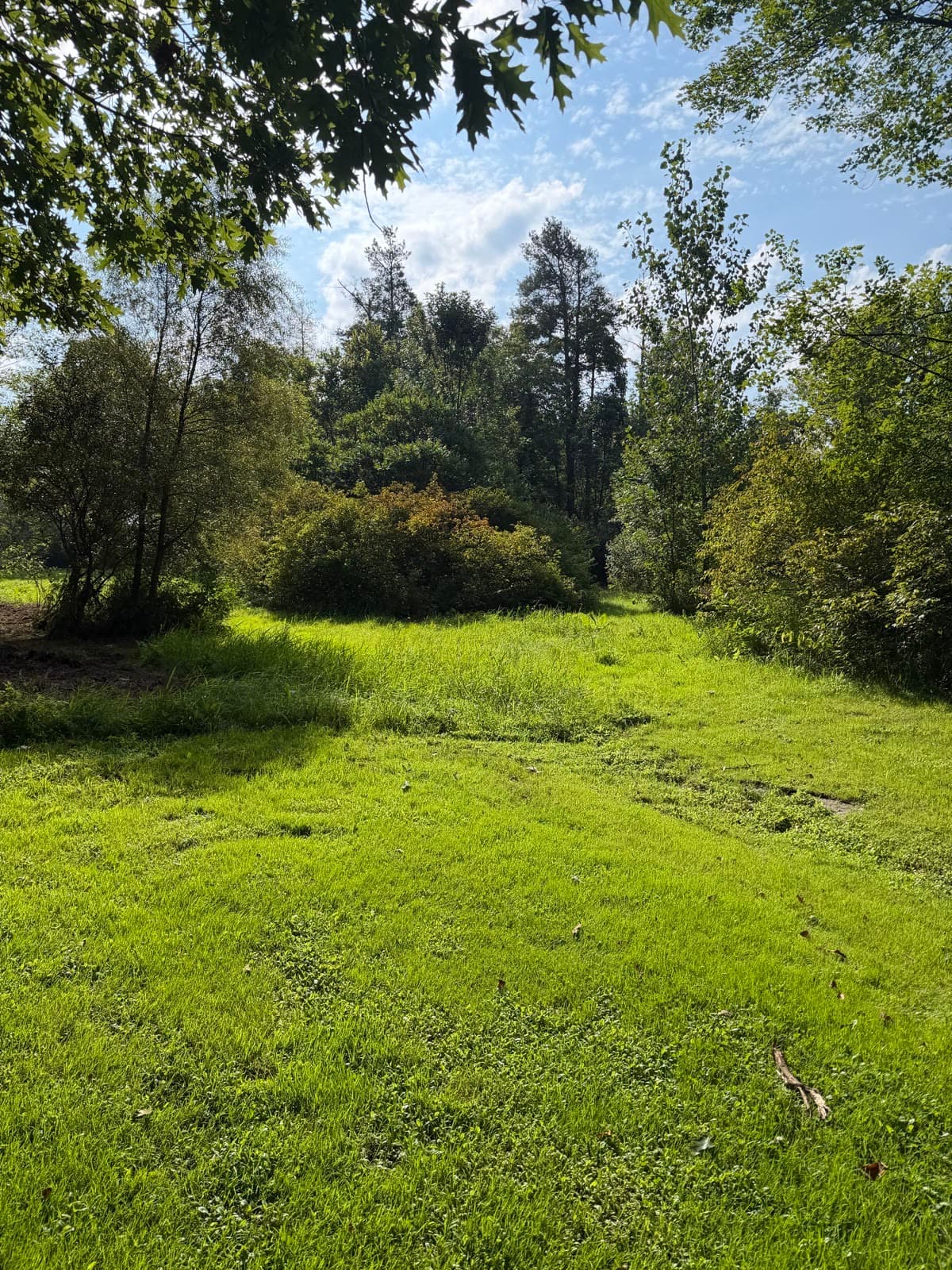 Actual BrushBoss footage · September 2026
Northeast Ohio · Woodland recovery
Real work. Real footage.
See past the tangle.
Brush and vines fill the space beneath your good trees. Start with the ground you want to use again.
Follow the transformation
The short answer
Seedlings come out by hand. Established shrubs have to be cut and then kept from resprouting, and a thicket that has taken over a woods is cleared as a whole and then held for the first few seasons while the old roots give up. Ohio State University Extension is plain about the trap: simply cutting the shrub off at the base causes prolific sprouting and increases the number of stems.
What nobody can honestly promise is that it will never come back. Birds keep carrying seed in from neighbouring hedgerows and woods, so the realistic goal is a woods where the thicket is gone, the floor is open and walkable, and any new seedling is small enough to pull on an afternoon walk. If you would rather hand the thicket to someone else, our honeysuckle removal service page explains how we approach it.
How do you identify bush honeysuckle?
"Bush honeysuckle" is a group. In Northeast Ohio it is usually Amur honeysuckle (Lonicera maackii), with Morrow’s, Tatarian and Bell’s honeysuckle mixed in. They behave alike and are removed alike. OSU Extension records that they arrived from Europe and Asia in the mid to late 1800s as ornamentals and wildlife cover, and now grow six to twenty feet tall on shallow roots. Four checks settle it:
- Split a stem. Cut a branch two or more years old lengthwise. The invasive bush honeysuckles are hollow, and Minnesota DNR describes that core as a hollow brown pith. OSU Extension notes that native honeysuckle has a solid stem. It is the most reliable single test, in any season.
- Check the leaves. Pairs directly opposite each other along the stem, one to three and a half inches long, smooth-edged with no teeth. Amur leaves end in an abruptly long point.
- Check the shape and bark. A fountain of long arching branches rather than a single trunk, with older stems greyish-brown and ridged so they look striped.
- Look for paired berries. Small round berries, usually red, sit in pairs where the leaves meet the stem from midsummer into fall.
The calendar tell: first green, last green
OSU Extension notes that the bush honeysuckles leaf out earlier in spring and hold their leaves later in fall than most native trees and shrubs. That gives you two free surveys a year. In April, the green haze in a still-bare woods is the honeysuckle. In late October and November, after the maples and oaks have dropped, the shrubs still in leaf are the honeysuckle again.
Look-alikes worth keeping
Several native shrubs also have opposite leaves, and they are the ones you want back once the honeysuckle is gone. Penn State Extension’s invasive shrub guidance warns specifically against mistaking native viburnums and dogwoods for invasive shrubs.
When in doubt, split the stem. Hollow means invasive bush honeysuckle; solid means leave it and look again.
Why honeysuckle matters on an estate
The cost is not the shrub but what disappears beneath it: the long views between the trunks, the light on the forest floor, and in time the young trees that would replace the old ones.
It shades out the forest floor
OSU Extension describes honeysuckle as shading out desirable native woodland species and forming pure, dense thickets totally void of other vegetation. The early leaf-out is why. Spring wildflowers and tree seedlings do much of their growing before the canopy closes, and honeysuckle takes that light first.
It stops the next generation of trees
In a survey of 93 forest stands near Oxford, Ohio, Hutchinson and Vankat (1997) found that tree seedling density, the variety of tree species among those seedlings, and herb cover all fell as Amur honeysuckle cover rose. In plain terms, the oaks and maples standing over a thicket today may have nothing coming up to replace them. Removing it is how an owner protects the canopy they want to keep, and it is the core of our woodland restoration work: the understory goes, and every good tree stays.
How to remove honeysuckle, by the size of the problem
The right method depends almost entirely on scale: a few seedlings along a lawn edge, a hedge line of mature shrubs, and two acres of woods gone solid green are three different jobs. Match the method to the job and the work is finite; mismatch it and you are back every year.
Seedlings and small shrubs: pull them
This is the scale where doing it yourself clearly wins. OSU Extension notes that small plants are shallow-rooted and pull out fairly easily, best after a rain, and that essentially every root has to come out. Shrubs too big to pull by hand can often be levered out whole with a lever-style root puller, the tool sold as a weed wrench; with the root crown gone there is nothing left to resprout. Fill the hole and cover the soil with leaf litter so it does not become a seedbed.
Large shrubs: never just cut
A mature honeysuckle cut at the base does not die. It pushes a ring of new stems from the crown, and a year later it is bushier than the one you cut. So a cut is only half a method. The other half is the crown: either treated the way extension services describe below, or cut back repeatedly while the regrowth is small until the root gives up. OSU Extension notes that cutting works best started in early summer, when the plant’s food reserves are at their lowest, and that repeated removal can eventually exhaust a small shrub.
Thickets: clear the whole stand at once
When honeysuckle has become the understory, working shrub by shrub stops being realistic. This is where forestry mulching earns its place. Prickly briars, scrub and the unwanted trees crowding your good ones go in one end, and clean mulched wood chips come out the other. Nothing is burned, nothing is hauled away, and no roots are pulled — the chips are spread where they fall and left as cover, so what you walk out onto is groomed rather than merely cut.
That gives you the woods back: the trunks visible, the ground walkable, the view through to the far side. What it does not do is kill the root crowns, because nothing is pulled. They will resprout, and Penn State Extension is clear that cutting invasive shrubs is not a standalone treatment. The clearing is the expensive part. The follow-up is cheap, provided it happens while the regrowth is small.
Will honeysuckle grow back? The follow-up calendar
Yes, from two directions: cut crowns resprout, and birds deliver new seed. Neither is a reason not to clear. Both are reasons to plan the first three years before you start.
| When | What to do |
|---|---|
| Late fall and winter, year one | Clear the thicket. The native trees are bare, so every honeysuckle stem is easy to see. |
| Late spring to early summer, year one | The first flush of resprouts: soft and ankle- to knee-high. Cut it back while it is small. |
| Late October, year one | Walk the ground. Anything still green after the natives drop is honeysuckle. Flag it. |
| Year two | A smaller flush from surviving crowns, plus the first seedlings. Same approach, far less of it. |
| Year three onward | Mostly bird-sown seedlings. Pull them on a spring and fall walk. |
Our guide to stopping regrowth after clearing covers the same principle for other brush. For honeysuckle, BrushBoss quotes include a written follow-up plan for cutting the regrowth back while it is ankle-high, so the second half of the work is agreed before the first half starts.
Skipping the first summer’s follow-up is how a cleared honeysuckle woods closes in again, and it is the cheapest visit of the project.
What extension services say about herbicide
Both OSU Extension and Penn State Extension treat herbicide as the most effective way to kill a mature honeysuckle root, because it reaches the crown that cutting leaves behind. This summary is for an informed conversation, not a recommendation of any product, and it is not a service BrushBoss provides: our work is mechanical, and we do not apply herbicide. If it is used, it is done by the owner on their own land, following the label exactly, or by a licensed commercial applicator. Product names and rates are on the label and in the linked fact sheets.
- Cut-stump. OSU calls it very effective: the shrub is cut close to the ground and the cut surface treated. Late summer, early fall and the dormant season all work; spring, when sap is rising, does not.
- Basal bark. For shrubs left standing, an oil-carried product on the lower twelve to eighteen inches of each stem in the dormant season. OSU notes the arching habit makes the base hard to reach.
- Late-fall foliar. Because honeysuckle stays green into late October after most natives are dormant, OSU notes late-fall foliar work can reach it with little impact on other plants.
If you hire this out, ask to see the applicator’s licence, and time the clearing around the treatment rather than against it.
When is the best time to remove honeysuckle?
Late fall into winter, for finding and clearing it. OSU Extension notes that honeysuckle stays green into mid to late October, when most native plants have gone dormant, so late fall is when it is easiest to see exactly where it is. Once the leaves are down every stem is visible and the ground is firmer, which makes it our preferred season for clearing a thicket. Early summer is the time to cut regrowth, because OSU notes the plant’s food reserves are lowest then. Seedlings can be pulled in any season, whenever the soil is moist enough to let the whole root go.
What to plant after honeysuckle removal
Open, sunlit soil is an invitation, so give it to something you want. That is also how the European-woods look is made: tall trunks, an open floor, and a low layer of native shrubs in the light.
Choose from the Ohio Department of Natural Resources’ selected Ohio native plants lists rather than a nursery tag that simply says "native". For the shaded understory of a woods, three reliable choices appear on ODNR’s upland woods list, and OSU Extension’s native shrubs fact sheet covers what they offer wildlife:
- Spicebush (Lindera benzoin): an understory shrub of moist woods found throughout Ohio, and one of the first to bloom in spring. It genuinely thrives in shade.
- Pawpaw (Asimina triloba): a native understory and woodland-edge tree that slowly forms a colony, which is exactly the behaviour you want holding ground.
- Native viburnums: arrowwood, blackhaw and mapleleaf viburnum. OSU Extension notes they adapt from full sun to part shade, and that mapleleaf viburnum is the shade-tolerant one.
Watch what comes up on its own in the first spring before buying anything; some of it may be natives the thicket was holding back. Pull the honeysuckle seedlings among it, and plant into the gaps.
What honeysuckle removal costs
BrushBoss publishes one price per unit of work, the same figures that appear on our pricing page. Small jobs are flat-priced; woodland work is priced per acre by how dense the growth is.
| Work | Price |
|---|---|
| A hedge line or fence line of honeysuckle, up to 500 sq ft | $295 |
| A longer strip along an edge, up to 1,000 sq ft | $495 |
| A corner or back edge, up to a quarter acre | $750 |
| Honeysuckle out of standing woods, every good tree kept | $2,000 – $2,990 / acre |
No project minimum. Small jobs are flat-priced, larger work is priced by the acre, and you get the number before anything starts.
A young hedge sits at the lower end of the per-acre band and a decades-old solid stand at the top. The number is fixed in writing after a walk of the property, with the follow-up plan included. See honeysuckle removal for how the work is done, or ask for a walk-through.
Every BrushBoss clearing project includes a workmanship guarantee. If we miss material within the agreed clearing zone, we come back and finish — free.
The Order of Operations
- 01
Confirm it: split a two-year-old stem. Invasive bush honeysuckle is hollow; native honeysuckles are solid.
- 02
Map it in late fall, when the shrubs still in green leaf after the native trees drop are honeysuckle.
- 03
Match the method to the scale: pull seedlings, lever out small shrubs whole, clear thickets as a stand.
- 04
Plan the resprouts before you cut, and cut the first summer’s flush back while it is ankle-high.
- 05
Hold the ground for three seasons, then plant natives into the light.
Frequently Asked Questions
How do I tell invasive bush honeysuckle from a native honeysuckle?
Cut a stem two or more years old. Invasive bush honeysuckle is hollow, usually with a brown pith; native honeysuckles are solid. The invasive species also have opposite, untoothed leaves and stay green later in fall than most native shrubs.
Will honeysuckle grow back after it is cut or cleared?
Yes. OSU Extension notes that cutting a shrub at the base causes prolific sprouting, and clearing leaves the root crowns in place. Expect a flush of resprouts the first summer and a smaller one the second. Cut them back while ankle-high and pull new seedlings each spring and fall; after about three seasons the ground usually holds.
When is the best time to remove honeysuckle in Ohio?
Late fall into winter for finding and clearing it, because honeysuckle stays green after most natives have dropped their leaves. Early summer is best for cutting regrowth, when OSU Extension notes its food reserves are lowest.
Does BrushBoss spray herbicide on honeysuckle?
No. BrushBoss works mechanically: we do the clearing and come back on follow-up visits to cut regrowth while it is ankle-high, and we do not apply herbicide. You may treat shrubs on your own land following the product label, or hire a licensed applicator, and we will time the clearing around it.
Is it illegal to have honeysuckle on my property in Ohio?
No. Amur, Morrow’s and Tatarian honeysuckle are on Ohio’s invasive plant list (Ohio Administrative Code 901:5-30-01), which restricts selling and propagating them. Having them on your land is not an offence.
How much does honeysuckle removal cost?
With BrushBoss, small jobs are flat-priced from $295 for a hedge or fence line up to 500 sq ft, and honeysuckle cleared out of standing woods is priced per acre by density, at $2,000 – $2,990 / acre. There is no project minimum, and the price is fixed in writing after a walk of the property.