Buckthorn
Removal in Ohio
Buckthorn is the dense, dark-leaved shrub that fills woodland edges and fencerows across Northeast Ohio and stays green after everything around it has turned. Two kinds grow here: common buckthorn, which is on Ohio's invasive plant list and may not be sold in the state, and glossy buckthorn, which ODNR counts among the most common invasive shrubs in the region. On an estate it closes the woods from the ground up, shading out the young trees and wildflowers beneath the canopy. BrushBoss clears it from under the trees you keep — small jobs from $295, per-acre work from $2,000.
Updated September 29, 2026
Land recovery and property protection · Northeast Ohio
We give you your land back, and we make it safe to use.
The brush, thorn and poison ivy that grew up under your good trees comes out, and what you get back is ground you can walk without watching your step.
From $295 for an afternoon's work to full estate restoration.
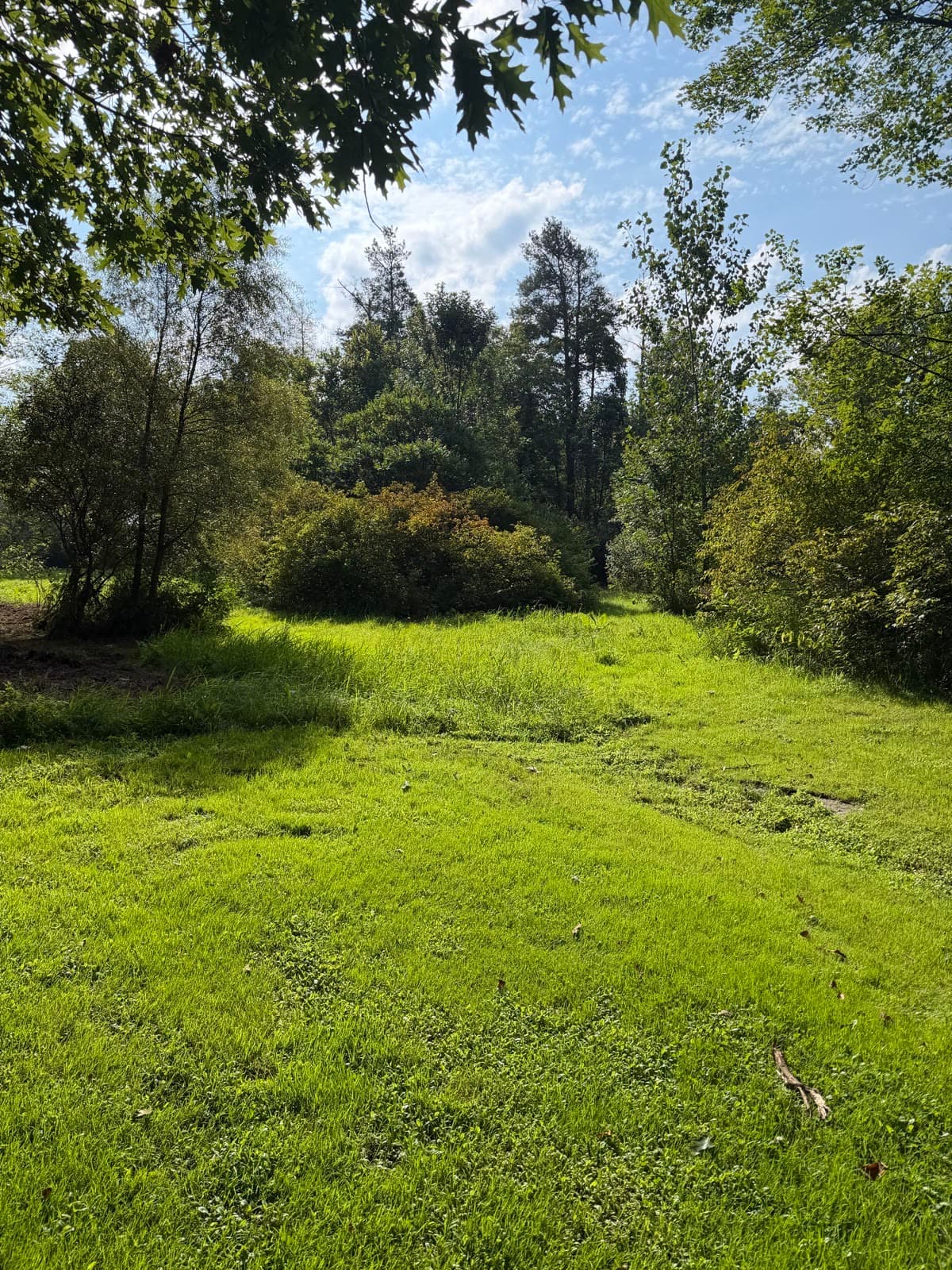 Actual BrushBoss footage · September 2026
Northeast Ohio · Woodland recovery
Real work. Real footage.
See past the tangle.
Brush and vines fill the space beneath your good trees. Start with the ground you want to use again.
Follow the transformation
What Is Buckthorn?
Buckthorn is a large shrub or small tree, usually ten to twenty-five feet tall, brought to North America from Europe and Asia as an ornamental and planted along fence rows and for wildlife. Two species escaped into Ohio. Common buckthorn (Rhamnus cathartica, also called European buckthorn) is the one with a thorn at the end of its twigs and black berries. Glossy buckthorn (Frangula alnus) has shiny, smooth-edged leaves, no thorn at all, and berries that turn from red to black. Both form dense thickets of stems all the same age, and both are well established across central and northern Ohio. Whichever you have, the effect on a property is the same: a wall of green between the lawn and the woods, and a woodland floor where nothing else grows.
How Do You Tell Common From Glossy Buckthorn?
Start at the twig tips and the leaf edges. A thorn and toothed leaves mean common buckthorn; shiny, smooth leaves and no thorn mean glossy. On either one, a cut stem shows pale yellow outer wood and a pink to orange centre.
| Feature | Common buckthorn | Glossy buckthorn |
|---|---|---|
| Leaves | Set nearly opposite each other, dark green, with fine rounded teeth along the edge | Alternate, shiny dark green, the edge smooth or slightly wavy |
| Veins | Three to five pairs, curving up toward the leaf tip | Eight or nine pairs, deep and parallel |
| Twig tip | Often ends in a short, sharp thorn in place of a bud | No thorn at all, despite the name; a fuzzy brown bud instead |
| Berries | Small, black when ripe, on female plants only | Small, red at first and ripening to black |
| Cut stem | Yellow outer wood, pink to orange at the centre | The same yellow and pink-to-orange |
| Where it grows | Drier ground: woodland edges, fencerows, old fields, open woods | Wetter ground: pond edges, stream banks, wet meadows, swamps, ditches |
What Looks Like Buckthorn but Is Not?
Several native shrubs are worth keeping, and a few are easy to confuse with buckthorn at a glance. Ohio State University Extension lists these:
- 1Shrub dogwoods. Opposite leaves like common buckthorn, but smooth-edged, with flowers and fruit in flat clusters at the branch ends and berries that ripen white or blue, never black.
- 2Chokecherry. Finely toothed leaves with a drawn-out point, alternate on the stem, and white flowers and fruit hanging in long clusters rather than tucked against the twig.
- 3Deciduous hollies. Alternate oval leaves, and berries that ripen orange or red and stay that way.
- 4Ohio’s native buckthorns. Alder-leaved buckthorn stays under three feet and has no thorns; Carolina buckthorn is mostly a southern plant. Both are uncommon to rare in the state.
When a plant will not settle into one column or the other, Ohio State's C. Wayne Ellett Plant Pest Diagnostic Clinic will identify a sample. We flag anything uncertain on the walk-through and leave it standing until you decide.
When Is Buckthorn Easiest to Spot?
Late fall. Common buckthorn keeps its dark green leaves late into fall, after most native trees and shrubs have dropped theirs, so a walk along the woodland edge in November shows every plant at once: whatever is still green in the understory is almost always buckthorn or bush honeysuckle, and the two usually grow together. In winter the thorn at the end of each common buckthorn twig is the giveaway. Glossy buckthorn is easiest to find by where it stands: the wet margins, around the pond and along the stream bank, where ODNR describes it as abundant in Northeast Ohio.
Why Does Buckthorn Matter on an Estate?
Because it takes the woods away from you without taking a single tree. Buckthorn grows into dense, even-aged thickets that crowd and shade out the native shrubs and wildflowers beneath them, often displacing them completely, according to the Ohio Invasive Plants Council. The canopy overhead still looks like woodland from the road. Underneath, the young trees that should replace it one day cannot get the light, the long view from the house stops at the first row of stems, and the pond disappears behind the bank.
It also spreads. Birds eat the berries and carry the seed across the property and onto the neighbour's — the USDA Forest Service names birds as important carriers of glossy buckthorn seed — and Ohio State Extension notes that buckthorn seed can stay viable in the ground for about five years. A thicket left alone is next year's larger thicket.
Where Does Buckthorn Grow in Northeast Ohio?
Common buckthorn is found mostly in the glaciated parts of Ohio, which include the northeast. It favours the drier ground: woodland edges, fencerows, old fields, roadsides and open woods — the strip where the lawn meets the trees and the line that used to be a pasture fence. That is why so much of it is fence-line work. Glossy buckthorn takes the wetter ground: swamps, wet meadows, pond edges, stream banks and ditches, though it also moves up into open woods and old fields. A property with a pond and a wooded back half can easily have both.
Is Buckthorn Illegal in Ohio?
Selling it is. Common buckthorn is number 51 on the list of invasive plants in Ohio Administrative Code 901:5-30-01, the Ohio Department of Agriculture's rule, in force in its current form since February 13, 2023. No one may sell, offer for sale, propagate, distribute or import it in Ohio, or intentionally spread it. Having buckthorn on your land is not an offence, and the rule expressly allows owners to control and dispose of it. Glossy buckthorn was on the state's original 2018 list but is not named in the current rule. That is a matter of regulation, not of behaviour: ODNR still describes it as one of the most common invasive shrubs in Northeast Ohio.
When Is the Best Time to Remove Buckthorn?
Late fall through winter. With the native canopy bare and the buckthorn still in leaf, every plant can be seen and marked, the trees you keep are easy to read, and the thicket comes out before the next summer's berries ripen and feed another round of seed to the birds. Leaf-off is also when the woods is most open to the eye, so it is the season to decide what the finished view should be. Ohio State Extension gives August to November as the most effective window for herbicide follow-up on the stumps, which fits the same calendar.
How Does BrushBoss Remove Buckthorn?
The thicket is cleared from under the trees you keep, down to the ground, and left on site as a fine mulch layer over open, walkable floor. Stems up to eight inches are part of the ordinary work, and nothing is hauled away. Seedlings too small to matter to the eye still matter to the future, so those are pulled: young buckthorn under half an inch has shallow, fibrous roots and comes out whole by hand. What you are left with is the look the property was meant to have — trunks standing in light, a clear line of sight through the woods, and ground you can walk. On larger stands, that is woodland restoration.
Will Buckthorn Come Back?
Some of it will, and it is better to know that now. A cut buckthorn resprouts from the stump, and seed in the soil keeps germinating for a few years. Keeping it back is modest work: cut new sprouts while they are ankle-high, and pull seedlings when the ground is soft. Ohio State Extension recommends a cut-stump herbicide treatment on stems over about an inch and a half, applied as the stem is cut. That is something you may do yourself on your own land by following the product label, or have done by a licensed applicator. BrushBoss does not apply herbicide, and we will not promise a permanent result.
What Should You Plant After Buckthorn?
In standing woods, often nothing at first: once light reaches the floor, give it a season and see what comes up, pulling any buckthorn seedlings that come with it. Along open edges and where a screen is wanted, the Ohio Invasive Plants Council recommends native shrubs in its place:
- 1Drier edges, where common buckthorn was: gray dogwood, black chokeberry and common witch-hazel.
- 2Wet ground, where glossy buckthorn was: buttonbush and common winterberry.
What Does Buckthorn Removal Cost?
A fencerow or the buckthorn along the edge of the lawn is small work, flat-priced at $295, $495, $750 depending on size, with no project minimum. Buckthorn cleared from under standing woods is priced by the acre, from $2,000 where it is light to $2,990 where the thicket is solid. The full schedule is on the pricing page, and you get your number before anything starts — send us the address.
Sources: Ohio Adm. Code 901:5-30-01; ODNR: Common Buckthorn; ODNR: Glossy Buckthorn; Ohio State University BYGL: Invasive Buckthorns; Ohio Invasive Plants Council: Buckthorn fact sheet; OIPC: Alternatives for Invasive Plants in Ohio; USDA Forest Service FEIS: Frangula alnus. All checked September 29, 2026.
Common Questions
Is buckthorn illegal in Ohio?
Common buckthorn (Rhamnus cathartica, listed as European buckthorn) is on Ohio’s invasive plant list in Ohio Administrative Code 901:5-30-01, which makes it illegal to sell, offer for sale, propagate, distribute or import in the state. Having it on your land is not an offence, and the rule expressly allows you to control and dispose of it. Glossy buckthorn was on the state’s original 2018 list but is not named in the current rule, effective February 2023; ODNR still counts it among the most common invasive shrubs in Northeast Ohio.
How can I tell buckthorn from a native shrub?
Look at the twig tips and the leaves. Common buckthorn often ends a twig in a short thorn, its leaves sit nearly opposite with three to five pairs of curving veins, and a cut stem shows pink to orange wood at the centre. Glossy buckthorn has shiny, smooth-edged leaves with eight or nine vein pairs and no thorn. Native shrub dogwoods have white or blue berries in flat clusters; buckthorn berries ripen black. If you are unsure, Ohio State’s Plant Pest Diagnostic Clinic identifies samples.
Does cutting buckthorn kill it?
No. A cut buckthorn resprouts from the stump, and the Ohio Invasive Plants Council notes that cutting or mowing alone often invigorates it. Seed already in the ground can stay viable for about five years. Clearing takes the thicket out and gives you the ground back; keeping it back means cutting new sprouts while they are ankle-high and pulling seedlings for a few seasons afterward.
Does BrushBoss treat the stumps with herbicide?
No. BrushBoss does not apply herbicide. Ohio State Extension recommends a cut-stump herbicide treatment for buckthorn stems over about an inch and a half, most effective from August to November. On your own land you may do that yourself by following the product label; anyone you hire to do it must be a licensed applicator. We can tell you which stems to watch, and the resprouts can also be cut back by hand while they are small.
How much does buckthorn removal cost?
Small buckthorn jobs, such as a fencerow or the edge of a lawn, are flat-priced from $295, with no project minimum. Clearing buckthorn from under standing woods is priced per acre, from $2,000 to $2,990 depending on how dense the thicket is. You get the number before anything starts.
Will clearing buckthorn damage the trees I want to keep?
No. The work takes the buckthorn out from under the canopy and leaves the trees standing. Every tree you want to keep is agreed before we start, and the promise is written into the job: without losing a tree worth keeping.
Buckthorn Closing In?
See the Woods Again.
Tell us where it is and roughly how much. We will tell you what it costs to open it up, before anything starts.
The tree line took a few feet a year until the lawn got small.
It goes back where it was, and every tree stays standing.
A drive or lawn edge up to 500 sq ft is $295 and about an hour.
Ground you can walk without watching your step — because we take the cover out.
Without losing a tree worth keeping.