Doubled
Geauga Lyme cases, 2025
Geauga Public Health issued an advisory in spring 2026 after confirmed Lyme cases in the county doubled over the previous year.
“Bush honeysuckle has conquered Ohio. Mowing it doesn't kill it — the roots survive and grow back thicker.”
Land recovery and property protection · Northeast Ohio
We give you your land back, and we make it safe to use.
The brush, thorn and poison ivy that grew up under your good trees comes out, and what you get back is ground you can walk without watching your step.
From $295 for an afternoon's work to full estate restoration.
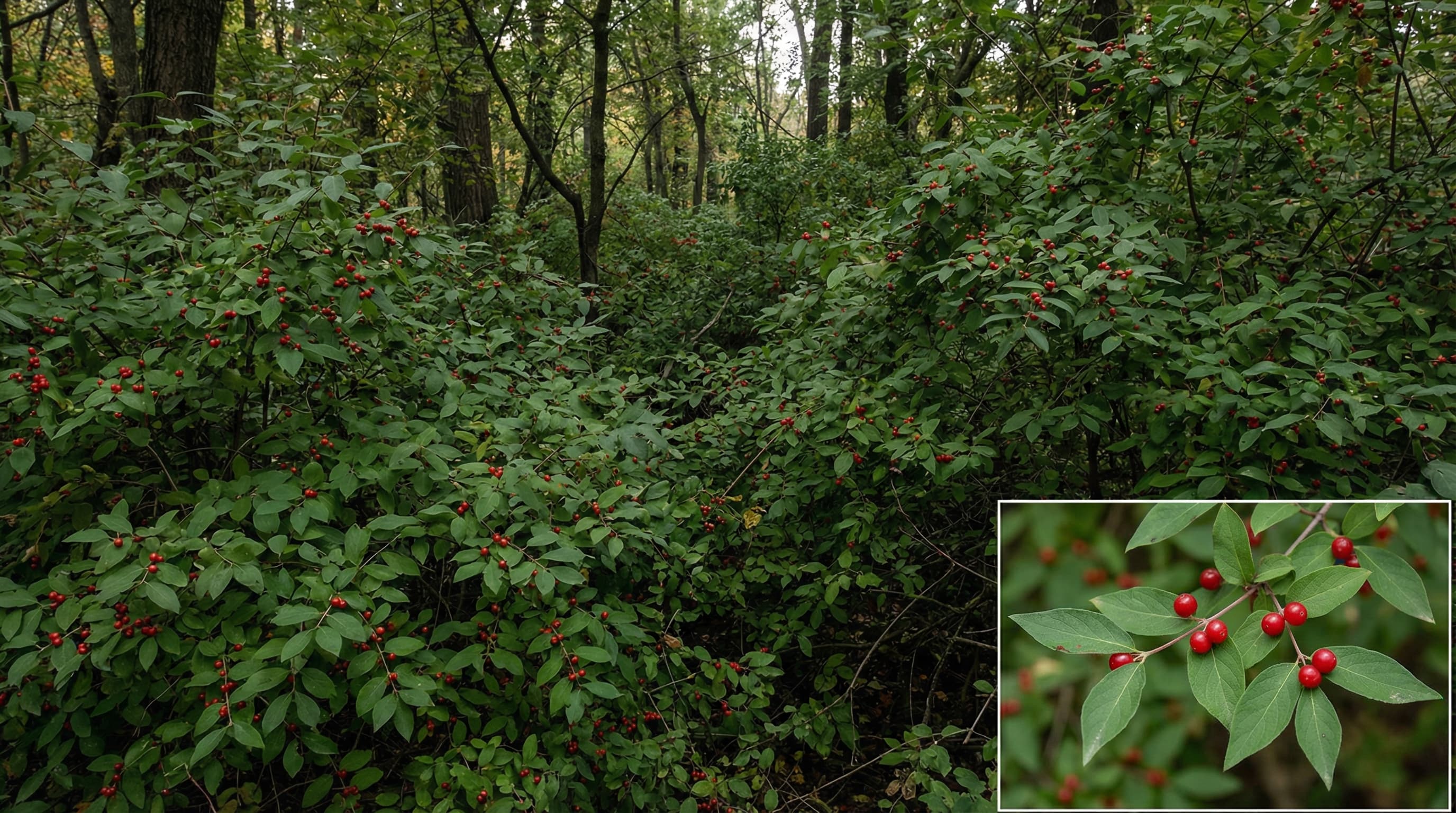
Dense thickets you can't walk through — especially in fence rows, forest edges, and areas that don't get regular mowing. The understory has been completely taken over: where you used to see native wildflowers and grass, there's nothing but honeysuckle, rose canes, and olive shoots.
In fall, the signs are unmistakable. Bush honeysuckle holds its green leaves weeks after native trees have dropped theirs. You can see the invasion mapped out across your property in November — every green patch is honeysuckle. In spring, berries from last season's crop are already germinating, spreading the problem into areas that were clear last year.
Invasive species spread because they leaf out early, produce heavy seed crops, tolerate poor conditions, and regrow when cut. Once established, they shade out native plants and build dense thickets that keep expanding unless the stems, crowns, and seed pressure are handled together.
Manual pulling works for individual honeysuckle plants under 2 inches in diameter, especially in loose or wet soil. For small patches — a dozen plants or fewer — this is effective and satisfying work. Pull the entire root ball, don't just snap the stem.
Chemical treatment is the standard forestry approach for scattered plants. Cut the stem close to the ground and apply concentrated glyphosate or triclopyr to the fresh stump within 15 minutes. This kills the root system. It's effective but labor-intensive for large areas — you're cutting and treating each plant individually. For a half-acre honeysuckle thicket with hundreds of stems, the cut-and-treat method could take 40+ hours.
BrushBoss removes invasive species by grinding dense thickets into mulch and reducing the stems and crowns that drive fast regrowth. The material stays on-site as ground cover, which cuts hauling, avoids burn piles, and helps suppress the next wave of seedlings.
The mulch layer left behind serves a critical purpose: it suppresses the seed bank. Invasive species leave thousands of seeds in the soil that can germinate for years after the parent plants are removed. A 2–3 inch mulch layer blocks light from reaching those seeds, reducing the next wave of germination significantly.
For severe infestations where the seed bank is extensive, we recommend a follow-up spot treatment 6–12 months after mulching. The mulching does the heavy lifting — removing 90%+ of the biomass in a day — and targeted herbicide on the regrowth handles what comes back from the root fragments and seed bank. This combination approach is the most effective invasive control strategy per dollar spent.
The reason most people miss
The prickly, thorny stuff at the back of the yard does not just block your view. It builds exactly what ticks need to survive: deep shade, a layer of wet leaves underneath that never dries out, and thick cover deer bed down in. The deer bring the ticks, and the tangle keeps them there. Much of it is bush honeysuckle, though most people just call it brush.
This is the part most people have not connected. That wall of green is not just untidy — it is where they live, and it sits right between the house and everywhere the kids and the dogs actually go.
It is rarely just brush, either. That same edge is where poison ivy runs — along the ground, up the trunks, through the tangle where you cannot see it until you are already in it. Vines are what make an overgrown edge genuinely unusable rather than merely ugly, and they come out with everything else.
Doubled
Geauga Lyme cases, 2025
Geauga Public Health issued an advisory in spring 2026 after confirmed Lyme cases in the county doubled over the previous year.
= Connecticut
Ohio's risk level, 2026
Ohio State researchers found the risk of encountering an infected blacklegged tick in Ohio is now comparable to Connecticut, where Lyme has been endemic for decades.
Lower
Tick risk after clearing
Work published in the Proceedings of the National Academy of Sciences found that clearing out invasive honeysuckle cut the density of infected tick nymphs, by changing where the deer spend their time.
Clearing takes that layer out. The big trees stay, the canopy stays, and the wet tangle at knee height — the part that holds ticks and hides deer — is what goes. Research measuring invasive brush removal has found fewer of the young ticks responsible for most Lyme cases afterward.
To be clear about what that means: this is habitat work, not medicine. Clearing the brush takes away the conditions ticks depend on. It does not make a property tick-free and it is not protection from disease — keep using repellent and keep checking after a walk. We are telling you this because it is a real reason to do the work, not because it is a guarantee.
Sources: Allan et al., PNAS (2010); Bron et al., Journal of Medical Entomology (2021); Geauga Public Health advisory (2026); Ohio State University (2026).
Get an instant estimate based on the size of the infestation, access to the thicket, and how clean you want the finished area. BrushBoss uses those details to scope a removal plan that handles the biomass instead of just cutting stems.
Ticks live in the tangle at the edge of your lawn.
Taking that cover out takes them with it, and it is a morning's work.
We'll tell you what the edge you walk would cost. From $295.
Ground you can walk without watching your step — because we take the cover out.
Without losing a tree worth keeping.