Does Land Clearing Increase Property Value?
By Kyle Abbey · ·
Land clearing usually increases property value when it is selective: taking out the brush and thorn beneath the trees makes land usable, opens views and brings a hidden pond back into sight. Clear-cutting can lower it instead, because published studies of home sales consistently associate mature trees with higher prices.
Instant QuoteThe short answer, and what it costs
No study we have found measures what understory clearing does to the sale price of rural acreage, so nobody can honestly promise you a percentage. What the evidence does show is where clearing earns its keep and where it does not. This guide covers what the research actually says, how an appraisal treats wooded land, what estate buyers can see and use, the cases where clearing is a mistake, Ohio’s CAUV rules, and how to weigh the cost.
Selective clearing with BrushBoss is flat-priced from $295 for an edge or a corner, and $2,000 – $2,990 / acre for the understory out of standing woods. To price your own ground, use the land clearing cost calculator.
Land recovery and property protection · Northeast Ohio
We give you your land back, and we make it safe to use.
The brush, thorn and poison ivy that grew up under your good trees comes out, and what you get back is ground you can walk without watching your step.
From $295 for an afternoon's work to full estate restoration.
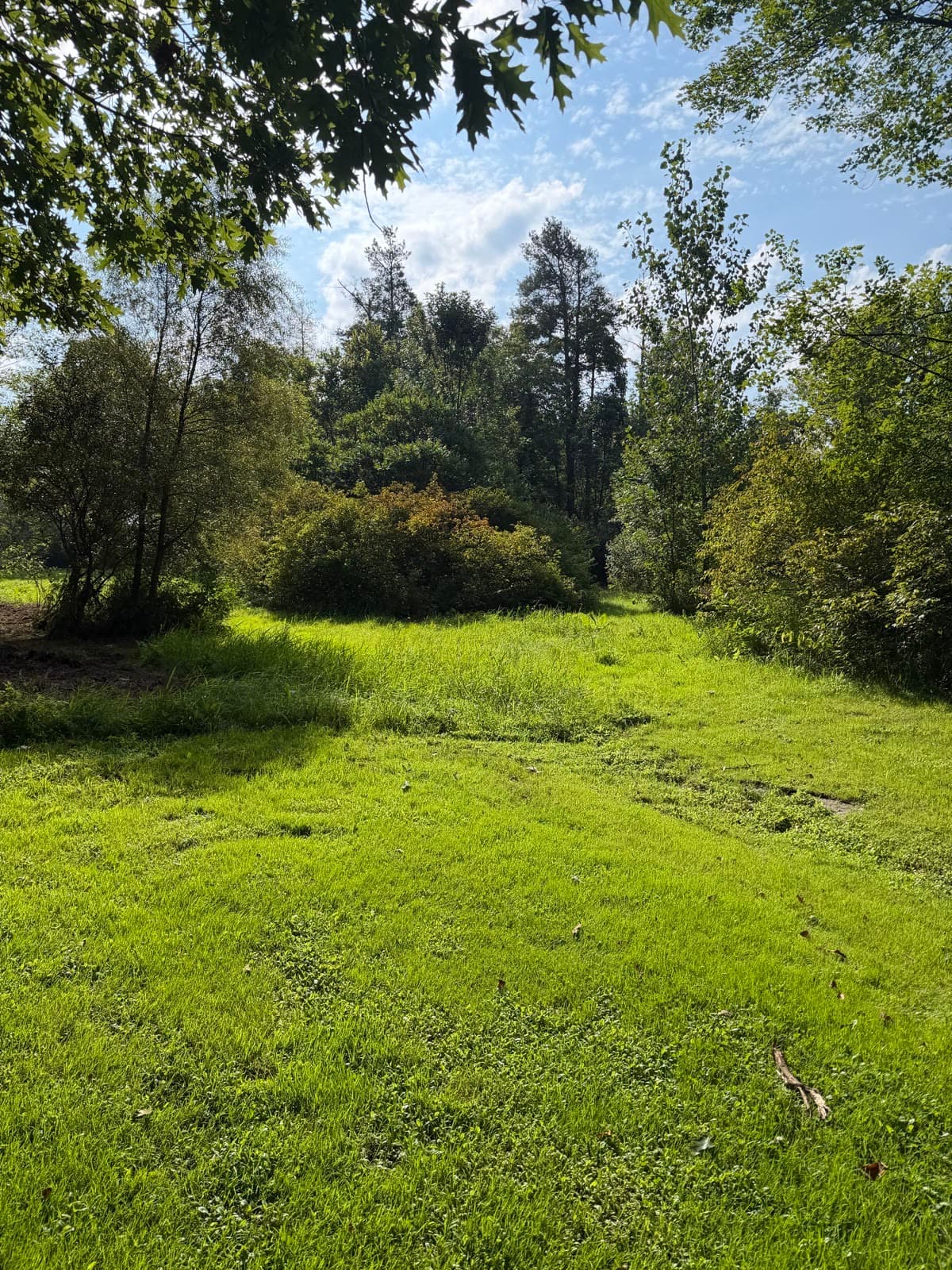 Actual BrushBoss footage · September 2026
Northeast Ohio · Woodland recovery
Real work. Real footage.
See past the tangle.
Brush and vines fill the space beneath your good trees. Start with the ground you want to use again.
Follow the transformation
The honest answer
Selective clearing that turns overgrown, unusable ground into open, walkable woods, a visible pond or a long view generally helps a property show better and sell more easily. Clearing that takes out mature trees can do the opposite, because the published research on trees and home prices consistently finds that mature trees add value. So the question is not whether to clear, but what to clear.
What nobody can tell you honestly is a percentage. We have looked for research that measures what brush or understory clearing does to the sale price of rural acreage, and have not found any. Anyone quoting you a precise uplift figure for clearing is guessing. What the evidence does support is a set of principles, and they are more useful than a number.
- Trees are the asset: studies of home sales associate mature trees with higher prices.
- Brush is not: nothing suggests buyers pay for a thicket they cannot walk into or see across.
- Clear for your own use first. If it also helps at sale, that is a second return.
What the research on trees and home value actually says
Almost all of the published work on landscape and sale price is about trees, not brush, and most of it studies suburban and urban homes rather than estates. It is still the best evidence available, and it points one way.
Mature trees are associated with higher sale prices
A study of 844 single-family home sales in Athens, Georgia, by Anderson and Cordell for the USDA Forest Service (1988), found that landscaping with trees was associated with a 3.5 to 4.5 percent higher sale price, and that the effect came largely from trees in the intermediate and large size classes, regardless of species.
In Portland, Oregon, Donovan and Butry (2010) estimated that street trees added $8,870 to the average sale price and shortened time on the market by 1.7 days, and that the benefit spilled over to neighbouring houses.
A 2022 national meta-analysis by Kovacs and colleagues, drawing on 21 property-value studies, found the relationship between tree cover and home value was four times stronger in neighbourhoods with more than 25 percent tree cover than in those with under 10 percent. Wooded settings, in other words, are where trees matter most to price.
What that means for clearing
Read together, these studies make one practical point for an owner of wooded acreage: the big trees are part of what a buyer pays for, and taking them out to "open the land up" risks removing value rather than adding it. None of the studies measures brush, honeysuckle or thorn, and it would be dishonest to stretch them into a claim that clearing understory raises price by some percentage.
That is the whole case for selective clearing over bulldozing. The understory comes out, the canopy stays, and the property keeps the asset the research does measure. It is the approach behind our woodland restoration work: every good tree kept, the tangle underneath gone.
How an appraisal sees wooded acreage
A residential appraisal is built mainly on comparable sales: recent sales of similar properties nearby, adjusted for the differences between them. That has two consequences worth understanding before you spend money on clearing with resale in mind.
Brush is not a line item
There is rarely an adjustment for "the back three acres are honeysuckle". An appraiser values the land, its size, its location and the home on it, in light of what comparable properties sold for. Clearing therefore seldom shows up as a direct credit. Where it can matter is in the condition and usability of the land, and in how the property compares with the sales it is measured against, particularly in a market where comparable estates show open, usable grounds.
Buyers set the comparables
The comparable sales an appraiser uses were themselves set by buyers, and buyers respond to what they can see and use. A buyer walking a property can price a mown lawn, a pond and a trail. They cannot easily price a wall of brush, except as work they will have to do, and work a buyer has to imagine is work they tend to discount. This is where clearing does its real job: not by adding a line to the appraisal, but by changing what a buyer sees on the walk and in the listing photographs.
Clearing changes how a property shows and what a buyer can imagine doing with it. It does not come with a guaranteed number, and anyone who promises one is guessing.
What estate buyers can see and use
A buyer looking at a Geauga or Chagrin Valley property on several acres is rarely buying acreage for its own sake. They are buying a setting: the view from the kitchen, the walk to the back line, the pond, the sense of space. Brush takes each of those away quietly, and selective clearing gives each of them back.
Usable acreage
Two properties with the same acreage on paper can feel entirely different on the ground. On one, a buyer can walk to every corner; on the other, the usable land ends at the edge of the lawn and the rest is a green wall. Taking the understory out from beneath the trees turns the second into the first, without changing a line on the survey. The land is the same size. More of it is usable.
Views and light
Many wooded properties once had longer views than they do now, and lost them gradually as the understory grew in. Opening a sightline from the house back through the trunks restores something the property already had. It is often the single change an owner notices most, because it is seen every day from inside.
Access and trails
A loop through the woods, a path to the back boundary, a way down to the creek: trails make the far side of a property part of daily life rather than a line on a plat. They also let a buyer actually see the land they are paying for. Our trail cutting page shows what that work involves.
The pond
A pond hidden behind a ring of brush is a pond nobody enjoys and few buyers notice. Opening the banks so the water is visible from the house and reachable on foot makes it part of the property again. For many estates it is the most striking before-and-after of any clearing.
Curb appeal without over-clearing
The look estate buyers respond to is not a cleared lot. It is a park-like woods: tall trunks, an open floor, light reaching the ground, and enough trees left at the road and the boundaries to keep the privacy that made the property desirable. The research on trees and price is the reason to stop short of clearing everything. Keep the canopy, keep the screen, and take out what grew up underneath.
When clearing does not help
Clearing is not automatically an improvement, and there are clear cases where it costs more than it returns.
- Removing mature trees. The evidence on trees and price runs the other way. Keep every good tree unless there is a specific reason to lose it.
- Taking out the privacy screen. A buffer of vegetation along a road or a neighbour’s line is often part of what a buyer is paying for. Thin it thoughtfully rather than removing it.
- Clearing land a buyer would not use anyway. A steep ravine or a wet bottom nobody will walk may cost more to open than it adds, especially on slopes, which are priced higher.
- Working near streams and wetlands without checking first. Some ground near water is regulated. Our Ohio land clearing permits guide covers when to ask before any work starts.
- Clearing the week before listing photographs. Freshly cleared ground looks best once it has had a growing season to green up. If you can, clear the year before you plan to sell.
- Changing the use of land enrolled in CAUV. See the next section.
Does clearing affect CAUV in Ohio?
It can, depending on what the land becomes afterwards. Ohio’s Current Agricultural Use Value program lowers the taxable value of qualifying farmland. The Ohio Department of Taxation requires, over the three years before applying, either ten or more acres devoted exclusively to commercial agriculture, or fewer acres producing an average of at least $2,500 a year in gross income. Applications go to the county auditor.
Woodland has its own rules. The department’s CAUV guidance for county auditors (Bulletin 26) quotes the state definition of woodland as land with at least 25 percent shade cover from forest trees, five acres or more, and notes that noncommercial woodland qualifies only as part of a farm with ten or more qualifying acres. Land that stops qualifying is converted out of the program, and conversion carries a recoupment charge.
Taking the understory out from beneath standing trees leaves the canopy that defines woodland in place, which is one more reason selective clearing is the safer choice on enrolled land. Converting woodland to open ground is a change of use. If your property is enrolled, talk to the county auditor before any large-scale clearing.
Cost against benefit
Because nobody can promise a resale return, the useful way to weigh the cost is against what you get to use in the meantime, and against the alternative of selling a property whose best features are hidden. BrushBoss publishes one price per unit of work, the same figures that appear on our pricing page:
| Work | Price |
|---|---|
| A drive edge or fence line, up to 500 sq ft | $295 |
| A strip along an edge, up to 1,000 sq ft | $495 |
| A corner or back edge, up to a quarter acre | $750 |
| Understory out of standing woods, every good tree kept | $2,000 – $2,990 / acre |
| Pond banks opened and sightlines cut back | $2,000 – $2,990 / acre |
| Trails through standing timber | $2,000 – $2,600 / acre |
No project minimum. Small jobs are flat-priced, larger work is priced by the acre, and you get the number before anything starts.
For most owners the sensible order is the one that pays back in daily use first: the sightline from the house, then the pond, then a trail to the back line, then the rest of the woods. Each of those is worth having whether or not you ever sell, and each is the kind of change a buyer notices on the walk.
A sensible plan if you are thinking of selling
- Walk the property with the listing in mind. Where would a buyer stand, and what would they want to see from there?
- Mark the trees to keep before anything else. Big trees, the road screen and the boundary buffer stay.
- Clear the understory where it hides the view, the pond or access to the back of the land.
- Do it a season ahead if you can, so the ground has greened up by the time the photographs are taken.
- If the land is in CAUV, check with the county auditor first.
If you would like a second pair of eyes on which parts of the property are worth opening up, ask for a walk-through. We will tell you what we would clear, what we would leave, and the fixed price for it.
Where Clearing Earns Its Keep
- 01
Usable ground: the understory out from beneath the trees, so every corner can be walked.
- 02
Views and light: a sightline reopened from the house back through the trunks.
- 03
The pond and the trails: water visible from the house, and a path to the back line.
- 04
The trees stay: mature trees, the road screen and the boundary buffer are the value to keep.
Frequently Asked Questions
Does land clearing increase property value?
Usually, when it is selective. Removing the brush and thorn beneath the trees makes the land usable, opens views and brings features like a pond back into sight, which buyers can see and use. Removing mature trees can work against value, because studies of home sales associate mature trees with higher prices.
How much does clearing land increase property value?
There is no reliable figure. We have not found published research measuring what brush or understory clearing does to the sale price of rural acreage, so any precise percentage is a guess. The research that does exist is about trees: studies of home sales, including USDA Forest Service work, associate mature trees with higher prices. That is why selective clearing, which keeps the trees and removes the brush beneath them, is the approach that protects value.
Can clearing land lower my property value?
Yes, if it removes the wrong things. Taking out mature trees, the privacy screen along a road or a neighbour’s line, or the woodland character that drew buyers to the area can make a property less attractive. Clearing the understory while keeping the canopy avoids that.
Should I clear land before selling or let the buyer do it?
If the brush hides the property’s best features — a view, a pond, the back of the land — clearing before listing lets buyers see what they are paying for rather than imagining work they will have to do. Ideally clear a season ahead, so the ground has greened up by the time photographs are taken.
Will an appraiser give credit for cleared land?
Not usually as a line item. A residential appraisal is built mainly on comparable sales, so clearing matters through the condition and usability of the land and how the property compares with similar sales, rather than as a direct adjustment for the work.
Does clearing woodland affect CAUV in Ohio?
It can. Ohio defines woodland for CAUV as land with at least 25 percent shade cover from forest trees, and land that stops qualifying is converted out of the program with a recoupment charge. Removing understory beneath standing trees keeps the canopy in place; converting woodland to open ground is a change of use. If your land is enrolled, check with the county auditor before large-scale clearing.
How much does selective land clearing cost?
BrushBoss prices small edges and corners flat from $295, and understory cleared out of standing woods per acre by density, at $2,000 – $2,990 / acre. There is no project minimum, the land clearing cost calculator gives an estimate from your address, and the price is fixed in writing after a walk of the property.